Three stories at once
Tolkien’s second volume tells its two halves separately: first everything in Rohan and Isengard, then the whole of Frodo and Sam’s journey towards Mordor. The film cuts between three threads instead, Frodo and Sam with Gollum, Merry and Pippin with the Ents, and Aragorn, Legolas and Gimli with the people of Rohan. That keeps every set of characters in view, at the cost of some of the book’s slow build. It also lets the film end each thread on a rising note at the same moment, which a straight adaptation of the book’s structure could not do.
The film opens where the first one left off, with a dream of Gandalf falling with the Balrog, and then picks up Frodo and Sam in the hills of the Emyn Muil. From there the threads draw apart and only meet again in theme: each group faces a choice about whether to fight, to hide or to trust someone dangerous. Treebeard’s slow deliberation, Théoden’s doubt and Frodo’s trust in Gollum are three versions of the same question.
The order of events is also rearranged. Shelob’s Lair, the end of the book’s second volume, was held back for the third film, and Faramir’s story in Osgiliath fills its place. The film ends instead with the twin victories at Helm’s Deep and Isengard, and Gollum already thinking about betrayal.
Gollum and the leap in performance capture
Gollum is the film’s great technical achievement. Andy Serkis performed the role on set opposite Elijah Wood and Sean Astin, then in a motion-capture studio, and Weta Digital’s animators built the digital character on his movements and expressions. It changed how audiences and studios thought about digital characters, and it made a creature that could have looked like a cartoon feel pitiable and frightening in the same shot.
The best-remembered scene is the argument between Gollum and Sméagol, shot as a conversation between two halves of one creature, with the camera cutting as if two people were talking. It turns a voice that the book reports in passing into a central piece of drama.
Gollum also carries the film’s quieter thread. Frodo’s pity for him, and Sam’s distrust, set up the tension that pays off in the third film. The Dead Marshes sequence, with the faces of drowned warriors under the water, gives a glimpse of the old wars that Gollum knows and the hobbits do not, and shows how heavy the Ring has already become for Frodo.
Rohan, the Ents and Helm’s Deep
Rohan is the heart of the film. Edoras was built on a rocky hill in New Zealand’s South Island, and the Golden Hall scenes show Théoden freed from Saruman, the exile of Éomer and Gríma Wormtongue’s flight to Isengard. The language of Rohan on screen is Old English, Tolkien’s own stand-in for Rohirric; see our note on the language of Rohan.
The Ents get more screen drama than in the book. The Entmoot ends in a refusal, and it is Pippin’s trick of taking Treebeard south, to see the ruined forest around Isengard, that brings the march. Our article on Treebeard’s language explains why the Ents speak so slowly.
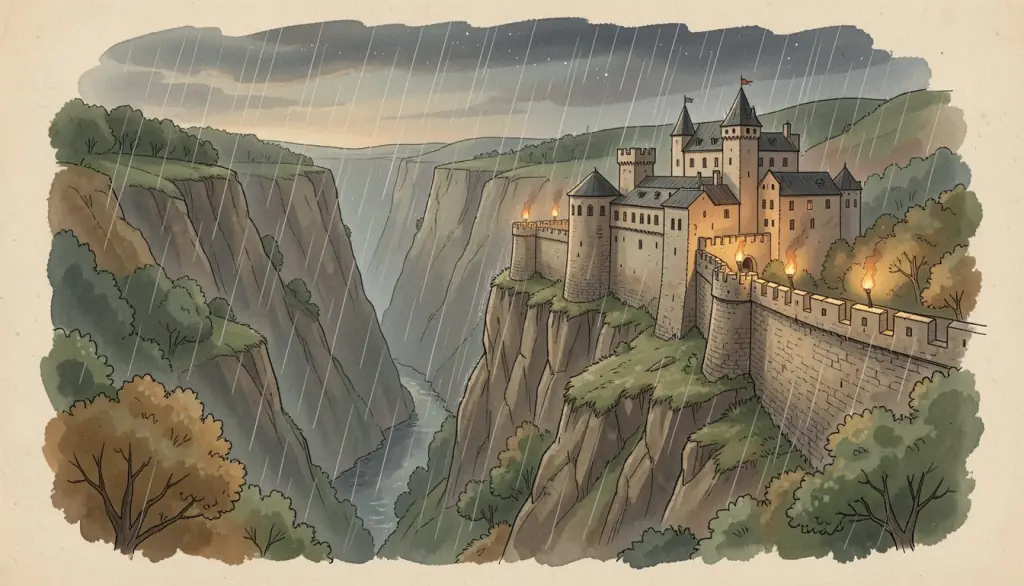
Helm’s Deep itself was shot over many weeks of night work in artificial rain. The film adds Haldir’s Elves to the defence and has Éomer, not Erkenbrand, return at dawn with Gandalf, but the shape of the battle, from the breach in the Deeping Wall to the final charge, follows the book closely. Gimli and Legolas keep their running count of kills, a detail taken straight from Tolkien.
The Elvish in The Two Towers
There is less Elvish here than in the first film, because most of the story happens among Men and hobbits. What there is was again written by linguist David Salo in Sindarin: Aragorn and Arwen’s scenes, held in memory and vision, Legolas’s brief warnings in the field, and the tense exchange between Aragorn and Legolas at Helm’s Deep. Our guide to Elvish in the LOTR films lists the lines one by one.
Legolas’s Sindarin on screen is short and practical, like Yrch, “Orcs”, a word Legolas already uses in the book (Book II, ch. 6 “Lothlórien”), and the plural of orch formed by a change of vowel rather than an added ending. For more of his lines, see Legolas’s Elvish quotes. If you want to say something of your own in the same language, try the Elvish translator or start the free Elvish course.
Reception and awards
The Two Towers was released in December 2002, one year after the first film, and was a large commercial success. Critics praised Gollum and the scale of Helm’s Deep, while some readers objected to the changes to Faramir, who in the book resists the Ring almost at once. Others defended the change as a way to show how strongly the Ring pulls on everyone who comes near it, even the most honourable.
The film won two Academy Awards, for visual effects and sound editing, and was nominated for Best Picture. The Extended Edition restores many scenes, including more of Boromir and Faramir’s brotherhood and of Treebeard and the hobbits.
Seen today, the film works as the turning point of the trilogy. It has no beginning and no ending of its own, yet it gives the story its widest canvas: a kingdom of Men under threat, a forest that wakes up, and a small creature whose divided mind decides more than any army. Watching it again after reading the book is the best way to see how much of Tolkien it keeps and where it chooses its own path.
Frequently asked questions
Who plays Gollum in The Two Towers?
Why are Elves at Helm’s Deep in the movie but not in the book?
Is Shelob in The Two Towers movie?
Why is Faramir different in the movie?
How many Oscars did The Two Towers win?
Answer key (10 questions)
- In Fangorn Forest, Aragorn, Legolas and Gimli meet a figure shining in white. Who is it? Gandalf The Two Towers (2002 film), Fangorn Forest
- Where does Théoden lead his people to make their stand against Saruman’s army? Helm’s Deep The Two Towers (2002 film), Helm’s Deep
- Who becomes Frodo and Sam’s guide through the Emyn Muil and the Dead Marshes? Gollum The Two Towers (2002 film), the Emyn Muil and the Dead Marshes
- At Edoras, what does Gandalf drive out of King Théoden? Saruman’s hold over his mind The Two Towers (2002 film), Meduseld at Edoras
- After escaping the Uruk-hai, Merry and Pippin flee into a forest and meet whom? Treebeard The Two Towers (2002 film), Fangorn Forest
- Who arrives at Helm’s Deep before the battle to fight alongside the Rohirrim? Elves of Lórien led by Haldir The Two Towers (2002 film), Helm’s Deep
- What finally makes Treebeard and the Ents march on Isengard? He sees the forest Saruman has cut down The Two Towers (2002 film), the march on Isengard
- After capturing Frodo and Sam, where does Faramir take them? Osgiliath The Two Towers (2002 film), Osgiliath
- At dawn on the last day at Helm’s Deep, who rides in with Gandalf at the head of the Rohirrim? Éomer The Two Towers (2002 film), Helm’s Deep at dawn
- After Aragorn falls from a cliff in the Warg attack, which horse finds him by the river? Brego The Two Towers (2002 film), after the Warg attack
