How The Silmarillion is built
The Silmarillion is not one story but five works bound together. The Ainulindalë tells the creation of the world through the music of the Ainur. The Valaquenta is a short catalogue of the Valar and the Maiar, including Melkor and the spirits who followed him. The long Quenta Silmarillion carries the main history, from the awakening of the Elves to the War of Wrath at the end of the First Age.
Two shorter pieces follow. The Akallabêth tells the rise and drowning of Númenor in the Second Age, and Of the Rings of Power and the Third Age bridges the gap to The Lord of the Rings, covering Celebrimbor, the forging of the rings and the Last Alliance. Read in order, the five parts move from myth to history and finally into the world of Frodo and Bilbo.
J.R.R. Tolkien worked on this material for most of his life and never finished it. Christopher Tolkien chose between versions, filled gaps and published the result in 1977. Later volumes of The History of Middle-earth show how much choosing that took, which is why some details in the book differ from what Tolkien wrote elsewhere.
The Valaquenta deserves a second look once you know the stories. It introduces Manwë and Varda, Ulmo of the waters, Aulë the smith, Yavanna who made the Two Trees, and Mandos the doomsman, along with the Maiar who serve them. Gandalf appears there under his Valinor name, Olórin, and Sauron is named as the greatest of Melkor’s servants. Many quiz questions about the First Age become easier once these figures are clear.
The jewels at the centre
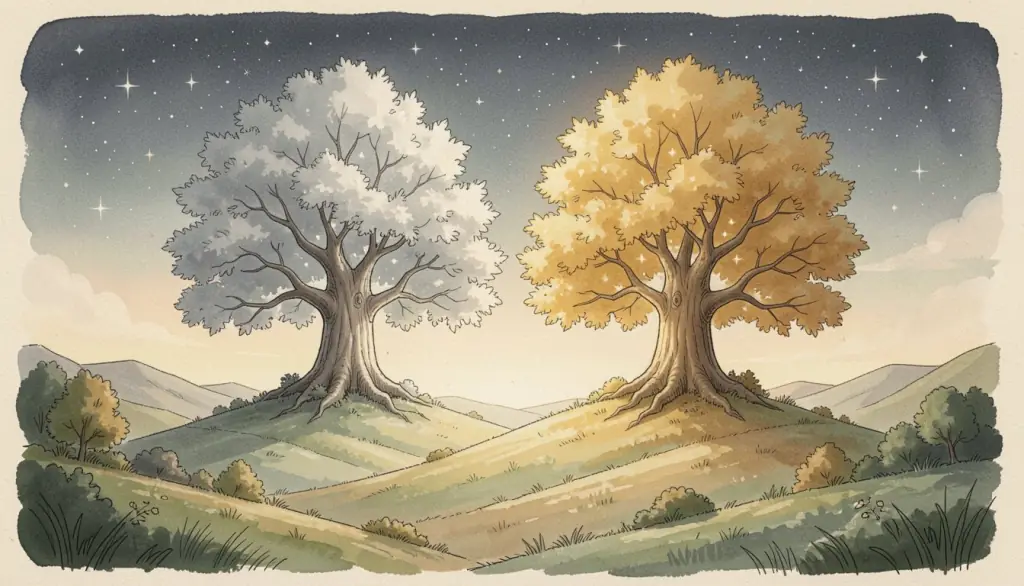
Almost every tragedy in the book turns on the three Silmarils. Melkor and Ungoliant destroy the Two Trees, Melkor steals the jewels, and Fëanor and his seven sons swear an oath against anyone who withholds them. That oath drives the Noldor out of Valinor, through three Kinslayings and into a long war they cannot win alone.
The jewels end in the three regions of the world. One is set on Eärendil’s brow and sails the sky as a star. One falls with Maedhros into the fire of the earth. One goes into the sea with Maglor. The Lord of the Rings keeps a thread of this: the Phial of Galadriel holds the light of Eärendil’s star, which is the light of a Silmaril. Our guide to Fëanor and the Silmarils follows each jewel in detail.
The Elvish in the titles
The section names are Elvish, and they are worth unpacking. Ainulindalë joins Quenya *Ainu*, “holy one, spirit”, with *lindalë*, “music”. Valaquenta joins *Vala*, one of the Powers, with *quenta*, “story, account”. Quenta Silmarillion is “the history of the Silmarils”, and the jewels’ own name is related to Quenya *silma*, a white crystal radiance.
The odd one out is Akallabêth, which is not Elvish at all but Adûnaic, the language of the Númenóreans. Tolkien glosses it “the Downfallen”. The contrast is deliberate: the tale of Men who grew proud and rejected the Elvish tongues is told under a title in their own speech.
Most personal names in the Quenta are Sindarin in form even when the bearer was born in Valinor, because the exiled Noldor adopted the speech of Beleriand. That is why the name everyone knows, Fëanor, is a Sindarin-shaped form of his Quenya mother-name *Fëanáro*; his father-name was *Curufinwë*. If you want to read these names yourself, start with Quenya vs Sindarin or our free Elvish course.
The great tales of the Quenta
Inside the Quenta Silmarillion sit a handful of stories that Tolkien thought of as the heart of the whole legendarium. Beren and Lúthien is the tale of a mortal man and an Elf-maiden who go into Angband itself and take a Silmaril from the Iron Crown. Their marriage joins the lines of Elves and Men, and through their descendants it reaches Elrond, Arwen and Aragorn.
Túrin Turambar is the darkest of the tales: a hero cursed by Morgoth, betrayed by his own pride, who kills the dragon Glaurung and destroys himself in the process. The Fall of Gondolin tells how the hidden city of Turgon was found and burned, and how Tuor, Idril and their son Eärendil escaped. Eärendil’s voyage to Valinor then brings the War of Wrath and the end of Morgoth.
Each tale also works as a lesson in how Tolkien builds names. Gondolin is Sindarin, glossed “Hidden Rock”, built on *gond* “stone”, the word that also gives Gondor; Lúthien means “enchantress”, and her other name, Tinúviel, is “daughter of twilight”, the nightingale. Read these chapters slowly and the names begin to explain the stories. Our post on Lúthien and Beren and our guide to Gondolin go further.
Where to start if the book feels hard
Many readers stall in the opening chapters, which are dense with names and have little dialogue. A good approach is to read the Ainulindalë, skim the Valaquenta as a reference list, and then read the Quenta for its great tales: Beren and Lúthien, Túrin Turambar, the fall of Gondolin and the voyage of Eärendil.
The index at the back of the book, with short notes on almost every name, is a real help, and so is keeping a map of Beleriand nearby. Christopher Tolkien later published three of the great tales as separate books, Beren and Lúthien, The Children of Húrin and The Fall of Gondolin, which read more like novels.
Frequently asked questions
Is The Silmarillion hard to read?
Do I need to read The Silmarillion before The Lord of the Rings?
Who wrote The Silmarillion?
What are the Silmarils?
What language are the names in The Silmarillion?
Answer key (10 questions)
- Who made the three Silmarils? Fëanor The Silmarillion, Quenta Silmarillion ch. 7 “Of the Silmarils and the Unrest of the Noldor”
- Whose light did Fëanor capture inside the Silmarils? The Two Trees of Valinor The Silmarillion, Quenta Silmarillion ch. 7 “Of the Silmarils and the Unrest of the Noldor”
- Who edited The Silmarillion and saw it published in 1977? Christopher Tolkien The Silmarillion, Foreword by Christopher Tolkien
- Which part of the book tells how the world was made through music? Ainulindalë The Silmarillion, Ainulindalë
- Who helped Melkor destroy the Two Trees? Ungoliant The Silmarillion, Quenta Silmarillion ch. 8 “Of the Darkening of Valinor”
- Where did the first Kinslaying take place? Alqualondë The Silmarillion, Quenta Silmarillion ch. 9 “Of the Flight of the Noldor”
- What price did Thingol set for Lúthien’s hand? A Silmaril from Morgoth’s crown The Silmarillion, Quenta Silmarillion ch. 19 “Of Beren and Lúthien”
- Who struck down Fëanor soon after he reached Middle-earth? Gothmog, Lord of Balrogs The Silmarillion, Quenta Silmarillion ch. 13 “Of the Return of the Noldor”
- Which High King of the Noldor fought Morgoth alone at the gates of Angband? Fingolfin The Silmarillion, Quenta Silmarillion ch. 18 “Of the Ruin of Beleriand and the Fall of Fingolfin”
- Which son of Fëanor cast his Silmaril into the sea? Maglor The Silmarillion, Quenta Silmarillion ch. 24 “Of the Voyage of Eärendil and the War of Wrath”
