The Three Elven Rings: Nenya, Narya and Vilya Explained
Try It Yourself — Free Elvish Tools
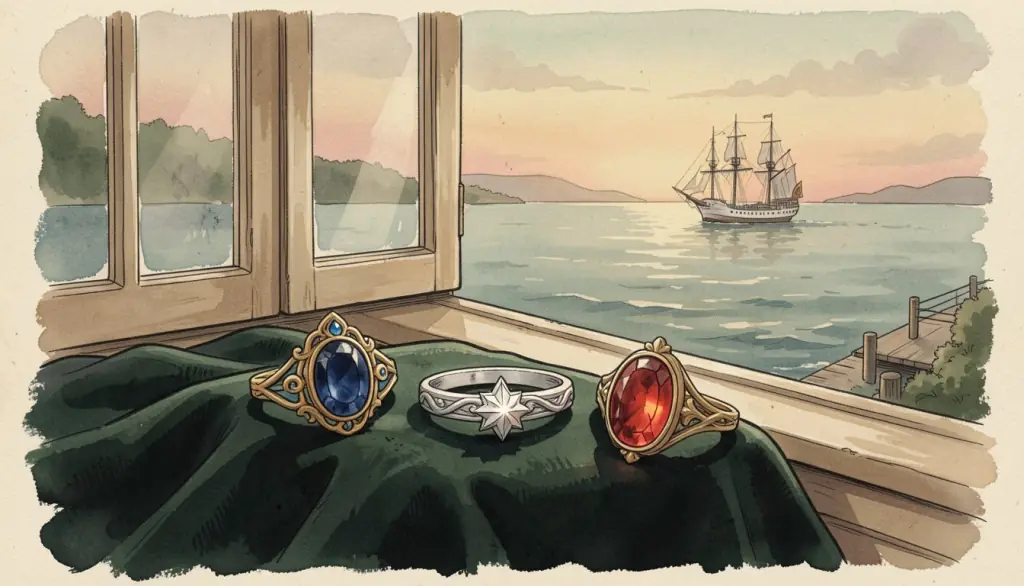
Quick Answer: The three Elven rings are Vilya, Nenya and Narya, the Rings of Air, Water and Fire. Celebrimbor, the Elven-smith of Eregion, made them alone in the Second Age, and Sauron never touched them, though they were still bound to his One Ring. Vilya, a gold ring with a blue stone, passed from Gil-galad to Elrond. Nenya, of mithril with a white stone, belonged to Galadriel. Narya, with a red stone, went to Círdan and then to Gandalf. When the One Ring was destroyed their power faded, and all three keepers sailed West from the Grey Havens in 3021 of the Third Age. Their names are Quenya: vilya "air, sky", nén "water", nár "fire".
Most readers meet the three Elven rings in a single line of the Ring-verse: "Three Rings for the Elven-kings under the sky." In the story itself they stay almost invisible. Tolkien keeps them hidden for most of The Lord of the Rings, shows one of them in Lórien, and reveals the other two only on the last pages. That restraint is the point. The Three are not weapons, and nobody in the book uses one to win a fight.
This guide takes each ring in turn: its name and what the name means in Quenya, its stone, the hands it passed through, what Tolkien says it actually did, where it appears in the text, and what became of it. For all twenty Rings of Power together, the Seven and the Nine included, see our hub The Rings of Power Explained: Elven, Dwarven and the Nine. For the forging of the ring that ruled them, see How Was the One Ring Made?
How the Three Were Made
The story is told in The Silmarillion ("Of the Rings of Power and the Third Age") and filled out in Unfinished Tales ("The History of Galadriel and Celeborn").
In the Second Age the Elven-smiths of Eregion, led by Celebrimbor, grandson of Fëanor, took instruction from a stranger who called himself Annatar, the Lord of Gifts. He was Sauron in disguise. With his help they made many rings. But the Three were different: Celebrimbor made them alone, after Sauron had left Eregion, and Sauron never set hands on them.
That did not make them free. They were made with the same arts Sauron had taught, and Sauron then forged the One Ring in Mount Doom to rule all the others. When he put it on, the Elves perceived him and his purpose and took their rings off. The Three were hidden. Unfinished Tales adds that when Eregion fell and Celebrimbor was captured, he would not reveal where the Three had gone.
So the Three have a double nature that runs through the whole story. They were made for good ends, and the evil of their maker's teacher never stained them directly. Yet their fate was tied to the One from the start. At the Council of Elrond, Elrond explains that they were never meant as weapons of war or conquest, but for understanding, making and healing, to keep things from fading.
For the smith himself, see Celebrimbor and the Rings of Power.
The Three at a Glance
"Mae govannen" — want to actually speak Elvish?
Try It Free →| Ring | Other name | Stone | First holder | Later holder | Bearer at end of Third Age |
|---|---|---|---|---|---|
| Vilya | Ring of Air | blue (sapphire), set in gold | Gil-galad | Elrond | Elrond |
| Nenya | Ring of Water, Ring of Adamant | white (adamant), set in mithril | Galadriel | Galadriel | Galadriel |
| Narya | Ring of Fire | red (ruby) | Gil-galad, then Círdan (per Unfinished Tales) | Gandalf | Gandalf |
The Silmarillion names the stones as ruby, adamant and sapphire. The Return of the King adds the settings: Vilya is a gold ring with a great blue stone, and Nenya is made of mithril with a single white stone.
Vilya, the Ring of Air
The name. Vilya is simply the Quenya word for "air, sky". Of the three names it is the most direct: the ring is called by the element it stands for, with no added ending.
The stone. A sapphire, a great blue stone set in gold. Tolkien calls Vilya the mightiest of the Three.
The bearers. According to Unfinished Tales, Celebrimbor sent Vilya to Gil-galad, the last High King of the Noldor in Middle-earth, in Lindon. In time Gil-galad passed it to Elrond, his herald and lieutenant. Elrond kept it through the whole of the Third Age.
What it did. Here Tolkien says less than many readers assume. He never writes a sentence stating that Vilya protects Rivendell. Imladris is a refuge of rest and healing all through the books, and connecting that peace to Elrond's ring is a reasonable reading, but it is a reading. What the text does make clear is that the Three were kept to preserve and to heal, and that Rivendell's power would wane once the One was gone.
Where it is revealed. Vilya is never mentioned by name while the Fellowship is in Rivendell. It appears in The Return of the King, Book VI, Chapter 9, "The Grey Havens", when Frodo meets the Elves riding west through the Shire. Elrond wears a mantle of grey and a star on his brow, and on his finger is the blue-stoned ring Vilya.
For the ring's two keepers, see Gil-galad: The Last High King of the Noldor and Elrond Explained. For his house, see Rivendell (Imladris) Explained.
Nenya, the Ring of Water
The name. Nenya is built on the Quenya noun nén, "water". The long vowel of nén becomes short before the two consonants of -ny-, a normal pattern in Quenya, so the ring is Nenya, not Nénya.
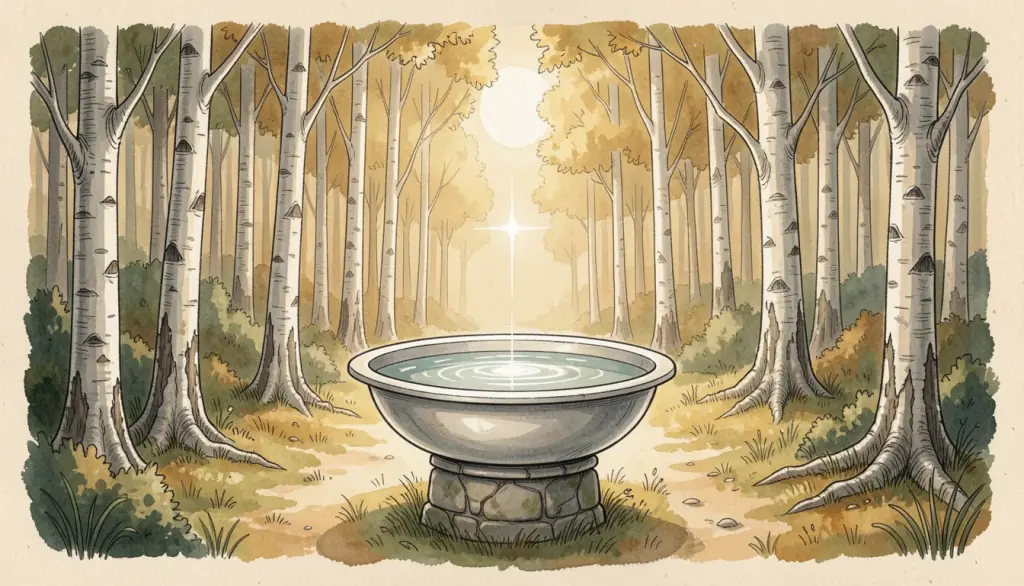
The stone. A single white stone, which The Return of the King compares to a frosty star, set in a ring of mithril. Galadriel herself calls it the Ring of Adamant. Adamant is an old word for the hardest of stones; The Silmarillion uses it for Nenya's stone where the others are ruby and sapphire.
The bearer. Nenya had only one keeper. Unfinished Tales says Celebrimbor gave it to Galadriel directly, and she held it until she left Middle-earth.
What it did. This is the ring whose effect Tolkien describes most clearly. Lothlórien under Galadriel is a place where time seems not to bite: the mallorn leaves do not fall until spring, and the Fellowship lose track of how long they stay. Galadriel tells Frodo that if the One is destroyed, the power of the Three will be diminished and Lórien will fade, carried away on the tides of time. If Sauron regains the One instead, he will see into her mind and all she has wrought. Either way, the ring that kept Lórien unstained could not keep it forever.
Where it is revealed. In The Fellowship of the Ring, Book II, Chapter 7, "The Mirror of Galadriel". After the Mirror, Frodo notices a ring on Galadriel's finger that glitters like starlight. Because he bears the One, he can see it; Sam sees only a star between her fingers. Galadriel names it as Nenya and herself as its keeper. It is the only one of the Three shown openly while the Quest is still under way.
For the Lady herself, see Galadriel Explained; for her realm, Lothlórien Explained.
Narya, the Ring of Fire
The name. Narya is built on Quenya nár, "fire", whose fuller form is nárë. As with Nenya, the long vowel shortens before the following -ry-.
The stone. Red: The Silmarillion calls it a ruby, and in "The Grey Havens" the stone is "red as fire". The same chapter calls the ring Narya the Great.
The bearers. Here the accounts differ in detail. Unfinished Tales says Celebrimbor sent Narya, together with Vilya, to Gil-galad, and Gil-galad gave it to Círdan, the shipwright of the Grey Havens. The Silmarillion and The Lord of the Rings, Appendix B, simply place it in Círdan's keeping. All accounts agree on the next step. When the Wizards came over the Sea, around the year 1000 of the Third Age, Círdan met them at the Havens, judged the grey pilgrim the greatest of them, and gave Narya to Gandalf. Unfinished Tales ("The Istari") adds that Saruman later learned of the gift and resented it.
What it did. Tolkien gives this ring's purpose in Círdan's own words, recorded in Appendix B and in The Silmarillion. Handing it over, Círdan says that with it Gandalf may "rekindle hearts to the valour of old in a world that grows chill." That is exactly how Gandalf works through the whole story. He does not rule a realm. He travels, encourages, rouses kings and hobbits to act. Narya is the ring of courage passed to the one who would need it most.
Where it is revealed. Nowhere until the last chapter. Through The Hobbit and almost all of The Lord of the Rings the reader has no idea Gandalf holds one of the Three. Only at the Grey Havens, as the ship is readied, does he appear with the ring on his hand. Then the travellers understand that Gandalf will sail too.
For the giver and the bearer, see Círdan the Shipwright Explained and Gandalf's Elvish Name: Mithrandir.
When the One Ring Was Destroyed
The keepers of the Three knew the cost of the Quest before it began. Galadriel says it outright in Lórien: if Frodo succeeds, the Three lose their power and the things made with them begin to fade. They helped him anyway.
That is what happened. When the One went into the fire in March 3019, Sauron fell and the binding that had shadowed the Three since the Second Age was broken, but with it went their power. Galadriel's work in Lórien could no longer hold back time. In the closing chapters the Elves are already a people preparing to leave. The Return of the King marks the moment as the end of the Third Age and the passing of the Days of the Rings.
The Three were the one corner of the ring-craft that Sauron never corrupted. Tolkien's answer to that fact is not that they survive and triumph, but that their keepers accept their loss as the price of defeating him.
The Departure over Sea, 3021
In the autumn of 3021 of the Third Age, the Keepers of the Three Rings rode to Mithlond, the Grey Havens. Elrond came with Vilya and Galadriel with Nenya, both now worn openly. Bilbo and Frodo went with them, the bearers of the One. At the Havens Círdan met them, and Gandalf was waiting with Narya on his hand. Together they boarded the white ship and sailed into the West (The Return of the King, Book VI, Chapter 9, "The Grey Havens"; Appendix B).
So all three rings, and the one ring's last bearers, leave Middle-earth on the same ship. The end of the Third Age in Tolkien's reckoning is defined by that sailing.
For the harbour itself, see The Grey Havens (Mithlond) Explained.
The Names in Elvish
All three ring names are Quenya, the old language of the Noldor in Valinor that the Elves of Middle-earth kept as a language of lore, much as Latin was kept in Europe. That fits their maker: Celebrimbor was a Noldo, grandson of Fëanor.
Two of the names follow one pattern. Nenya and Narya take a noun, nén "water" and nár "fire", and add the ending -ya. Quenya uses -ya widely to form adjectives and other derived words, so a loose reading is "watery, of water" and "fiery, of fire". Tolkien does not give a word-by-word gloss of the ring names in the published books, so treat that as the natural reading of the parts rather than a translation he signed off on. Vilya is different: it is itself the word for "air, sky".
| Word | Language | Meaning | Source |
|---|---|---|---|
| vilya | Quenya | air, sky | LotR |
| nén | Quenya | water | Silmarillion, Etymologies |
| nen | Sindarin | water, lake | LotR |
| nár, nárë | Quenya | fire, flame | Silmarillion, PE17 |
| naur | Sindarin | fire | LotR |
| narwa | Quenya | fiery red | Etymologies |
| corma | Quenya | ring | LotR |
| cor | Sindarin | ring, circle | RC |
| mírë | Quenya | jewel, gem, treasure | LotR, RGEO |
| luinë | Quenya | blue | LotR, Silmarillion |
| ninquë | Quenya | white | Etymologies |
| Mithlond | Sindarin | Grey Havens | LotR, Silmarillion |
A few notes on the table:
- Sindarin cousins. Nen and naur are the everyday Sindarin forms of the same roots. You hear naur in Gandalf's cry at Caradhras, Naur an edraith ammen!, the wizard who carries the Ring of Fire calling on fire in another tongue.
- The word "ring". Quenya corma is attested in the praise at the Field of Cormallen, where the Ring-bearers are hailed as Cormacolindor. The field's own name, Cormallen, contains the Sindarin cor, "ring, circle".
- Colours. The stones' colours have Quenya words too: luinë for Vilya's blue, ninquë for Nenya's white, and narwa, "fiery red", from the same root as Narya.
- What we did not do. We have not built phrases such as "my ring" or "ring of water" in Elvish. Tolkien wrote none, and a reconstruction would be our invention, not his.
Pronunciation. Under the rule in The Lord of the Rings, Appendix E, words of two syllables are stressed on the first. So: VIL-ya, NEN-ya, NAR-ya. The ny in Nenya is an n followed by a y glide, close to the ñ in Spanish año, and the r is lightly trilled.
Writing the Three Names in Tengwar
Each ring name is short and uses common letters, which makes them good first words to write in Tengwar, the script Fëanor devised. In the Quenya mode the vowels sit above the consonants as small marks called tehtar, so Narya is written as three consonant signs with two vowel marks. For the letters themselves, see the Tengwar Alphabet Guide. To see a ring name, or your own, written out, type it into our Tengwar name tool.
The Three in The Rings of Power
Amazon's The Rings of Power tells the forging differently. In the show the Three are made at the end of Season 1, before the other rings, with Sauron in disguise involved in their making. In Tolkien they come later: Celebrimbor made them after Sauron had left Eregion, and without him. The series is its own adaptation, and it is worth keeping the two orders apart when you read about the rings online. Season 3 premieres on Prime Video on 11 November 2026. For the languages heard in it, see our Rings of Power Season 3 Elvish Preview.
People Also Ask
What are the three Elven rings called? Vilya, Nenya and Narya, the Rings of Air, Water and Fire. Celebrimbor made them alone; by the end of the Third Age Elrond, Galadriel and Gandalf wore them.
Which ring does Galadriel have? Nenya, the Ring of Water, mithril with a white stone. She shows it to Frodo in Lórien and calls it the Ring of Adamant.
What is Gandalf's ring? Narya, the Ring of Fire, with a red stone. Círdan gave it to him at the Grey Havens, and the reader learns this only in the book's last chapter.
What is Elrond's ring? Vilya, the Ring of Air, a gold ring with a blue stone, the mightiest of the Three. It came to him from Gil-galad.
Learn the Language Behind the Rings
Vilya, nén and nár are three words of Quenya you now know, and every one of them is attested. Put them next to other words Tolkien actually wrote with our Elvish translator, or start the free lessons at Learn Elvish.
Related Reading
- The Rings of Power Explained: Elven, Dwarven and the Nine
- Celebrimbor and the Rings of Power: The Smith Who Made the Three
- How Was the One Ring Made?
- Galadriel Explained
- Elrond Explained
- Gil-galad: The Last High King of the Noldor
- Círdan the Shipwright Explained
- Gandalf's Elvish Name: Mithrandir
- Lothlórien Explained
- Rivendell (Imladris) Explained
- The Grey Havens (Mithlond) Explained
- Quenya for Beginners
People Also Ask
What are the three Elven rings called?
They are Vilya, Nenya and Narya, the Rings of Air, Water and Fire. Celebrimbor of Eregion made them alone, without Sauron's help. By the end of the Third Age Elrond wore Vilya, Galadriel wore Nenya and Gandalf wore Narya.
Which ring does Galadriel have?
Galadriel keeps Nenya, the Ring of Water, made of mithril with a single white stone. She shows it to Frodo in "The Mirror of Galadriel" and calls it the Ring of Adamant. Its power helped preserve Lothlórien from the decay of time.
What is Gandalf's ring?
Gandalf wears Narya, the Ring of Fire, set with a red stone. Círdan the Shipwright gave it to him when he landed at the Grey Havens. Readers learn this only in the last chapter of The Lord of the Rings, when Gandalf wears it openly.
What is Elrond's ring?
Elrond holds Vilya, the Ring of Air, a gold ring with a great blue stone. Tolkien calls it the mightiest of the Three. It first belonged to Gil-galad, High King of the Noldor, who passed it to Elrond.
Did Sauron touch the three Elven rings?
No. Celebrimbor made the Three alone and Sauron never handled them. But they were made with the same craft he had taught the smiths, so they were bound to the One Ring, and when the One was destroyed their power faded.
What do Nenya, Narya and Vilya mean?
They are Quenya. Vilya is the word for air or sky. Nenya is built on nén, water, and Narya on nár, fire, each with the ending -ya, which Quenya uses to form adjectives and derived words. So the names match the Rings of Water and Fire.