All the Rings of Power Explained: the Three, the Seven, the Nine and the One
Try It Yourself — Free Elvish Tools
Quick Answer: There are twenty Great Rings in Tolkien's legendarium. Three were made for the Elves (Narya, Nenya and Vilya), seven went to Dwarf-lords, nine went to mortal Men, and Sauron forged the One Ring in the fire of Orodruin around the year 1600 of the Second Age to rule them all. The Elven-smiths of Eregion, led by Celebrimbor, made the Seven and the Nine with Sauron's help while he wore the disguise of Annatar; Celebrimbor made the Three alone. The Nine turned their bearers into the Nazgûl, dragons consumed four of the Seven, and the Three passed West over the Sea with Galadriel, Elrond and Gandalf at the end of the Third Age.
Most readers meet the rings through a single line of verse, the inscription Tolkien set at the front of The Lord of the Rings. It names the four groups and their owners, but it hides most of the history: who actually made each ring, which ones Sauron touched, which survived, and why the Elven rings have Quenya names while the others have none at all.
This guide is a map of all twenty. It follows Tolkien's own texts: The Lord of the Rings (especially "The Shadow of the Past", "The Council of Elrond" and Appendices A and B), the chapter "Of the Rings of Power and the Third Age" in The Silmarillion, and "The History of Galadriel and Celeborn" in Unfinished Tales. Where those books disagree, we say so.
The Twenty Rings at a Glance
The table below lists every Great Ring that Tolkien accounts for. The Three and the One are named individually; the Seven and the Nine are never given individual names, so they are grouped by what happened to them.
| Group | Number | Maker | Given to | Fate |
|---|---|---|---|---|
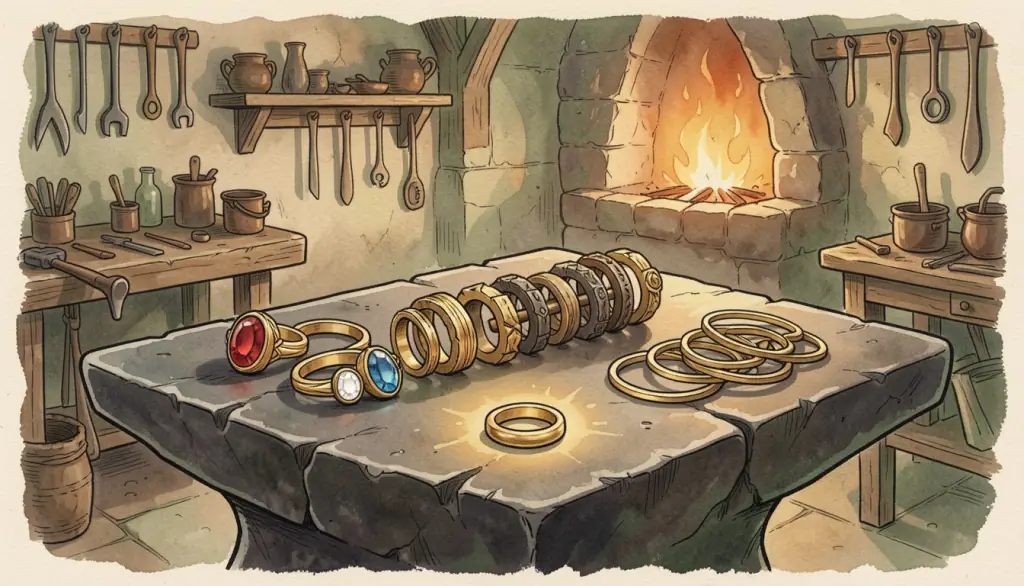
| Narya, the Ring of Fire (red stone) | 1 | Celebrimbor alone | Gil-galad, then Círdan, then Gandalf | Taken West by Gandalf, Third Age 3021 |
| Nenya, the Ring of Adamant or Water (white stone) | 1 | Celebrimbor alone | Galadriel | Taken West by Galadriel, Third Age 3021 |
| Vilya, the Ring of Air (blue stone) | 1 | Celebrimbor alone | Gil-galad, then Elrond | Taken West by Elrond, Third Age 3021 |
| The Seven: ring of Durin's line | 1 | Elven-smiths of Eregion (Sauron's help disputed for this ring) | Durin III of Khazad-dûm, then his heirs | Taken from Thráin II in Dol Guldur, Third Age 2845 |
| The Seven: the other two recovered | 2 | Elven-smiths with Sauron's help | Dwarf-lords | Recovered by Sauron |
| The Seven: lost to dragons | 4 | Elven-smiths with Sauron's help | Dwarf-lords | Consumed by dragons |
| The Nine | 9 | Elven-smiths with Sauron's help | Nine mortal Men, three of them Númenórean lords | Kept by Sauron; the Nazgûl perished with the One |
| The One Ring | 1 | Sauron alone, in Orodruin | Sauron; later Isildur, Gollum, Bilbo, Frodo | Destroyed in Orodruin, 25 March 3019 of the Third Age |
That makes 3 + 7 + 9 + 1 = 20. The count of three Seven-rings recovered by Sauron (the ring of Durin's line plus two others) comes from Gandalf's words in "The Shadow of the Past": three recovered, the rest consumed by dragons.
Beside these twenty there were many lesser rings. Gandalf tells Frodo they were early experiments of the smiths, made before the craft was mature, and that even they could be perilous for mortals. Tolkien never lists them, numbers them or names them.
Who Forged the Rings of Power
"Mae govannen" — want to actually speak Elvish?
Try It Free →The story begins in the middle of the Second Age, in Eregion, the land west of the Misty Mountains that Men later called Hollin. Noldorin Elves settled there near the west gate of Khazad-dûm, and their smiths formed a brotherhood that The Silmarillion calls the Gwaith-i-Mírdain, the People of the Jewel-smiths. Their greatest craftsman was Celebrimbor, grandson of Fëanor. (For his full story see Celebrimbor and the Rings of Power.)
Sauron came to them in a fair form and under an assumed name, Annatar, which Tolkien glosses as "Lord of Gifts". Its first element is the Quenya anna, "gift". Gil-galad and Elrond distrusted him and would not admit him to Lindon, but the smiths of Eregion welcomed his teaching. The Silmarillion says their craft grew greatly under his instruction.
The order of events in Appendix B, "The Tale of Years", runs like this:
- c. Second Age 1500: instructed by Sauron, the Elven-smiths reach the height of their skill and begin forging the Rings of Power.
- c. 1590: the Three Rings are completed in Eregion.
- c. 1600: Sauron forges the One Ring in Orodruin, the fire-mountain in Mordor. Celebrimbor perceives his designs.
- 1693: the War of the Elves and Sauron begins. The Three are hidden.
- 1697: Eregion is laid waste and Celebrimbor dies. Elrond founds Imladris (Rivendell) with the survivors.
- 1701: Sauron is driven out of Eriador with the help of a fleet from Númenor.
Two points matter more than any date. First, Sauron helped make the Seven and the Nine, which is why he could bend them. Second, Celebrimbor made the Three by himself, after Annatar had gone; The Silmarillion says Sauron never touched them. They were unstained, but they were made with the same craft he had taught, so they too were bound to the One. For how the master ring itself was made, see How Was the One Ring Made?.
The Moment the Elves Saw Sauron
When Sauron put on the One Ring and spoke its words, the Elves heard him. The Silmarillion says Celebrimbor and the other ring-bearers became aware of Sauron at once, understood that he meant to be master of all they had made, and took off their rings.
Sauron demanded that all the rings be given up to him, claiming the smiths could not have made them without his lore. The Elves refused and fled with the Three. Sauron made war on them, and in the sack of Eregion in 1697 he seized the house of the Mírdain and with it the rings that were stored there.
This is why the Seven and the Nine came to their owners from Sauron's hand, not from the Elves. He held them, and he dealt them out himself, each one a gift with a hook in it.
The words he spoke in Orodruin are written in the Black Speech of Mordor, not in Elvish. Their full text, grammar and meaning are covered in The One Ring Inscription Explained.
The Three Rings for the Elven-kings
The line of the Ring-verse that most people search for is its first:
"Three Rings for the Elven-kings under the sky" — J.R.R. Tolkien, The Lord of the Rings
The Silmarillion names the three and their stones: Narya, the Ring of Fire, set with a ruby; Nenya, the Ring of Water, set with adamant; and Vilya, the Ring of Air, set with a sapphire. It calls Vilya the mightiest of the three. In The Lord of the Rings Galadriel names hers to Frodo as "Nenya, the Ring of Adamant" and he sees it on her finger as a ring of mithril with a white stone ("The Mirror of Galadriel", FotR II.7).
The Three were not made for war or domination. Tolkien describes their powers as understanding, making and healing, and preserving things from the wear of time. That is why Rivendell and Lothlórien feel as they do in the story: Vilya and Nenya are at work there.
Who held them. Unfinished Tales gives the clearest chain:
- Celebrimbor gave Nenya to Galadriel, on her counsel that the Three be hidden and never used while Sauron held the One.
- He sent Narya and Vilya to Gil-galad in Lindon.
- Gil-galad gave Narya to Círdan the Shipwright and, later, Vilya to Elrond.
- Círdan gave Narya to Gandalf when he came to the Grey Havens at the start of his mission in the Third Age, saying he would need it for the labours ahead.
For the people behind those names see Gil-galad, the Last High King, Círdan the Shipwright Explained, Elrond Explained and Galadriel Explained. A dedicated guide to the three Elven rings themselves, with their stones and powers, is in Nenya, Narya and Vilya: The Three Elven Rings.
Their fate. The Three were bound to the One, so when it was destroyed in 3019 their power faded. On 29 September 3021 of the Third Age the three bearers, Elrond, Galadriel and Gandalf, sailed from the Grey Havens, and in "The Grey Havens" chapter Gandalf at last wears Narya openly, its red stone shining like fire.
The Seven Rings of the Dwarf-lords
The Silmarillion says the foundation of each of the seven hoards of the Dwarf-kings of old was a golden ring. Sauron gave the Seven to Dwarf-lords, but the Dwarves did not fall to him as Men did. Appendix A explains that the Dwarves proved tough and hard to tame: the rings could not turn them into shadows, and Sauron could not bend their wills. The only power the rings had over them was to inflame their desire for gold and precious things, and the hoards drew dragons.
That is the fate Gandalf summarises in "The Shadow of the Past": of the Seven, the dragons consumed some, and Sauron took back the rest. Four were consumed; three were recovered.
The ring of Durin's line. One ring of the Seven belonged to the house of Durin, the kings of Khazad-dûm. Appendix A records that the Dwarves of Durin's line held a different tradition from the general account: they said their ring was given to Durin III by the Elven-smiths themselves, not by Sauron. It passed down the line to Thrór, who gave it to his son Thráin II before going to his death in Moria.
Thráin was later captured and imprisoned in Dol Guldur. Appendix B, under the year 2845 of the Third Age, says the last of the Seven Rings was taken from him there. Gandalf found him dying in the dungeons in 2850 and received from him the map and key that later passed to Thorin Oakenshield in The Hobbit.
For the Dwarves' history in full, see Dwarves of Middle-earth Explained. For the dragons who took the four rings, our guide to the Dragons of Middle-earth covers the great worms of the north.
The Nine Rings of Mortal Men
Of all the peoples, The Silmarillion says, Men proved easiest to ensnare. Sauron gave nine rings to nine Men, and three of them were great lords of Númenórean race. The rings gave them long life, wealth and power, and over time they faded into shadows, invisible to most eyes and wholly under the will of the master of the One.
These are the Nazgûl, the Ringwraiths. Their name is Black Speech, not Elvish: nazg is the word for "ring" that appears in the Ring inscription. Appendix B records that the Nazgûl first appear around the year 2251 of the Second Age, in the reign of Tar-Atanamir in Númenor. Only two are given any individual identity in Tolkien's writings: the Witch-king of Angmar, their lord, and Khamûl the Easterling, who is named in Unfinished Tales (see Khamûl the Easterling Explained).
Sauron kept the Nine himself. That is the key difference from the Seven: the Dwarves' rings were lost or taken back, but the Nine never left Sauron's keeping in the Third Age. When the One was destroyed, the Nazgûl were destroyed with it. Tolkien does not say what became of the nine physical rings.
For their full history, from Númenor to the Fords of Bruinen, see The Nazgûl Explained.
The One Ring
The One was made by Sauron alone, in Orodruin, around Second Age 1600. He poured much of his own native power into it, which is why it could command the others and why its destruction unmade him.
Its later history is the spine of The Lord of the Rings: Isildur cut it from Sauron's hand in 3441 of the Second Age, lost it in the Anduin at the Gladden Fields, and it lay hidden until Déagol found it and Sméagol murdered him for it. Bilbo took it from Gollum's cave, passed it to Frodo, and Frodo carried it to Mount Doom, where it went into the fire on 25 March 3019 of the Third Age ("The Council of Elrond" and Appendix B tell the long middle of this story).
It is the only one of the twenty with an inscription that Tolkien gives in full.
The Names of the Rings in Elvish
Only three of the twenty rings have names, and all three are Quenya. The Seven and the Nine are never named in any language, and the One has no Elvish name: in the Black Speech it is simply nazg, "ring". The names below come from Tolkien's texts, and the single words are all in our attested vocabulary list.
| Name or word | Language | Meaning | Source |
|---|---|---|---|
| Narya | Quenya | the Ring of Fire; built on nár, "fire" (fuller form nárë) | Silmarillion; RotK "The Grey Havens"; Appendix B |
| Nenya | Quenya | the Ring of Water, also the Ring of Adamant; built on nén, "water" | FotR II.7; Silmarillion |
| Vilya | Quenya | the Ring of Air; vilya, "air, sky" | Silmarillion; RotK |
| corma | Quenya | ring | LotR (in Cormacolindor, "Ring-bearers") |
| cor | Sindarin | ring, circle | Tolkien's later writings |
| mírë | Quenya | jewel, gem, treasure | LotR, Namárië |
| Gwaith-i-Mírdain | Sindarin | People of the Jewel-smiths | Silmarillion |
| Annatar | Quenya | Lord of Gifts; first element anna, "gift" | Silmarillion |
| Orodruin | Sindarin | Mountain of Red Flame; orod "mountain" + ruin "red flame" | Silmarillion, LotR |
| nazg | Black Speech | ring (not Elvish) | Ring inscription |
A few notes on these names:
The ending -ya. All three Elven ring names end in -ya, a common Quenya adjective ending. Narya can be understood as "fiery, of fire" and Nenya as "watery, of water"; Vilya is identical to the noun for air and sky. The names describe the element each ring is linked to, not the stone it carries.
Ring words. Quenya corma is the word behind Cormacolindor, the Quenya praise-title for the Ring-bearers sung at the Field of Cormallen (RotK VI.4). Sindarin cor means "ring" or "circle". Neither word is ever used as part of a ring's name.
Pronunciation. Under the stress rule in Appendix E, two-syllable words take stress on the first syllable: NAR-ya, NEN-ya, VIL-ya. The r in Narya is lightly trilled, and every vowel is pronounced as in Italian or Spanish, so Vilya sounds like "VEEL-ya", not "VILL-ya".
No invented ring-phrases. You will find online "Elvish engravings" for wedding rings that claim to be the inscription of Nenya or Vilya. Tolkien wrote no inscription for any of the Three. If you want a phrase for a ring of your own, use an attested one, as we explain in our Elvish wedding vows guide, and check every word against a source.
Where Tolkien's Accounts Differ
Tolkien wrote about the rings across several decades, and his texts do not always agree. Three differences are worth knowing.
How the Three were distributed. The Lord of the Rings states the end state (Elrond, Galadriel and Gandalf as the bearers) without telling the whole chain. Unfinished Tales supplies the version given above, with Galadriel receiving Nenya from Celebrimbor directly and Gil-galad receiving the other two. Tolkien's drafts differ on details such as when exactly Vilya passed to Elrond, so it is safest not to pin that hand-over to a single year.
Whether Sauron gave Durin his ring. The general account in The Silmarillion has Sauron dealing out the Seven. Appendix A records the dissenting tradition of Durin's line that their ring came from the Elven-smiths. Tolkien presents this as what the Dwarves believed, not as a ruling, and he leaves the question open.
How the Nine were made. Every account agrees the Elven-smiths made them with Sauron's help. They do not say how many of the Nine were finished in Eregion before the war and how much Sauron did to them afterwards; we do not speculate beyond the texts.
The Rings on Screen
The Rings of Power on Prime Video tells the forging story on its own terms. Season 1 showed the making of the three Elven rings, and Season 2 showed the Seven and the Nine. Season 3 premieres on 11 November 2026 and is set years later, during the war that follows.
The series compresses and changes Tolkien's timeline. In the show the Three are forged first, before the Seven and the Nine; in Appendix B the smiths begin forging rings around 1500 and the Three are not completed until around 1590, after Annatar had already shared his craft. The show also gathers events that Tolkien spread over centuries into a much shorter span. Reported plot details for Season 3 should be treated as unconfirmed until the episodes air.
For the Elvish you can expect to hear in the new season, see our Rings of Power Season 3 Elvish Preview.
People Also Ask
How many Rings of Power are there in Lord of the Rings? Twenty Great Rings: three for the Elves, seven for the Dwarves, nine for Men and the One Ring. There were also many lesser rings that Tolkien never counted.
Who forged the Rings of Power? The Elven-smiths of Eregion, led by Celebrimbor, made the Seven and the Nine with Sauron's help. Celebrimbor made the Three alone. Sauron forged the One in Orodruin around Second Age 1600.
Who had the three Elven rings? At the end of the Third Age, Galadriel held Nenya, Elrond held Vilya and Gandalf held Narya, which Círdan had given him.
What happened to the seven Dwarf rings? Dragons consumed four and Sauron recovered three. The last was taken from Thráin II in Dol Guldur in Third Age 2845.
See the Ring Names in Tengwar
Narya, Nenya and Vilya are short, regular Quenya words, ideal for a first look at how Elvish is built. Type any of them into our Tengwar name tool to see them in Fëanor's letters, or try the Elvish translator to see how attested words like nár, nén and vilya combine.
Related Reading
- Nenya, Narya and Vilya: The Three Elven Rings
- Celebrimbor and the Rings of Power: The Smith Who Made the Three
- How Was the One Ring Made?
- The One Ring Inscription Explained
- The Nazgûl Explained
- Galadriel Explained
- Elrond Explained
- Círdan the Shipwright Explained
- Gil-galad, the Last High King
- Dwarves of Middle-earth Explained
- Rings of Power Season 3 Elvish Preview
People Also Ask
How many Rings of Power are there in Lord of the Rings?
Twenty Great Rings: three for the Elves, seven for the Dwarves, nine for Men and the One Ring made by Sauron to rule the rest. The Elven-smiths of Eregion also made many lesser rings, which Tolkien never counted.
Who forged the Rings of Power?
The Elven-smiths of Eregion, the Gwaith-i-Mírdain led by Celebrimbor, made the Seven and the Nine with the help of Sauron, who came to them in disguise as Annatar. Celebrimbor made the Three alone, and Sauron never touched them. Sauron forged the One Ring by himself in Orodruin around the year 1600 of the Second Age.
Who had the three Elven rings?
In Unfinished Tales, Celebrimbor gave Nenya to Galadriel and sent Narya and Vilya to Gil-galad. Gil-galad gave Narya to Círdan and Vilya to Elrond, and Círdan later gave Narya to Gandalf. At the end of the Third Age the three bearers were Galadriel, Elrond and Gandalf.
What happened to the seven Dwarf rings?
Gandalf says in The Fellowship of the Ring that dragons consumed four of the Seven and Sauron recovered the other three. The last was taken from Thráin II in the dungeons of Dol Guldur in 2845 of the Third Age.
What happened to the nine rings of Men?
Sauron gave them to nine Men, among them three great lords of Númenor. The rings lengthened their lives until they faded into the Nazgûl, the Ringwraiths, wholly under Sauron's will. Sauron kept the Nine himself, and the Nazgûl perished when the One Ring was destroyed.
What do Narya, Nenya and Vilya mean?
They are Quenya names. Narya is built on nár, "fire", Nenya on nén, "water", and Vilya is the word vilya, "air, sky". Tolkien calls them the Rings of Fire, Water and Air.