Naur an Edraith Ammen: What Gandalf's Fire Spell Means
Try It Yourself — Free Elvish Tools
Quick Answer: Naur an edraith ammen is Sindarin, written by Tolkien himself in The Fellowship of the Ring. It means roughly "fire be for the saving of us." Word by word: naur "fire", an "for, to", edraith "rescue, saving", ammen "us". Gandalf says it on the pass of Caradhras, and he follows it with naur dan i ngaurhoth, "fire against the werewolf-host", when wolves attack the Company. Both lines are book Sindarin, not film dialogue. The second shows a real grammar feature: gaur "werewolf" becomes ngaur after the article i.
Few lines of Tolkien's Elvish are shouted as often by fans as Gandalf's fire spell. It is short, it sounds like a command, and it sits at a famous scene. It also hides more grammar than most readers notice. This guide takes it apart: what each word is, why gaur turns into ngaur, how it should sound, and how the books and the films handle spells differently.
For the wider word family, our page Elvish Word for Fire covers the Quenya and Sindarin words side by side. This post stays with the spell itself.
Where the Spell Appears in the Book
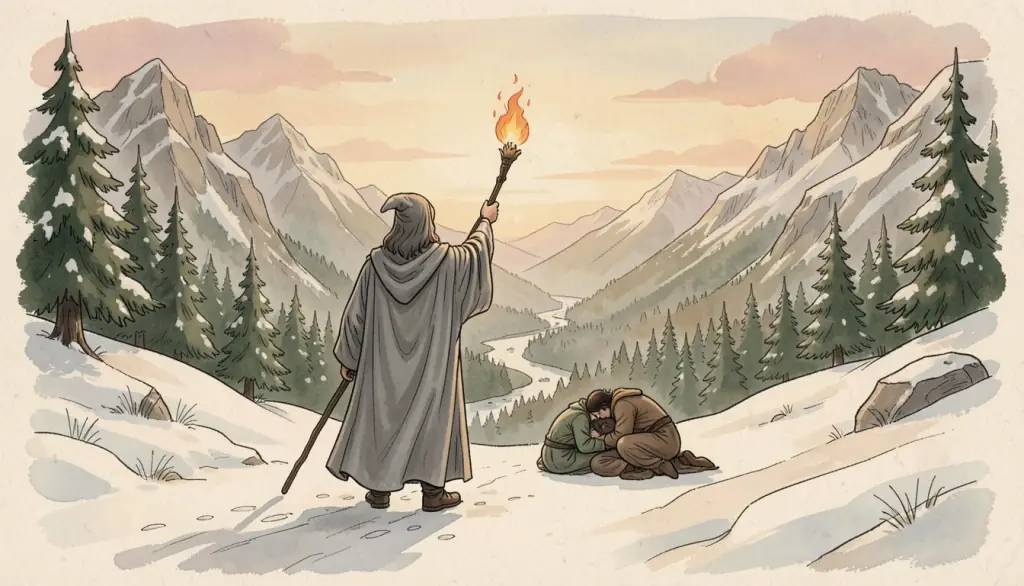
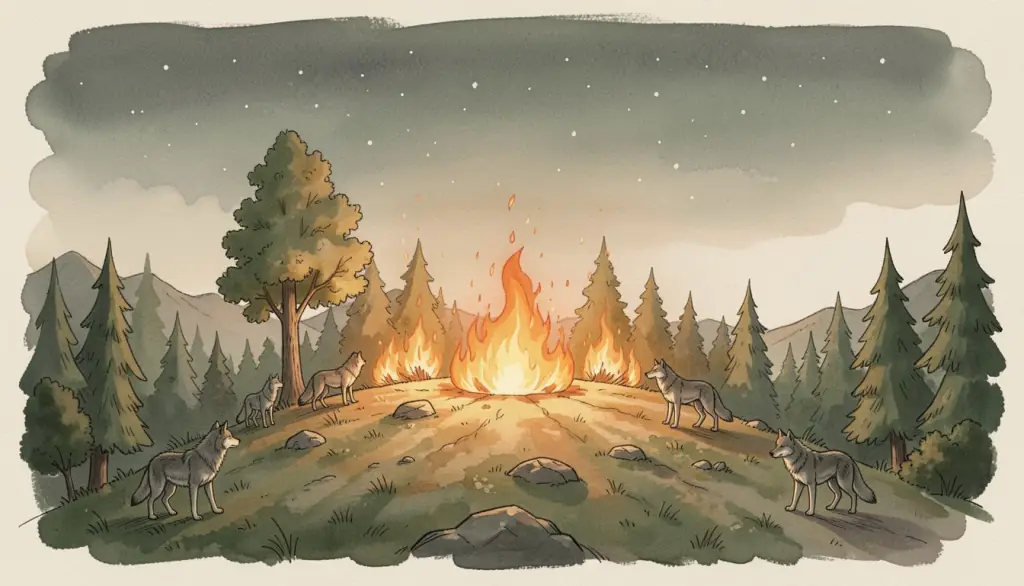
Both lines are printed in Book II of The Fellowship of the Ring. The fire line comes on the slopes of Caradhras, in the chapter "The Ring Goes South", when the Company cannot light a fire in the snow and Gandalf finally does it with a word. The wolf line comes when the Company is attacked by wolves in Hollin, the night before they reach the walls of Moria, at the start of "A Journey in the Dark". Gandalf's blaze scatters the pack.
Two points about the source are worth stating plainly.
- The book gives no translation. Tolkien prints the Sindarin and moves on. The English glosses we use come from his own later notes, as collected and discussed by scholars. That is why you will see slightly different English renderings of the same line.
- It is Gandalf's Sindarin, not a "magic language". Tolkien does not treat these as spell words with special power. They are ordinary Sindarin sentences, spoken by a wizard who knows the Elvish tongue well. What gives them force in the story is the speaker, not the grammar.
If you want the other famous Gandalf line in Sindarin, the gate at Moria, read Speak Friend and Enter. The wizard's Elvish name is covered in Gandalf's Elvish Name: Mithrandir.
The Words, One by One
"Mae govannen" — want to actually speak Elvish?
Try It Free →| Word | Language | Meaning | Source |
|---|---|---|---|
| naur | Sindarin | fire | LotR Book II; our word list |
| an | Sindarin | to, for | LotR, Unfinished Tales, Letters |
| edraith | Sindarin | rescue, saving | LotR, PE17 |
| ammen | Sindarin | to us, for us | LotR, as glossed from Tolkien's notes |
| dan | Sindarin | back to, against, down upon | LotR, PE17, PM |
| i | Sindarin | the (article) | LotR |
| gaur | Sindarin | werewolf | LotR, The Silmarillion |
| hoth | Sindarin | host, horde | The Silmarillion, Unfinished Tales |
| ngaurhoth | Sindarin | werewolf-host | LotR Book II |
Naur. A plain noun, "fire". It is used as a bare noun here, almost like a call: "Fire!" Do not confuse it with ruin "red flame, fiery red", a different word in our list.
An. A short preposition, "to" or "for". In this line it introduces who or what the fire is for.
Edraith. A noun, "rescue" or "saving". It is built on the sense of delivering someone from danger. Literally the phrase an edraith ammen is "for the saving to-us", which is why the clean English is "for our saving" or "for the saving of us".
Ammen. The pronoun "us", in a form that goes with the preposition. We leave its internal structure alone, because Tolkien published no full table of Sindarin pronouns and breaking it into parts would mean guessing.
Put together, the sentence has no verb. Naur an edraith ammen is close to "Fire, for the saving of us." The English "be" in "fire be for the saving of us" is a natural way to read the wish in it, not a Sindarin word. That is worth remembering if you want to make a similar phrase: the model has no verb in it.
The Second Line: Naur dan i Ngaurhoth
The wolf line reuses the same first word and swaps the rest.
- Naur "fire"
- dan "against", from a preposition that carries ideas of "back to" and "against"
- i "the"
- ngaurhoth "the werewolf-host"
So the line is "Fire against the werewolf-host." The two lines form a pair: the first asks for fire to protect, the second sends it against an enemy. It is the same four-part shape in both: noun, preposition, then what the fire is for or against.
The preposition dan also shows up in the film Sindarin written by David Salo. His line tolo dan nan galad uses it too. That is film Sindarin (Salo), not Tolkien's, but it is a useful reminder that Salo borrowed the preposition from the book language, which is exactly what a reconstruction should do.
Why Gaur Becomes Ngaur: Mutation
The most interesting thing in the spell is a letter. The root word is gaur, "werewolf". In the phrase it is written ngaur. Nothing was added; the first sound changed.
Sindarin changes the first consonant of a word depending on what comes before it. This is called mutation, and it is the grammar feature that most often surprises new learners. Our guide Sindarin Grammar: A Complete Guide explains the full system. Three facts are enough for this line:
- The change is regular. After certain words, the initial g of the next word shifts. In this phrase, g becomes ng, a sound like the one in English "finger".
- The article triggers it here. The word before ngaurhoth is the article i. Tolkien's line shows g turning to ng after it. Which exact mutation applies after the article in each case is a topic where Tolkien's own usage is not perfectly tidy, so treat the line itself as the authority rather than a rule you extend freely.
- The spelling shows what is said. Tolkien writes the mutated form, so the change appears on the page and in the pronunciation.
For a learner, the practical lesson is to always learn a noun in its plain form and then notice how it looks inside a sentence. Gaur in a dictionary and ngaur in a phrase are the same word.
The Collective Ending: Hoth
The last part of ngaurhoth is hoth, "host" or "horde". Sindarin uses it to name groups. You can see the pattern in another word Tolkien gives for orcs: Glamhoth, "yelling horde", the name the Elves used for orc-bands. That word is in our list as the Elvish name for orcs, built on the same final element.
So ngaurhoth is a compound meaning a whole company of werewolves, not a single beast. The grammar here is the same idea as English "-pack", "-flock" or "-horde" added to a noun.
A caution about copying this pattern. A fan can easily make a similar word, such as naurhoth, "fire-host". That form appears in some fan material, but Tolkien never wrote it. If you see it, treat it as a reconstruction, not as a quotation. See our guide to wolves in Middle-earth for the wolf words that are attested, and Elvish Word for Wolf and Dragon for the Sindarin and Quenya wolf vocabulary. In particular, gaur means "werewolf", not an ordinary wolf; the ordinary wolf has other words.
How to Pronounce It
Tolkien describes Sindarin sounds in Appendix E of The Lord of the Rings. Using that guide:
| Sound | How to say it |
|---|---|
| au | like ow in "how" |
| ai | like "eye" |
| dan, an, ammen | short a, like the a in "father" cut short |
| ng (in ngaur) | like the ng in "finger", with the g sounded |
| th | a voiceless th, as in "thin" |
Stress follows Tolkien's rules. Two-syllable words are stressed on the first syllable. In a longer word, the stress goes on the syllable before the last if it is long, holds a diphthong, or is closed by two consonants. That gives:
- NOWR an ed-RAITH AM-men
- NOWR dan ee NGAUR-hoth
In edraith, the stress falls on -raith because the ai is a diphthong. A common spoken version, close to the one on our site, is "NOWR an ed-RYTH AM-men". All consonants are pronounced, including the final th. For more on the sound system, see the Sindarin pronunciation guide or our reference page on pronunciation.

Related Words from the Fire Root
The word naur is not alone. Sindarin and Quenya both have fire words from a related source. Here is what is attested.
| Word | Language | Meaning | Note |
|---|---|---|---|
| naur | Sindarin | fire | the word in Gandalf's spell |
| nár | Quenya | fire | seen in the name of the ring Narya |
| nárë | Quenya | flame, fire | the fuller noun form of nár |
| Nárië | Quenya | June | glossed "Fire-ness" by Eldamo; the gloss is inferred |
| ruin | Sindarin | red flame, fiery red | a different word, for colour of flame |
Quenya nár and Sindarin naur look like relatives, and that matches how the two languages are related: Quenya and Sindarin descend from a shared older tongue. We do not need to claim the exact chain here. What matters is that the fire in the ring name Narya, Gandalf's ring, is the Quenya cousin of the fire in his Sindarin spell. Gandalf, the keeper of the Ring of Fire, shouts the Sindarin word for fire on Caradhras. Our post on Nenya, Narya and Vilya explains the ring and what its Quenya name means.
One false friend to avoid: Anor, "sun", as in Minas Anor, "Tower of the Sun", belongs to the sun word Anar in Quenya. It is not a fire word, even though the sun gives light and heat.
Spells in the Books and Spells in the Films
Tolkien's wizards do very little that looks like stage magic. Gandalf's fire on Caradhras is one of the few cases where a spoken command is printed, and the book treats it as a skill, not as a formula. The words matter less than the person.
The films stage spells differently. They need a sound for magic, so the screenplay and its Elvish dialogue lean on spoken lines. The Elvish in those films was largely written by the linguist David Salo, building new sentences from Tolkien's grammar. That means:
- Lines taken straight from the book, such as Gandalf's gate words, are Tolkien's.
- New lines written for the films are film Sindarin (Salo). They are skilled work, but they are not Tolkien's own sentences.
- A film does not always keep a book line in the same place. The books put the fire spell on Caradhras and the wolf spell at Moria. When a film moves or merges scenes, the Elvish may move with it.
We have not transcribed any film dialogue here, and we do not cite film lines we cannot check. If you want to compare, play the scene and read the line against the printed text. Where the Sindarin differs, the printed text is Tolkien's. For more on telling the two apart, see Elvish Movie Quotes from The Lord of the Rings and Fellowship of the Ring Elvish Phrases.
Using the Phrase Well
People ask how to use naur an edraith ammen in games, in costumes, on cards and on posters. Some simple guidance:
- Quote it, do not rebuild it. As a quotation it is attested and safe. If you change a word, you leave Tolkien's text and enter guesswork.
- Credit the speaker. "Gandalf, The Fellowship of the Ring" tells readers where the line comes from, which is also the best defence against someone telling you it was film Elvish.
- Do not swap words casually. Replacing naur with another word does not give you a new spell. The grammar of how Sindarin forms commands, wishes and moods is not fully published, so a made-up sentence is a reconstruction at best.
- For games, label your own lines. If you write new phrases for a campaign, mark them as invented or "Neo-Sindarin", as our D&D guide does. See Elvish Phrases for D&D Campaigns.
- If you write it in Tengwar, the Sindarin spelling above is the one to transcribe. Our Tengwar name tool and the reading and writing guide show how.
For a broader list of attested lines, start with Lord of the Rings Elvish Phrases. To test a phrase of your own against our attested word list, use the Elvish translator, which marks reconstructed forms as such.
What the Spell Teaches About Sindarin
It is a small phrase, but it shows six things a learner needs.
- Sindarin can build a full wish without a verb. Naur an edraith ammen is a noun, a preposition, a noun and a pronoun.
- Prepositions carry a lot of meaning. An "for" and dan "against" turn the same noun into two opposite commands.
- Words change shape in a sentence. Gaur becomes ngaur. Learn mutation early.
- Compounds name groups. Hoth gives a whole host, as in Glamhoth and ngaurhoth.
- Mutation is written. The page shows the changed sound.
- Attested and invented are different. Naurhoth is easy to coin and was never written by Tolkien.
If those ideas are new, our grammar guide and Sindarin word list are good next steps, and Sindarin Basics is a short introduction.
People Also Ask
What does naur an edraith ammen mean? Roughly "fire be for the saving of us." Naur is fire, an "for", edraith "rescue, saving", ammen "us". Gandalf says it on Caradhras.
What does naur dan i ngaurhoth mean? "Fire against the werewolf-host." Dan is "against", i is "the", and ngaurhoth is gaur "werewolf" plus hoth "host", with g mutated to ng.
Is it Tolkien's Elvish or film Elvish? Tolkien's. Both lines are printed in The Fellowship of the Ring. Elvish written for the films is by David Salo and is film Sindarin.
How do you pronounce naur an edraith ammen? Roughly NOWR an ed-RYTH AM-men. Au is like ow in "how" and ai is like "eye". The stress falls on the diphthong in edraith.
Can I use it as a tattoo or in a game? Yes, as a quotation. Keep it exactly as Tolkien wrote it and credit Gandalf. Do not rebuild it into new sentences, because the full verb grammar is not published.
Learn the Language Behind the Spell
Gandalf's fire lines are a good first sentence of real Sindarin: short, attested and rich in grammar. Try the words in our Elvish translator, or start the free lessons at Learn Elvish, where you read, hear and write the words Tolkien actually used. You can also see how the same words look in script with the Tengwar name tool.
Related Reading
People Also Ask
What does naur an edraith ammen mean?
It is Sindarin and means roughly "fire be for the saving of us." Naur is fire, an is "for" or "to", edraith is "rescue" or "saving", and ammen is "us". Gandalf says it on Caradhras in The Fellowship of the Ring when he lights the wet wood.
What does naur dan i ngaurhoth mean?
It means "fire against the werewolf-host." Naur is fire, dan is "against", i is the article "the", and ngaurhoth is gaur "werewolf" plus hoth "host, horde", with the first g softened to ng after the article. Gandalf cries it when wolves attack the Company.
Is naur an edraith ammen Tolkien's Elvish or movie Elvish?
It is Tolkien's own Sindarin, printed in The Fellowship of the Ring. It is not film dialogue. Film Sindarin was written later by David Salo, and the two should not be confused.
How do you pronounce naur an edraith ammen?
Roughly NOWR an ed-RYTH AM-men. The au is like ow in "how", the ai in edraith is like "eye", and every consonant is sounded. The stress falls on the ai in edraith because that syllable holds a diphthong.
Can I use naur an edraith ammen as a real spell or a tattoo?
As a quotation from Tolkien it is safe, and many fans use it that way. Keep it exactly as written and credit Gandalf. Do not alter it to say other things, because Tolkien never published how the verb or mood works.
Related Tags
Learn Elvish Free
39 free Elvish lessons, an AI tutor, and spaced repetition review — no credit card required.
Start Learning Free