Ungoliant Explained: Tolkien's Spider of Unlight, Mother of Shelob
Try It Yourself — Free Elvish Tools
Quick Answer: Ungoliant is the monstrous spider-spirit of The Silmarillion. She lived in Avathar in the far south of Aman, where she hungered for light. Melkor, the first Dark Lord, enlisted her to destroy the Two Trees of Valinor; she drank their light and spun the Unlight that darkened the Blessed Realm. Their alliance then failed over the Silmarils at Lammoth, where Balrogs drove her off. Her end is left uncertain. Her brood bred in the mountains of Beleriand, and Shelob in The Two Towers is called her last child. The Sindarin word ungol means "spider."
Ungoliant is a strange figure even by Tolkien's standards. She is not a dragon, an Orc or a Dark Lord, and she has no wish to rule anything. She wants to eat the light of the world, and she will eat anything that stands between her and that hunger, including, in the end, her own master. Readers usually meet her through her descendants: Shelob in The Lord of the Rings and the spiders of Mirkwood in The Hobbit. The ancestor is a far larger and more frightening story.
This guide follows Ungoliant from her first appearance to her last, then looks at her children and at her name. It sticks to what Tolkien actually published, and it flags where the text is uncertain. For the wider spider lineage and the later episodes, see our hub post Giant Spiders of Middle-earth.
Who Ungoliant Is
Ungoliant appears in The Silmarillion, chiefly in the chapter "Of the Darkening of Valinor" and the one that follows it. Tolkien gives her almost no origin. The Eldar did not know where she came from. Some, the text says, held that she descended out of the darkness that lies about Arda, from the time when Melkor first turned his envy toward the world. In any case she had served Melkor in the earliest days, and she later forsook him and kept to herself.
Three facts about her are stated clearly:
- Her shape. She took the form of a spider of monstrous size.
- Her home. She lived in Avathar, a dark and narrow region between the mountains of the Pelóri and the sea, in the south of Aman.
- Her hunger. She devoured light, and what she drank she spun out again as the Unlight, a darkness that seems to have substance of its own.
Ungoliant is usually described as a spirit that took spider form, not as a natural beast, which is one reason she belongs with the great beings of the First Age and not with the animals. For the context of the Valar and the lands of Aman where she lived, see Valinor, the Undying Lands.
The Alliance with Melkor
"Mae govannen" — want to actually speak Elvish?
Try It Free →When the Valar released Melkor after his long captivity, he feigned repentance, then spread lies among the Noldor and so set Fëanor and his sons against the Valar. By the time the Noldor were in open unrest, Melkor was already planning his revenge on the Valar and on the light of the Two Trees.
He knew he could not do it alone. The Silmarillion says he went south to Avathar and found Ungoliant there. She was reluctant. She feared him and had no love for the Valar, but she wanted what he offered: whatever she could desire, and to be filled. Melkor promised to give her whatever she asked for in payment. This promise is the hinge of the entire betrayal, because Ungoliant takes it literally.
Their plan was simple. Melkor would wound the Trees and Ungoliant would drink the wounds dry. They chose a moment when a great festival was held on Taniquetil and almost no one remained in the city of Valmar. Tolkien describes the two of them crossing the Pelóri together, Ungoliant spinning her darkness around them, so that they came to the Trees unseen.
The Darkening of Valinor
The death of the Two Trees
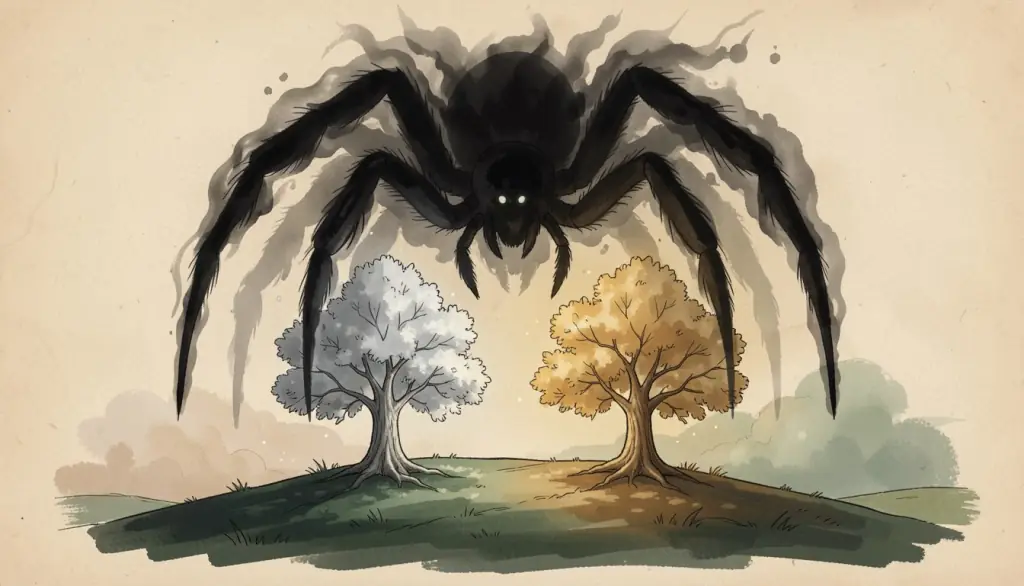
Telperion, the silver tree, and Laurelin, the golden tree, had lit Valinor since the early days of Arda. Melkor stabbed each with his black spear, and from the wounds the sap poured out. Ungoliant drank it, and then drank the Trees' light directly. The poison she breathed back into them killed them. She also drained the Wells of Varda, where the dew of Telperion was gathered, and as she did so she swelled until even Melkor was afraid of her.
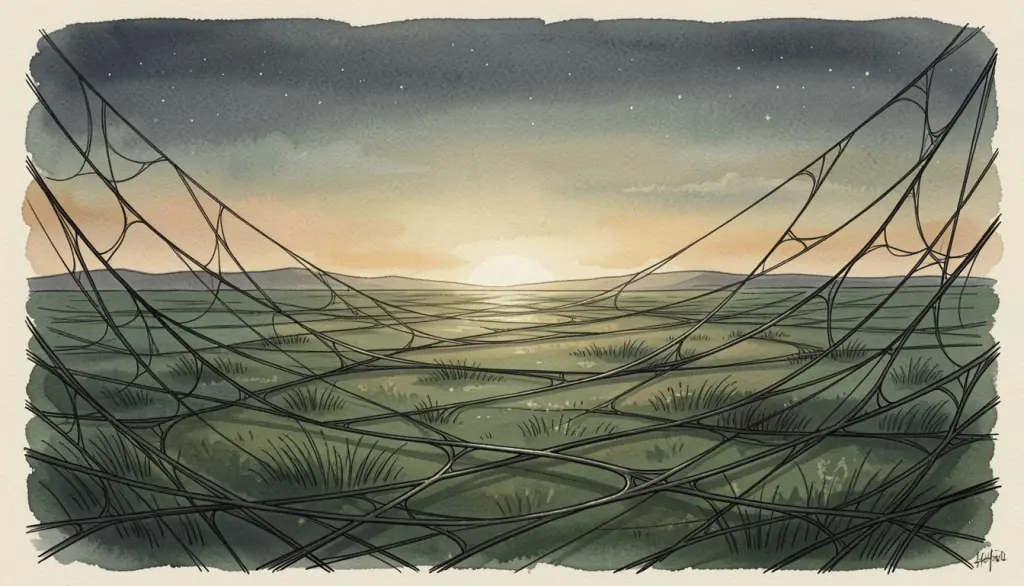
The Unlight she spun spread across Valinor. In the great shadow the Valar could not see where the two had gone. By the time Yavanna sang to the dead Trees, nothing could be saved except a single flower and a single fruit: the last flower of Laurelin and the last fruit of Telperion, from which the Valar later made the Moon and the Sun.
Formenos and the Silmarils
The destruction of the Trees is only half of what happened that night. Melkor and Ungoliant went north to Formenos, Fëanor's fortress. There Melkor killed Finwë, King of the Noldor, at his gate, and took the Silmarils, the three jewels in which Fëanor had caught the light of the Trees before they died.
Those jewels are why the rest of the First Age happens. Fëanor swore his terrible oath, the Noldor rebelled and left Valinor, and the long war with Melkor, now called Morgoth, began. If you want the story from Fëanor's side, including his refusal to give up the Silmarils and the grief at Formenos, read Fëanor and the Silmarils. If you want the light-and-darkness vocabulary that runs through all of it, the guides to Elvish words for light and dark and Elvish words for stars and the night sky collect the attested words.
The Quarrel at Lammoth
Ungoliant had been paid in part. At Formenos she devoured the treasures that the Noldor had stored, and she grew greater. But Melkor had promised her whatever she asked, and she asked for the Silmarils.
He refused. The Silmarillion tells that he held them in his hand, that the jewels burned him because they were blessed, and that he would not release them. The place where this happened lay in the far north of Middle-earth, in the land called Lammoth. Ungoliant attacked him, wrapped him in her webs and began to strangle him. His cry of anguish echoed through the surrounding hills, and that echo gave Lammoth its name, "the Great Echo."
Balrogs who still lurked in the ruins of Angband heard the cry and came. They drove Ungoliant away with whips of flame. Our post on Balrogs of Middle-earth covers this rescue as the first great appearance of the Balrogs in the story. It is also one of the few moments when Tolkien shows his strongest Dark Lord in real danger, and the thing that endangers him is a being who was once his own servant.
| Event | Where | What happens |
|---|---|---|
| Alliance | Avathar | Melkor promises Ungoliant whatever she asks |
| Darkening of Valinor | Valmar and the Two Trees | The Trees and the Wells of Varda are drained |
| Slaying of Finwë | Formenos | Melkor kills the King and steals the Silmarils |
| Quarrel | Lammoth | Ungoliant demands the Silmarils and attacks Melkor |
| Rescue | Lammoth | Balrogs drive her off with whips of flame |
What Became of Ungoliant
After Lammoth, Ungoliant leaves the main story. The Silmarillion says she went into the far south of the world, and then adds that some tell she came to an end by devouring herself in her hunger. This is the only account of her death, and Tolkien phrases it as a report, not as established fact. The honest summary is that her end is uncertain: she is driven off, she disappears and the text records a tale about her self-consumption.
What the text is surer of is that her kind survived her. Before she vanished, she settled beneath the Ered Gorgoroth, the Mountains of Terror, in the valley that became Nan Dungortheb, "the valley of dreadful death." There she bred with other spider-shaped creatures already living in the region and filled the valley with her brood. It lay between the Girdle of Melian around Doriath and the heights of Dorthonion, so travellers could hardly pass it alive. Beren's journey through it on his way to Doriath is one of the most dangerous stretches of his story; our post on Lúthien and Beren tells it in full, and Doriath and the Girdle of Melian explains the kingdom that the valley sits beside.
Ungoliant's Descendants
Shelob
The clearest link between Ungoliant and The Lord of the Rings is in The Two Towers, Book IV, chapter 9, "Shelob's Lair." The narrator explains that Shelob was already there before Sauron came to Mordor, and calls her the last child of Ungoliant to trouble the unhappy world. Like her ancestor she serves no one, not even the Dark Lord, who simply finds her useful as an unpaid guard on the pass.
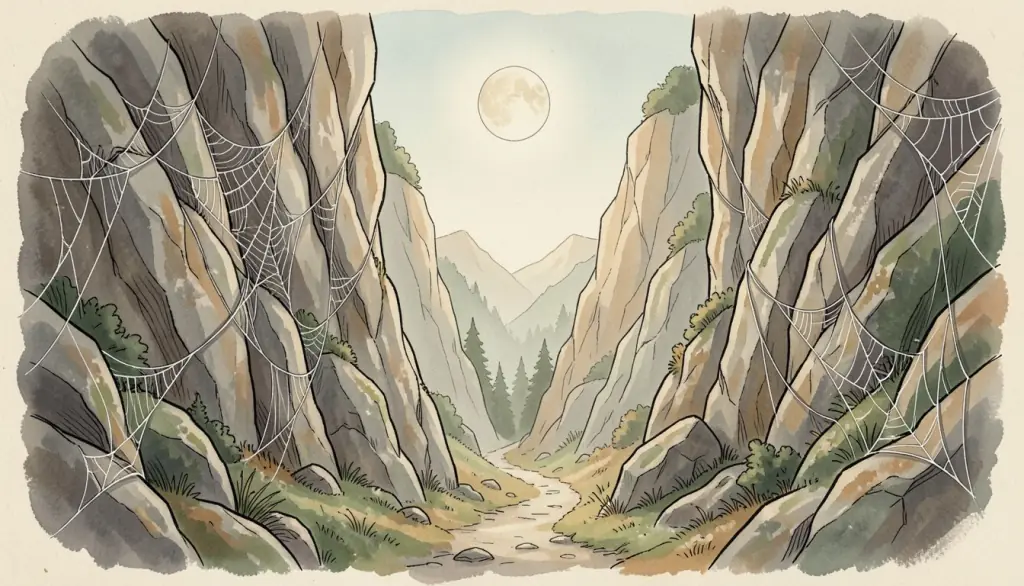
She lives above Minas Morgul in the pass of Cirith Ungol, where Gollum leads Frodo and Sam in the hope that she will kill them and leave him the Ring. The narrator also says she grew fat on endless feasts, and that her kind once bred with her own offspring. Frodo carries the Phial of Galadriel, which holds the light of Eärendil's star; that star is a Silmaril, and the Silmarils held the light of the Two Trees that Ungoliant drank. Tolkien rarely underlines such a connection, but the circle from Ungoliant to Shelob closes neatly. Galadriel Explained covers the Lórien background to the gift, and Lothlórien Explained covers the wood where she gave it.
The spiders of Mirkwood
In The Hobbit (chapter 8, "Flies and Spiders") Bilbo and the Dwarves meet giant spiders in Mirkwood. Bilbo kills one and names his small elven blade Sting. The spiders are clearly the same sort of creature as Shelob, and readers have long treated them as part of the same dark family. We should be careful, though: The Hobbit itself does not name their ancestry, since Tolkien had not yet developed the wider legendarium when he wrote it. The connection to Ungoliant is something later readers draw from the shared nature of the creatures, not a line spelled out in that book. For the forest itself and its darkening, see Mirkwood and the Woodland Realm.
Other dark creatures of the same world
Ungoliant sits oddly among the monsters of Middle-earth. Dragons, Orcs and Balrogs all belong to Morgoth's armies; she does not. If you want to see how those servants compare with her, read Dragons of Middle-earth and Orcs and Goblins of Middle-earth.
What Does the Name Ungoliant Mean?
The word you can rely on is Sindarin ungol, "spider." It is in the Elvish vocabulary we use on this site, where it is sourced to Tolkien's Letters and the War of the Ring volume of the History of Middle-earth. It is the same element that gives the pass of Cirith Ungol its name: Sindarin cirith means "cleft, pass," so Cirith Ungol is "the pass of the spider." A related Quenya word, ungwë, "spider's web," is also attested.
Beyond that, be careful.
- The longer form. Tolkien's writings give the name in a longer Quenya shape, Ungoliantë, and readers connect it to the spider and web words above. The exact analysis of the ending is not something we can state with confidence from the published text.
- "Gloomweaver." Some reference works translate the name as "Gloomweaver" or "dark spider." We treat that as a secondary gloss, because the safe, attested part is the spider element. If you see it quoted, check whether the source is Tolkien or a later commentator.
- No Elvish name for Shelob. Tolkien never gives her an Elvish name; Shelob is an English coinage. Nor does he give a special word for the Mirkwood spiders beyond the general word for spider.
| Word | Language | Meaning | Where |
|---|---|---|---|
| ungol | Sindarin | spider | Letters, War of the Ring |
| Cirith Ungol | Sindarin | pass of the spider | The Lord of the Rings |
| ungwë | Quenya | spider's web | The Lord of the Rings, Parma Eldalamberon 17 |
| Ungoliantë | Quenya form | longer form of the name | The Silmarillion and related writings |
For the language behind these words, see Tolkien's Elvish languages: a complete guide, the Sindarin word list and our beginner's guide to Sindarin.
Why Ungoliant Matters
Ungoliant is the spark of the whole First Age. Without her the Trees would not have died in that night, the Silmarils might not have been stolen when they were, and Fëanor's oath, the Kinslaying and the long wars of Beleriand would have had a different shape. She also shows something about Tolkien's idea of evil. Melkor can corrupt and command, but he cannot control a hunger that is bigger than his own ambition. Ungoliant is evil as pure appetite, and she is dangerous to Melkor because she cares nothing for his plans.
Her descendants carry that mark. Shelob serves nobody. The spiders of Mirkwood take what they can. Where the Orcs follow an order, the spiders follow hunger, and that difference is why Tolkien keeps them separate from the armies of the Enemy.
People Also Ask
Who is Ungoliant?
A primeval spirit in the form of a giant spider, described in The Silmarillion. She lived in Avathar, hungered for light, and helped Melkor kill the Two Trees of Valinor before turning on him.
What did Ungoliant do to the Two Trees?
After Melkor struck Telperion and Laurelin with his spear, she drank their sap and drained the Wells of Varda. The Trees died and darkness fell on Valinor.
Is Shelob the daughter of Ungoliant?
The Two Towers calls Shelob the last child of Ungoliant to trouble the unhappy world. The text does not name her father.
What does the name Ungoliant mean?
It contains Sindarin ungol, "spider." Fuller etymologies, such as "Gloomweaver," come from secondary glosses and should be treated with caution.
Learn the Languages Behind the Names
Most of the names around Ungoliant are Elvish: ungol, cirith, Ered Gorgoroth, Nan Dungortheb and Taur-nu-Fuin. Learning a few Sindarin roots makes these names readable at a glance. You can start free with the Elvish course, or try a name or phrase in the Elvish translator.
Related Reading
People Also Ask
Who is Ungoliant in Tolkien's writings?
Ungoliant is a primeval spirit in the shape of a gigantic spider, described in The Silmarillion. She lived in Avathar, in the south of Aman, and hungered for light. Melkor persuaded her to help him destroy the Two Trees of Valinor, and then she turned on him.
What did Ungoliant do to the Two Trees?
After Melkor wounded Telperion and Laurelin with his spear, Ungoliant drank their sap and then drained the Wells of Varda. The Silmarillion says the Trees died and a great darkness fell on Valinor. This is called the Darkening of Valinor.
What happened to Ungoliant in the end?
Melkor's cry in the north summoned the Balrogs, who drove her off with whips of flame. The Silmarillion then says she went into the far south, and that some tell she ended by devouring herself in her hunger. Tolkien leaves her end as a report, not a certainty.
Is Shelob the daughter of Ungoliant?
The Two Towers calls Shelob the last child of Ungoliant to trouble the unhappy world. She came to the mountains of Mordor before Sauron did and lives at Cirith Ungol. The text does not name Shelob's own father.
What does the name Ungoliant mean?
The Sindarin word ungol means "spider," and it is the element Tolkien's readers recognise in Ungoliant and in Cirith Ungol. The full etymology of the name is less settled, and glosses such as "Gloomweaver" come from secondary reference sources, so treat them with care.
Is Ungoliant in the Lord of the Rings films?
No. Ungoliant appears only in The Silmarillion and related writings. The films show Shelob and, in The Hobbit films, the spiders of Mirkwood, but they never show or name Ungoliant.