Elvish Word for Snow and Winter — Lossë, Loss, Hrívë, Rhîw
Try It Yourself — Free Elvish Tools
Quick Answer: Snow is lossë in Quenya and loss in Sindarin. Winter is hrívë in Quenya and rhîw in Sindarin. Ice is Sindarin heleg and Quenya helca ("icy"). Tolkien wrote no Elvish word for Christmas, and the phrase "Merry Christmas" is not attested.
Tolkien's world has plenty of snow: the cold peak of Taniquetil, the white flowers of Lothlórien, an Elvish spear named for ice. His word lists also hold a good set of snow, frost and winter words. This guide collects them, says where each one comes from, and flags the points where popular lists go beyond the sources.
Every word below is checked against the Elvish word database on this site, which draws on Tolkien's published work and the Eldamo reference. Where a gloss was worked out by the Eldamo editors rather than written by Tolkien, that is said.
The Core Words
| English | Quenya | Sindarin | Source |
|---|---|---|---|
| snow | lossë | loss | Eldamo, root GLOS |
| snowy | lossëa | lossen | PE17, VT42; RGEO |
| to snow | hriz- | — | PE17 (archaic or poetic) |
| fall of snow | hrissë | — | PE17 |
| winter | hrívë | rhîw | LotR Appendix D; Sindarin in LotR and PM |
| ice | — | heleg | Etymologies, PE23 |
| icy, ice-cold | helca | — | Silmarillion, Etymologies |
| cold | niquë, ringa | ring | Etymologies, PE17, VT49; Silmarillion, VT42 |
| frost, snowflake | nixë | — | Etymologies, WJ |
| snowflake, ice-flake | niquis, niquessë | — | PE17, WJ |
| icicle, snow-point | — | aeglos | Unfinished Tales |
| white | ninquë, fána | nim, nimp, fain | Etymologies, Silmarillion |
| snow-white | lossëa | glosui | PE17 |
A few of these need a note. PE means Parma Eldalamberon, the journal that publishes Tolkien's linguistic papers, and VT means Vinyar Tengwar, a sister journal. These are real primary sources, but they are specialist ones. Hriz-, hrissë, niquis and niquessë come from Tolkien's later and unpublished-until-recently word lists, and Eldamo marks hriz- as archaic or poetic. They are attested, but they are not words a reader finds in the novels.
Snow: Lossë and Loss
"Mae govannen" — want to actually speak Elvish?
Try It Free →The basic pair is simple. Lossë is Quenya and loss is Sindarin. Both come from the root GLOS, and the Sindarin form is the same word with the final vowel dropped, a pattern that runs through the two languages.
Pronunciation, Quenya: LOS-seh. The double s is held a little longer, and the final ë is sounded as a short "eh". The stress falls on the first syllable.
Pronunciation, Sindarin: LOSS, one syllable, rhyming with "boss".
The adjectives follow the same line. Quenya lossëa means "snowy" or "snow-white" (PE17, VT42), and Sindarin lossen means "snowy" (RGEO). The same root turns up in the Quenya compound lairelossë, "summer-snow-white", the name of a tree in Númenor from Unfinished Tales. The tree is white-blossomed in summer, so the "snow" is its flowers.
The snowfall words
Quenya has a verb and a noun built on a different root. Hriz- is "to snow" and hrissë is "a fall of snow" (PE17). Eldamo labels hriz- archaic or poetic. If you want a plain, common word for snow, use lossë. If you want a word for a snowfall, hrissë is the attested noun.
There is also hristil, listed as "snow (?peak)". The question mark is Eldamo's and it matters: the meaning is uncertain even in the source, so it is better left out of anything you plan to print.
The initial hr
Quenya hr- in words like hrívë and hrissë is a voiceless r, a breathy sound close to h followed by r. English has no clean equivalent. A workable approximation is "HREE-veh" for hrívë and "HRIS-seh" for hrissë, where the h is audible. Tolkien describes the sound in the pronunciation notes to The Lord of the Rings. For a first attempt, say the h and then the r, and you will be understood by anyone who knows the language. For more on sounds, see the Elvish pronunciation guide.
Winter: Hrívë and Rhîw
Hrívë is the Quenya word for winter. It is listed in Appendix D of The Lord of the Rings, where Tolkien sets out the calendar of the Elves. Rhîw is the Sindarin word, drawn from The Lord of the Rings and The Peoples of Middle-earth.
Pronunciation: hrívë is HREE-veh. The accent mark on í shows a long vowel, so hold it. Rhîw begins with the voiceless r again, spelled rh in Sindarin, and the circumflex marks a long vowel. A rough guide is "HREE-oo" with the last sound like a quick "oo".
The six seasons of the Elvish year
The Elves do not count four seasons. Appendix D describes six, called the loa in Quenya. Winter sits in the middle of the year's cold stretch, between the fading of autumn and the stirring of early spring.
| Season | Quenya | Sindarin | Meaning |
|---|---|---|---|
| early spring | coirë | echuir | stirring |
| spring | tuilë | ethuil | spring |
| summer | lairë | laer | summer |
| autumn | yávië | iavas | harvest, autumn |
| late autumn | quellë | firith | fading |
| winter | hrívë | rhîw | winter |
The order that matters for this page is quellë, hrívë, coirë: the fading, the winter, and the stirring. Winter is not the final word of the year. It ends in coirë, which is the season that wakes the world for the new year, and our guide to the Elvish calendar, days, months and seasons lays out the whole system with sources.
Winter months
Two month names carry the cold. Quenya Ringarë is December, and Eldamo glosses it "Coldness" (marked as the editors' inference). Quenya Metterrívë, recorded in The Peoples of Middle-earth, is January, "End-winter" in Eldamo's gloss; Appendix D itself names January Narvinyë. Sindarin Girithron is December too, "Shuddering-one", again an editors' gloss. The Elvish months in The Lord of the Rings appear only in Appendix D, and the English glosses are reconstructions, so treat the translations as informed readings, not Tolkien's own sentences.
Ice, Frost and Cold
Snow is one part of a larger family. Ice, frost and cold each have their own roots.
- Heleg is Sindarin for "ice" (Etymologies, PE23). It is the word to reach for when you need ice as a substance.
- Helca is Quenya for "icy" or "ice-cold" (Silmarillion, Etymologies). It is an adjective, so "icy wind" would be built from it, not "ice wind".
- Nixë is Quenya for "frost" and "snowflake" (Etymologies, WJ). Niquis and niquessë are close relatives: a snowflake, an ice-flake, or the patterns that frost leaves on a window. Eldamo even gives a literal sense for niquessë, "chill feather".
- Niquë is Quenya "cold" as a noun, and the verb niqu- means "to be chill, to freeze, to snow" (PE17, WJ). So the root NIK-W covers cold, frost and snow all at once.
- Ringa is Quenya "cold" as an adjective (CPT, VT49), and ring is Sindarin "cold, chill" (Silmarillion, VT42).
Two further compound words show how the pieces combine. Quenya hondoringa means "cold-hearted" (CPT). Eldamo notes the form was deduced from inflected forms. And Sindarin aeglos means "icicle" or "snow-point" (Unfinished Tales), Eldamo reads it as "snow-point", with loss as the snow element. It is also the name of Gil-galad's spear in the Silmarillion, so a weapon named "snow-point" turns up in the history of the Elves.
White Words: Snow's Neighbours
White and snow often travel together in Tolkien's names, so the colour words are worth knowing.
| English | Quenya | Sindarin | Notes |
|---|---|---|---|
| white | ninquë | nim, nimp | Root NIK-W; Nimloth, "white flower" |
| white | fána | fain | Fain: "pale, white", as in Fanuilos |
| dazzling white | — | gloss | RGEO, Etymologies |
| snow-white | lossëa | glosui | PE17 |
| white cloud | fanya | fân | LotR (Namárië); Letters, RGEO |
The Quenya word for white as a colour is ninquë, not lossë. A name that holds nim, such as Nimloth (the White Tree's descendant, "white flower"), is white, not necessarily snowy. A name that holds loss is a different matter and is the stronger claim to snow.
Snow in the Names of Middle-earth
This is where popular lists go wrong most often, so it pays to be careful.
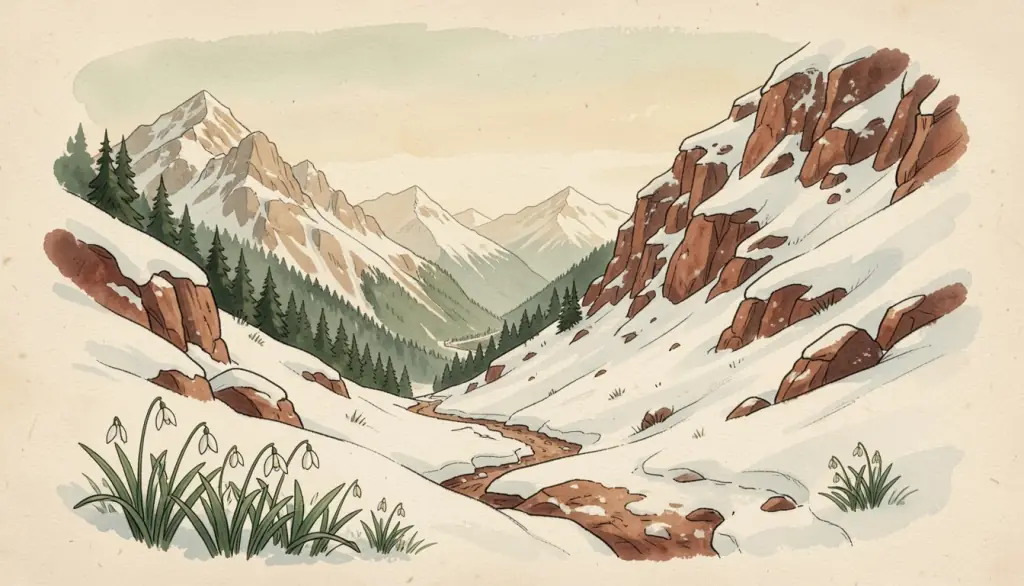
Taniquetil is Quenya for "High White Peak" (Silmarillion, RGEO, PE17). The mountain is the tallest in the world and is crowned with snow. Its Quenya epithet Oiolossë means "ever-snow-white", and that one really does contain the snow word lossë.
Aeglos is the spear of Gil-galad, as above. It is the strongest case of "snow" appearing in an Elvish name of a thing, because the word is transparent: aeg "point" plus loss "snow".
Hithaeglir is the Misty Mountains. The name is hith, mist (Silmarillion), plus aeglir, a plural of the same aeg, point, that sits in aeglos. So the Misty Mountains are "the peaks of mist", not "the snow peaks". The word aeglir means "peaks", and the snow is a modern guess.
Caradhras is the pass that the Fellowship tries in The Fellowship of the Ring, famous for its snow. Tolkien gives the name as Redhorn, not Snow Mountain. This is the clearest warning in the whole subject: the mountain is snowy, but the name is not about snow.
Niphredil is a pale flower in Lothlórien. Letters and the Etymologies describe it as a white flower like a snowdrop, and Eldamo reads the name as roughly "pale point". The word for snowdrop proper is Quenya nieninquë (Etymologies), "snowdrop". The name is a flower name that borrows the colour of snow.
Fanuilos is a name of Varda, "ever-white", from the notes on fain in the vocabulary. It is a title of a figure, and it is about whiteness, not snow itself.
The same caution applies to Helcaraxë, the ice-bridge of the First Age. It appears in the Silmarillion as the Grinding Ice, and it clearly belongs to the cold and ice family, but the breakdown of its parts is not something this guide will assert beyond what Tolkien's text says. If a list gives you a neat word-by-word split of it, check the source.
What Is Not Attested
Some of the phrases people most want do not exist in Tolkien's writing.
- "Merry Christmas." Christmas is not a feast in Middle-earth, and Tolkien wrote no Elvish word for it. Anything you find online is a fan reconstruction or a machine guess. Our guide to Elvish Christmas and Yule phrases goes through what can be said with attested words and what cannot.
- "Snowman," "snowflake" as an affectionate name, or "snow queen." There are attested words for snowflake (nixë, niquis), but no attested compound for any of these ideas. A name built from lossë is a modern coinage.
- "Let it snow," "winter is coming," "happy winter." These are sentences, and Tolkien wrote nothing close to them. You can say "winter" and "snow" as single words, and that is as far as the sources go.
- A single Elvish word for "blizzard," "snowstorm" or "ski." Not found in the word lists.
- Sindarin forms of hriz-, hrissë, niquis. These are Quenya only, as far as the record goes. There is no Sindarin verb "to snow" in the sources reviewed here.
If you need a phrase, a grammar guide will show you how the pieces fit, and the attested vocabulary above is the safe pool. Anything beyond it is Neo-Quenya or Neo-Sindarin, meaning a modern reconstruction by enthusiasts, and it should be labelled as such.
Gifts, Tattoos and Names
A few practical notes if you are choosing a word to keep.
Pick one attested word. Lossë (Quenya) and loss (Sindarin) are both safe. Hrívë for winter is the one backed by Tolkien's own calendar. A single word is a far stronger choice than an invented sentence.
Mind the diacritics. The acute accent on hrívë marks a long vowel, and the diaeresis on ë marks a pronounced final vowel. Dropping them gives a different spelling. Decide on one style and keep it the same everywhere.
Check the script. If you want it in Tengwar, the Elvish writing system, the spelling has to follow the sounds, not the Latin letters. The voiceless r in hrívë has its own Tengwar letter. Our reading and writing guide explains the basics, and the Tengwar name tool shows a word in the script.
Names for people and pets. Lossë and Loss are plain words, not names of any Tolkien character, so a name built on them is a modern choice. For ideas about meaning and what is attested, see Elvish names for pets and the list of Elvish baby names.
Say it plainly in a card. "Snow" and "Winter" as two words, with the Elvish beneath, is accurate and looks good. Avoid claiming it is a "traditional Elvish winter blessing". There is no such thing in the sources.
Winter in Elvish Thought: A Short Note
The Elvish idea of winter is not just a season of death. The sixfold year gives winter a neighbour on each side: quellë, the fading, before it, and coirë, the stirring, after it. The Eldarin names mark winter as a pause between ending and waking, not an end. That is a point about the words, and it follows from Appendix D.
The same pairing of cold and light shows in the names above. Taniquetil is both the highest and the whitest of mountains, and Varda's title Fanuilos puts "ever-white" next to the stars. If you are interested in how white, light and shadow fit together as a vocabulary, see Elvish words for light and dark, and for the mountains that carry the snow, see the Elvish word for mountain.
Quick Practice
Try these with the table in mind, and check the answers against the vocabulary above.
- Which word is "snow" in Sindarin, and which is "winter"?
- Is lossëa a noun or an adjective?
- Does Caradhras contain a snow word?
- What do Oiolossë and Aeglos have in common?
The answers are: loss and rhîw; an adjective ("snowy"); no, it is Redhorn; and both contain the root of loss, snow.
You can run your own phrases through the Elvish translator. It uses the same attested vocabulary, and it marks anything it has to reconstruct.
People Also Ask
What is the Elvish word for snow? Snow is lossë in Quenya and loss in Sindarin, both from the root GLOS. The forms are recorded in Eldamo. Quenya also has a verb, hriz-, "to snow", and a noun hrissë, "a fall of snow", from Parma Eldalamberon 17.
What is the Elvish word for winter? Winter is hrívë in Quenya, listed in Appendix D of The Lord of the Rings, and rhîw in Sindarin. Hrívë is one of the six seasons of the Elvish year, the loa.
How do you say ice or frost in Elvish? Sindarin heleg means ice, and Quenya helca means icy or ice-cold. Quenya nixë is frost or a snowflake, and niquis is a snowflake or a loose petal of a white flower. Sindarin ring and Quenya ringa mean cold.
How do you say Merry Christmas in Elvish? There is no attested Elvish phrase for Merry Christmas. Tolkien wrote no Elvish word for Christmas, and any ready-made phrase online is a fan reconstruction. Attested winter and festival words can be used if they are labelled honestly.
Does Caradhras mean snow mountain? No. Caradhras is Sindarin for Redhorn, and Tolkien names it that in The Lord of the Rings. The mountain is famous for its snow, but the name is about its colour. The Sindarin words for snow, loss and lossen, are not in it.
Related Reading
- Elvish Christmas and Yule: What Can Be Said
- Elvish Calendar: Days, Months and Seasons
- Elvish Words for Light and Dark
- Elvish Word for Mountain
- Elvish Word for Sea — Ëar in Quenya, Gaear in Sindarin
- Elvish Word for Water — Sindarin & Quenya
- Elvish Words for the Natural World
- Elvish Dictionary — Common Words in Quenya and Sindarin
Learn Elvish with Tengwar
Tengwar teaches Tolkien's Elvish — Quenya and Sindarin — through short lessons with an AI tutor (Mithrandir) that cites Tolkien sources for every answer. Plus Klingon and Dothraki on the same platform. Start free → — every lesson free on the web, no credit card required.
People Also Ask
What is the Elvish word for snow?
Snow is lossë in Quenya and loss in Sindarin, both from the root GLOS. The forms are recorded in Eldamo, the reference database of Tolkien's own word lists. Quenya also has a verb, hriz-, to snow, and a noun hrissë, a fall of snow, from Parma Eldalamberon 17.
What is the Elvish word for winter?
Winter is hrívë in Quenya, listed in Appendix D of The Lord of the Rings, and rhîw in Sindarin. Hrívë is one of the six seasons of the Elvish year, the loa.
How do you say ice or frost in Elvish?
Sindarin heleg means ice, and Quenya helca means icy or ice-cold. Quenya nixë is frost or a snowflake, and niquis is a snowflake or a loose petal of a white flower. Sindarin ring and Quenya ringa mean cold.
How do you say Merry Christmas in Elvish?
There is no attested Elvish phrase for Merry Christmas. Tolkien wrote no Elvish word for Christmas, and any ready-made phrase on the internet is a fan reconstruction. Attested winter and festival words can be used, as long as they are labelled honestly.
Does Caradhras mean snow mountain?
No. Caradhras is Sindarin for Redhorn, and Tolkien names it that in The Lord of the Rings. The mountain is famous for its snow, but the name is about its colour. The Sindarin words for snow, loss and lossen, are not in it.