Radagast the Brown Explained: Aiwendil, Rhosgobel and the Wizard of Beasts and Birds
Try It Yourself — Free Elvish Tools
Quick Answer: Radagast the Brown is one of the five Istari, the wizards the Valar sent to Middle-earth around Third Age 1000. In Valinor he was a Maia named Aiwendil, and he came at the request of Yavanna, the Vala who loves growing things. He lived at Rhosgobel near the borders of Mirkwood and was a master of shapes and hues and a friend of birds and beasts. In The Lord of the Rings Saruman uses him, without his knowledge, to lure Gandalf to Isengard, but his message to the birds brings the eagle that rescues Gandalf. The rabbit sledge and the Dol Guldur scenes of the Hobbit films are not in the books.
Radagast is the wizard everyone remembers and almost nobody can describe. He is a single name in The Hobbit, a few paragraphs of reported speech in The Lord of the Rings, and a handful of sentences in Tolkien's late notes. That is all the book text there is. Yet he matters more than his page count suggests, because the one thing he does in the main story turns out to save Gandalf's life, and because his quiet failure says something about the wizards' mission that the bigger figures do not.
This guide sets out what Tolkien actually wrote about Radagast, keeps the film and television material clearly apart, and explains his names. We have not filled the gaps with invention. Where Tolkien is silent, we say so.
Radagast is one member of a larger order. For the five wizards as a group, see our guide to the wizards of Middle-earth. This page is about the Brown Wizard himself.
Radagast the Brown at a Glance
| Name | Radagast the Brown |
| Valinorean name | Aiwendil (Quenya), from a late note in Unfinished Tales, "The Istari" |
| Kind | Maia, one of the Istari or Wizards |
| Patron Vala | Yavanna, who asked that he be sent (Unfinished Tales, "The Istari") |
| Arrived | About Third Age 1000 (The Lord of the Rings, Appendix B) |
| Home | Rhosgobel, near the borders of Mirkwood (The Lord of the Rings, "The Council of Elrond") |
| Known for | Lore of herbs and beasts; friendship with birds; mastery of "shapes and changes of hue" |
| Main role | Carries Saruman's message to Gandalf in 3018, and Gandalf's request for news back to the birds |
| Fate | Not recorded by Tolkien |
| First appearance | The Hobbit (1937), chapter 7, "Queer Lodgings", as a name only |
| Screen | Sylvester McCoy in Peter Jackson's Hobbit trilogy; absent from the Lord of the Rings films and, so far, The Rings of Power |
Radagast Timeline
"Mae govannen" — want to actually speak Elvish?
Try It Free →Tolkien gives very few dates for Radagast himself. The table below combines the few that touch him directly with the events around him that frame his story. Where Radagast is absent from an event, we say so.
| Date | Event | Source |
|---|---|---|
| Before the Third Age | Aiwendil is a Maia in Valinor, of Yavanna's following in the story of the council of the Valar | Unfinished Tales, "The Istari" |
| Council of the Valar (undated) | Yavanna asks Curumo (Saruman) to take Aiwendil with him to Middle-earth | Unfinished Tales, "The Istari" |
| c. Third Age 1000 | The Istari appear in Middle-earth | Appendix B |
| c. TA 1050 | A shadow falls on Greenwood the Great, which men begin to call Mirkwood | Appendix B |
| TA 2463 | The White Council is formed; Radagast is not named among its members | Appendix B; The Silmarillion, "Of the Rings of Power and the Third Age" |
| TA 2941 | Bilbo's journey; Gandalf mentions "my good cousin Radagast" to Beorn | The Hobbit, "Queer Lodgings" |
| TA 2941 | The White Council drives the Necromancer from Dol Guldur; Radagast is not mentioned | Appendix B |
| TA 3018, mid-year | Gandalf meets Radagast on the road and receives Saruman's message | Appendix B; "The Council of Elrond" |
| TA 3018, 10 July | Gandalf is imprisoned in Orthanc | Appendix B |
| TA 3018, 18 September | Gandalf escapes from Orthanc on Gwaihir, who came with news because of Radagast's request | Appendix B; "The Council of Elrond" |
| TA 3018, 25 October | At the Council of Elrond, Gandalf tells the story, the fullest account of Radagast in Tolkien | "The Council of Elrond" |
| After 3018 | Radagast does not reappear in the narrative; his end is never told | The Lord of the Rings; Unfinished Tales |
The gap in that table is the point. From his arrival to 3018, roughly two thousand years of Radagast's life pass without a single recorded deed. The only light on that long stretch comes from one sentence in Unfinished Tales, which we look at below.
Who Radagast Is
Radagast is not a man who learned magic. Like all the Istari, he is a Maia, one of the lesser Ainur, the spirits who entered the world at its making. Unfinished Tales explains that the Istari came in the shape of Men, clothed in bodies that could grow weary and feel fear, and that they were forbidden to dominate the free peoples or to match Sauron's power with power. Their task was to advise and encourage, not to rule.
Within that order, Tolkien gives each wizard a colour. Saruman is White, Gandalf is Grey, the two lesser-known wizards who went into the East are the Blue Wizards, and Radagast is Brown. Tolkien never explains the brown in so many words, but it fits everything else we are told: earth, bark, feathers, the colours of a creature that does not wish to be seen. Even his home, as we will see, carries a word for a reddish-brown colour.
The fullest description of him comes from Gandalf at the Council of Elrond, who calls him a worthy wizard, "a master of shapes and changes of hue", with much lore of herbs and beasts, and especially a friend of birds (The Lord of the Rings, "The Council of Elrond"). That is close to all we have. It is enough to give a clear picture of a wizard whose gifts face outward, to the living world, rather than toward the politics of kings.
Aiwendil in Valinor: Yavanna's Choice
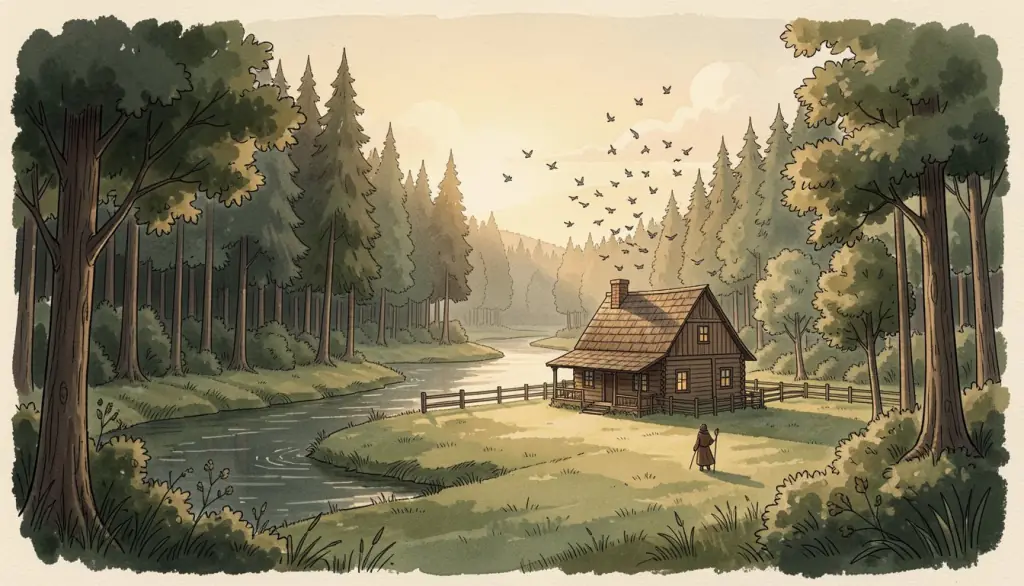
Radagast's story starts in a short, late note that Christopher Tolkien printed in Unfinished Tales, in the section called "The Istari". It describes a council of the Valar, called by Manwë, at which the question was who should go to Middle-earth.
According to that note, Curumo, later called Saruman, came forward from the people of Aulë, and Alatar from the people of Oromë. Olórin, later Gandalf, was sent at Manwë's bidding. Then Yavanna asked Curumo to take Aiwendil with him, and Curumo agreed. Alatar in turn took his friend Pallando. That is the whole of Aiwendil's entrance: he is not a volunteer in this account but a companion added at a Vala's request.
The note is brief and was never polished for publication, and Unfinished Tales presents it as one of several late writings on the wizards rather than a finished chapter. Its details should be held lightly. Still, two points in it shape everything we know about Radagast.
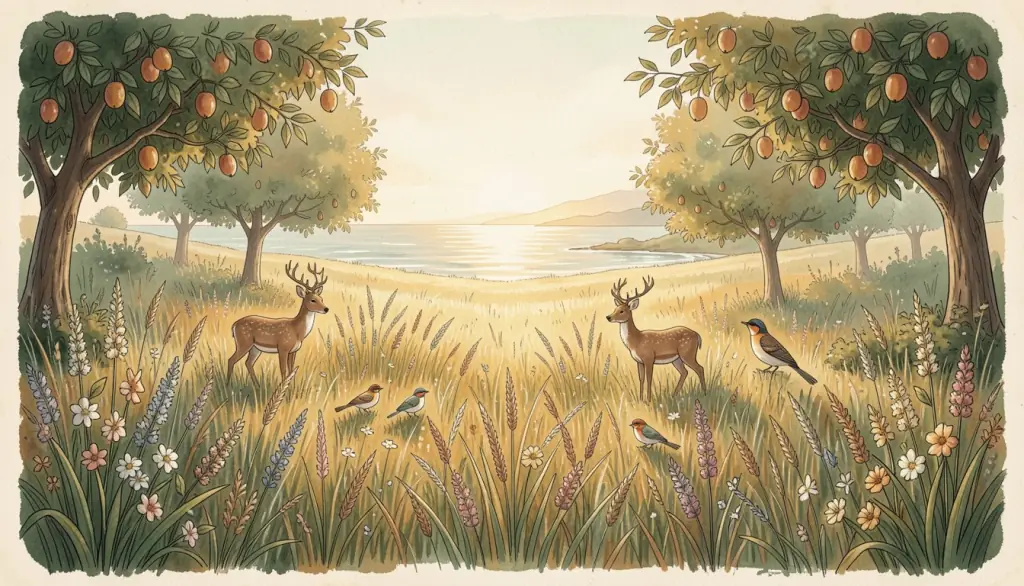
The first is Yavanna. She is the Vala of growing things, the Giver of Fruits, whose name appears in Yavannië, the Quenya name for the ninth month. In The Silmarillion she is the Vala who fears for the living world. In "Of Aulë and Yavanna" she worries that the Dwarves her husband made will cut her trees, and she asks Manwë what will protect the kelvar and the olvar, the creatures that move and the things that grow rooted in the earth. The answer to that prayer is the Ents, the shepherds of the trees. Radagast belongs to the same concern. If Yavanna had a hand in choosing him, it is easy to read him as her answer for the beasts and birds, a shepherd of creatures in the way the Ents are shepherds of trees. Tolkien does not spell that out, and we offer it as a reading, not a fact, but the parallel is close.
The second is Saruman. The note ties Radagast's coming to Saruman's agreement. Saruman's later scorn for him reads differently in that light: the head of the order was asked to bring along a nature-loving companion he had not chosen. Whether Tolkien meant that as the root of the contempt we cannot say for certain, because he never wrote it out. But it fits the man who, two thousand years later, calls Radagast a fool to Gandalf's face.
Arrival in Middle-earth
Appendix B of The Lord of the Rings says that around the year 1000 of the Third Age the Istari, or Wizards, appeared in Middle-earth, and that they came out of the West. Few in Middle-earth knew what they were. Círdan of the Havens knew more than most, but to Men they were simply old men of great knowledge.
The Silmarillion, in "Of the Rings of Power and the Third Age", names three of them in the order of their coming: Curunír the eldest came first, "and after him came Mithrandir and Radagast", and others who went into the East. That is the only place in The Silmarillion where Radagast appears. It places him third in the main tradition, with Gandalf, and before the wizards who left the western lands behind.
Some fifty years later, Appendix B records that a shadow fell on Greenwood the Great and the forest began to be called Mirkwood. Radagast's home lay on the borders of that same forest. He spent the Third Age, in other words, as a neighbour of the darkness that would turn out to be Sauron himself, hidden in Dol Guldur. We are never told what he saw or did there. The Hobbit films fill that silence with a whole subplot; the books leave it empty.
Rhosgobel: The Brown Wizard's Home
The name of Radagast's home is given only once in The Lord of the Rings. At the Council of Elrond Gandalf says Radagast dwelt at Rhosgobel, near the borders of Mirkwood. The Hobbit puts him near the southern borders of the forest. Neither book describes the place. Later maps and readers usually set it on the western eaves of the forest, near the Vales of Anduin, but the texts themselves only say "borders".
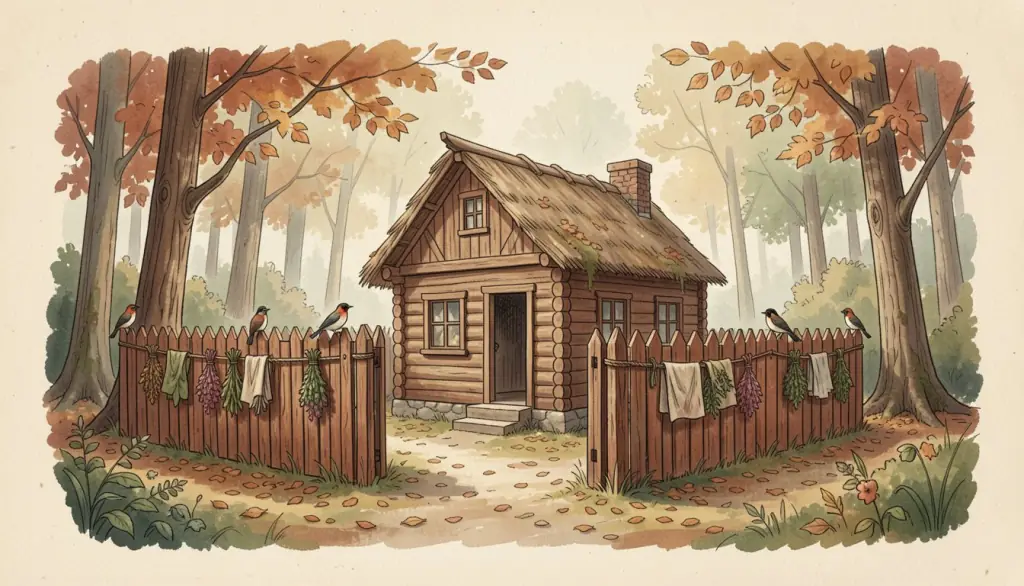
The name is Sindarin, and its two parts are both recorded in Tolkien's word lists:
- rhosc, "russet", a reddish-brown colour;
- gobel, "village, town", in the old sense of an enclosure or walled dwelling.
So Rhosgobel is roughly "the russet enclosure" or "brown town". It is the only place in Tolkien whose name carries the colour of the wizard who lives in it. A house fenced against the wild, built where the forest meets the river valley, named for a brown that is also the colour of its master: it is a small piece of naming that tells you more about Radagast than most of the narrative does.
We should be careful not to go further. There is no description of Rhosgobel's buildings, no account of who else lived there, and no record of what became of it. Anything more detailed you read online, including the cottage in the films, is invention.
Radagast in The Hobbit: Gandalf's Good Cousin
The first time Tolkien wrote Radagast's name, he was not yet a member of any order of wizards. He was a single line in The Hobbit, published in 1937.
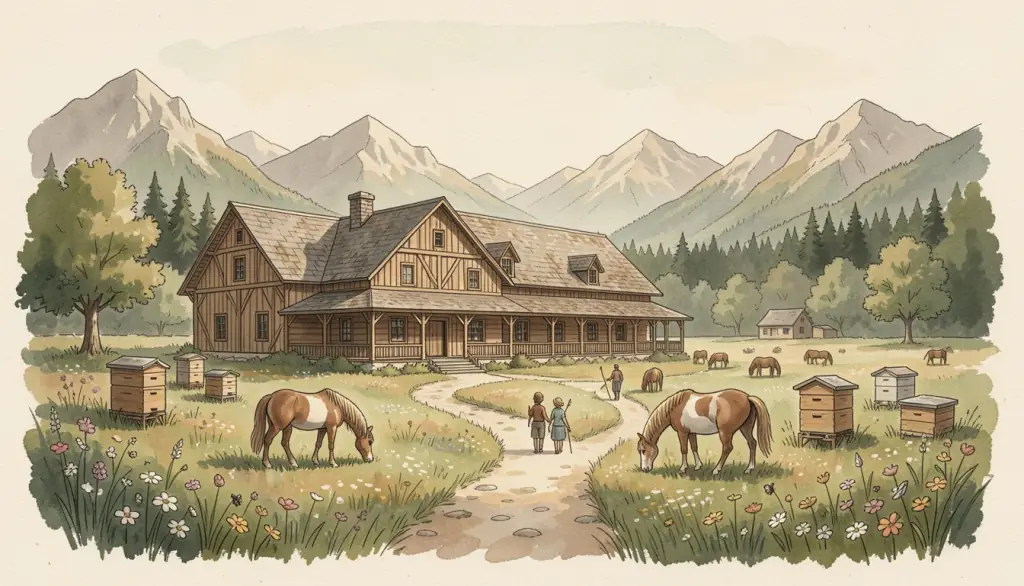
In chapter 7, "Queer Lodgings", Gandalf is trying to win the trust of Beorn, the skin-changer, who distrusts visitors. Gandalf introduces himself and then reaches for a reference: he asks whether Beorn has heard of "my good cousin Radagast", who lives near the southern borders of Mirkwood. Beorn has. He answers that Radagast is "not a bad fellow as wizards go" and that he used to see him now and again.
That is the whole of Radagast in The Hobbit. He does not appear, speak or act. He does not go to Dol Guldur. He is not at the Battle of Five Armies. He is a name that opens a door.
Three things about that short exchange are worth noticing.
He is known to Beorn. Of all the people Gandalf might name, he chooses the one wizard a solitary friend of animals would trust. Beorn keeps horses, dogs, sheep and bees as companions, and Radagast is the wizard of beasts. The reference works because the two are alike.
He is Gandalf's "cousin". In 1937 there were no Istari, no Maiar and no Valinor in the published story, and "cousin" reads as an ordinary word for a kinsman of the same trade. Once Tolkien later made both wizards Maiar sent together from the West, the word gained a deeper sense: they really are kin, spirits of the same order. Tolkien did not go back and change the line, and it fits the later picture surprisingly well.
He is "not a bad fellow as wizards go". Beorn's tone is the faint praise of a neighbour, and it sets the pattern for how Radagast will be seen ever after: likeable, harmless, a little odd, and not quite one of the great.
3018: The Messenger on the Road
Radagast's only active part in the main story comes in the summer of the year the Ring left the Shire. Appendix B records it in a single line: in the middle of 3018, Gandalf meets Radagast. The details come from Gandalf himself, months later, at the Council of Elrond.
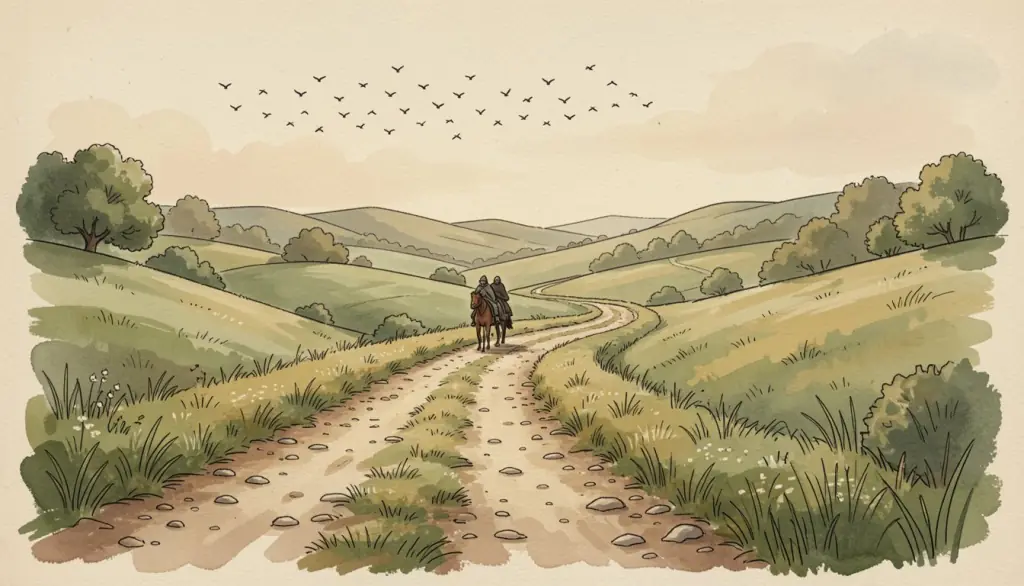
Gandalf was travelling in the west, anxious about the Shire and about rumours of war in the south, when he met Radagast on the road. Radagast was in a hurry and had news. He told Gandalf that the Nine were abroad again: they had crossed the River secretly and were moving westward, disguised as riders in black.
Radagast also brought a message from Saruman. As Gandalf reports it, Saruman wished to see him, said he would help if Gandalf felt the need, but urged him to come to Isengard at once. To Radagast this was simply a message from the head of their order to a colleague in trouble. To Saruman it was bait.
Gandalf did two things. He decided to go to Isengard, which nearly cost him everything. And he asked Radagast to send word to all the beasts and birds that were his friends, asking them to bring any news that bore on the matter to Saruman and to him at Orthanc. Radagast agreed and rode away toward Mirkwood. Gandalf never saw him again in the story.
It is worth stressing how ordinary this scene is. There is no magic in it, no confrontation, no grand speech. Radagast is useful here for the same reason he is overlooked everywhere else: he is honest, he knows the wild creatures, and he does what he is asked. Gandalf at the Council is clear that Radagast acted in good faith. There was no treachery in him.
Orthanc and the Eagle: How Radagast Saved Gandalf
The trap closed at Isengard. Saruman revealed that he wanted the Ring, Gandalf refused to join him, and Gandalf was imprisoned on the pinnacle of Orthanc on 10 July 3018 (Appendix B).
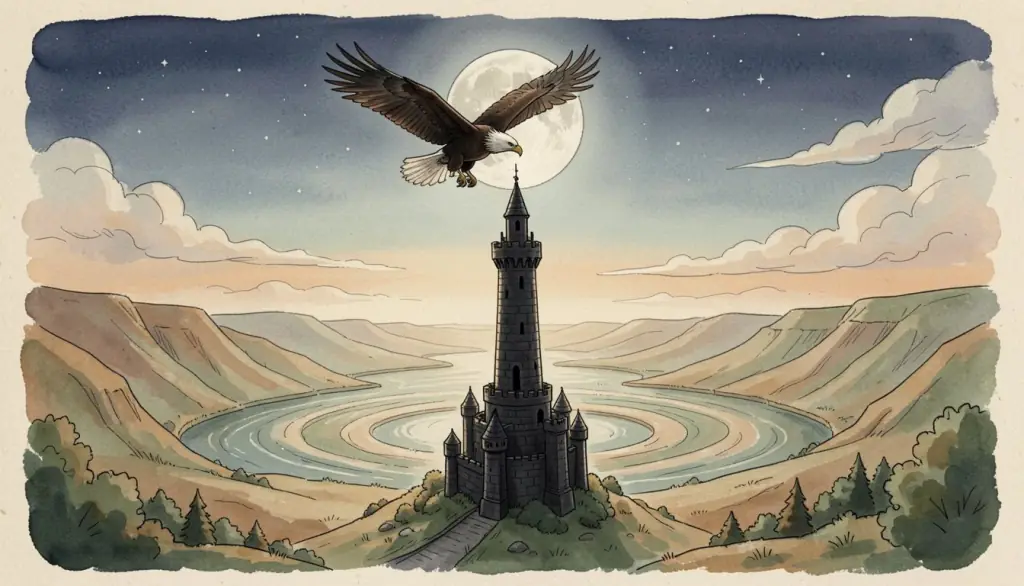
In Gandalf's account, Saruman also gloated about how he had brought Gandalf there. He mocked the messenger he had used: "Radagast the Bird-tamer! Radagast the Simple! Radagast the Fool!" In Saruman's mouth the point is that Radagast had just wit enough to carry the bait without suspecting it.
Then the plan undid itself. Radagast had done exactly what Gandalf asked. The birds and beasts carried news. Gwaihir the Windlord, the swiftest of the Great Eagles, came to Orthanc bearing news of wolves and Orcs gathering, and found Gandalf on the tower top. Gandalf asked to be carried away, and Gwaihir bore him off. Appendix B dates the escape to the early hours of 18 September 3018. The story of the eagles themselves is told in our guide to the Great Eagles of Middle-earth.
This is the one real event in Radagast's book career, and it is beautifully built. Saruman used Radagast because he thought him simple. The same simplicity, an honest wizard passing on an honest request to creatures who trusted him, is what brought the eagle. Saruman counted on Radagast being harmless. He did not count on Radagast being faithful. The thing Saruman despised in him is the thing that defeated him.
There is a further irony that Tolkien leaves unstated. Gandalf asked for the news to be sent to Orthanc because he expected to be there as Saruman's guest. It reached him there as Saruman's prisoner, and the messenger was strong enough to carry him away.
Did Radagast Fail?
The answer Tolkien gives is yes, but it is a gentle yes.
In the essay on the Istari printed in Unfinished Tales, Tolkien says that Radagast "became enamoured of the many beasts and birds" of Middle-earth, forsook Elves and Men, and spent his days among the wild creatures. In the same passage he says that of all the Istari only one remained faithful, meaning Gandalf. Radagast's failure, in other words, is set beside Saruman's and the Blue Wizards' as a falling short of the mission.
But look at what kind of failure it is. Saruman fell through pride and the desire for power; he ends as a petty tyrant in the Shire. Radagast fell, if that is the word, through love. He was sent to help Elves and Men against Sauron, and he gave his attention instead to the creatures he had been chosen to care about. If Yavanna asked for him, it is hard to say he betrayed her purpose, even if he neglected Manwë's.
There are two ways to read that, and the text supports both.
The strict reading. The Istari had one task: to rouse the free peoples against Sauron. Radagast's absence from the White Council, from Dol Guldur and from the War of the Ring shows that he did not do it. A wizard who disappears into the woods for two thousand years, while the shadow grows in the forest next door, has failed, however kind his reasons.
The generous reading. Radagast's love of the living world is itself part of what the free peoples were fighting for. Gandalf, Tolkien's model of faithfulness, still trusted him at the crisis, and his one act in the story was decisive. Perhaps he failed the mission and served the world anyway.
We come back to this in Our Take. What matters here is that Tolkien does not paint Radagast as a villain or even as a fool. Only Saruman calls him a fool, and Saruman is the one wizard in the story whose judgement is worthless by the end.
Radagast and the Other Wizards
Radagast is defined in large part by contrast with the other Istari. Their stories are told in their own guides; here we only set out how each relates to him.
| Figure | Relationship to Radagast | Source |
|---|---|---|
| Yavanna | The Vala who asked that Aiwendil be sent | Unfinished Tales, "The Istari" |
| Saruman (Curumo, Curunír) | Took him to Middle-earth at Yavanna's request; later uses and mocks him | Unfinished Tales; "The Council of Elrond" |
| Gandalf (Olórin, Mithrandir) | Calls him "cousin"; trusts him and asks his help in 3018 | The Hobbit, "Queer Lodgings"; "The Council of Elrond" |
| The Blue Wizards (Alatar, Pallando) | Fellow Istari who went into the East | Unfinished Tales, "The Istari" |
| Beorn | Knows him and used to see him now and again | The Hobbit, "Queer Lodgings" |
| Gwaihir the Windlord | Brings news to Orthanc because of Radagast's request | "The Council of Elrond" |
Saruman is his opposite. Saruman studied the Rings and the arts of the Enemy, made a fortress and an army, and came to want power over everything. Radagast studied herbs, shapes and colours, and made a home in a fenced clearing. Saruman's colour broke into many; Radagast's stayed the colour of earth. See our guides to Saruman and to Saruman's Isengard and its languages.
Gandalf is the friend. Gandalf moves between peoples, Elves, Dwarves, Hobbits and Men, as Radagast moves among creatures. Both are wanderers, both are humble, and neither wants to rule. The difference is focus: Gandalf never forgot the task. Our guides to Gandalf and to his Elvish name Mithrandir cover his side.
The Blue Wizards share Radagast's mystery. Like him, they vanish from the main history; unlike him, they leave not even a single deed in the published story. Tolkien's changing ideas about them are set out in our guide to the Blue Wizards, Alatar and Pallando.
The Names: Radagast, Aiwendil and Rhosgobel
Radagast's names come from three different languages, which is a small lesson in how Tolkien layered his world.
| Name | Language | Meaning | Source |
|---|---|---|---|
| Radagast | Mannish (Vales of Anduin) | said to mean "tender of beasts" | Tolkien's late note in Parma Eldalamberon 17 |
| Aiwendil | Quenya | bird-friend, from aiwë + -ndil | Unfinished Tales, "The Istari" |
| Rhosgobel | Sindarin | russet enclosure, from rhosc + gobel | "The Council of Elrond"; Tolkien's word lists |
| Istar, pl. Istari | Quenya | wizard, wise one | The Lord of the Rings; Unfinished Tales |
| Ithron, pl. Ithryn | Sindarin | wizard | Unfinished Tales |
Radagast
Radagast is not an Elvish name. Tolkien did not explain it in any book he published, and The Lord of the Rings treats it as simply the name he was known by. In a late private note on names in The Lord of the Rings, published long after his death in the journal Parma Eldalamberon (issue 17, 2007), Tolkien said the name came from the language of the Men of the Vales of Anduin, and that it was said to mean "tender of beasts", though the meaning was no longer clear.
That is a modest and rather fitting origin. The people who knew Radagast best were not Elves but the Men of the river valleys near his home, and the name they gave him describes what he did. Because the note is late and was never prepared for publication, we treat it as Tolkien's private explanation rather than settled canon, but it is the only explanation he gave.
Aiwendil
Aiwendil is Quenya, the language of Valinor, which is where the name belongs: it is what the Maia was called before he came over the Sea. It has two parts:
- aiwë, "(small) bird";
- -ndil, an ending that The Silmarillion's appendix of name elements explains as "devoted to" or "friend of", found in names like Elendil and Mardil.
So Aiwendil is naturally read as "bird-friend" or "lover of birds". That is a remarkable thing: his Valinorean name already describes the wizard Gandalf meets on the road in 3018. Radagast did not become a friend of birds in Middle-earth. He was one before he arrived. The love that Unfinished Tales counts as his failure was, by his own name, his nature from the start.
Wizards in Quenya and Sindarin
The order Radagast belonged to is called Istari in Quenya, singular Istar, a word connected with ista-, "to know": the wise ones. In Sindarin they are the Ithryn, singular Ithron (Unfinished Tales). Tolkien gives no Sindarin personal name for Radagast in the published texts, unlike Gandalf's Mithrandir or Saruman's Curunír. The Elves of Middle-earth, it seems, never gave the Brown Wizard a name of their own, which fits a wizard who spent so little time among them.
Radagast in the Books vs the Films vs The Rings of Power
Most people know Radagast from the screen, and the screen Radagast is very different from Tolkien's. Here is what each version contains.
Peter Jackson's Hobbit Films
Sylvester McCoy plays Radagast in An Unexpected Journey (2012), The Desolation of Smaug (2013) and The Battle of the Five Armies (2014). The films turn a one-line mention into a supporting role. These elements are inventions of the films, not Tolkien:
- The sledge pulled by rabbits. The "Rhosgobel rabbits" and the chase in which Radagast draws the wargs away from the Dwarves are film-only.
- Sebastian the hedgehog. Radagast's healing of a sick hedgehog, and the whole idea of the forest's creatures falling ill, are invented.
- The house and its appearance. The cluttered cottage, the bird's nest under his hat and the dishevelled, eccentric manner are film designs.
- Dol Guldur. In the films Radagast is the first to enter Dol Guldur, confronts the Necromancer and brings Gandalf a Morgul blade as proof. In the books, Radagast has no recorded connection with Dol Guldur at all; it is Gandalf who enters it, long before Bilbo's journey, and the White Council that drives the Necromancer out in 2941 (Appendix B).
- The later battles. His arrival with the eagles and Beorn at the Battle of Five Armies is also film-only. In the book he is never at the battle.
These additions are not random. They give a role to a named wizard the films had available, they dramatise the Necromancer story that the book of The Hobbit keeps offstage, and they make Radagast a living example of the forest sickening under Sauron. In that sense they enlarge a real theme of the books, the corruption of Greenwood into Mirkwood, which we describe in our guide to Mirkwood and the Woodland Realm. But they are not Tolkien's Radagast, and they change his tone: the films play him for comedy, while the books play him quietly and with respect.
Peter Jackson's Lord of the Rings Films
Radagast does not appear in The Fellowship of the Ring (2001) or its sequels. The films drop the meeting on the road, and Gandalf goes to Isengard of his own accord. Gandalf's escape from Orthanc is rewritten: he whispers to a moth, which brings Gwaihir. In the book, the eagle comes because Radagast passed on Gandalf's request to the birds and beasts. The moth scene is effective cinema, but it removes the one place where Radagast changes the course of the story.
The Rings of Power
The Rings of Power is set in the Second Age, a thousand years and more before Tolkien says the Istari arrived. The show has nonetheless brought a wizard in early: the Stranger, revealed in Season 2 as Gandalf, as covered in our guide to the Stranger in The Rings of Power. Season 2 also introduced a hostile figure called the Dark Wizard, a character created for the show and not identified with any of Tolkien's Istari.
Radagast himself did not appear in Seasons 1 or 2. Season 3 premiered on Prime Video on 11 November 2026, and our Season 3 Elvish preview follows what has been confirmed. As of mid-November 2026, while the season was airing, we found no confirmed casting or appearance for Radagast. Claims online that he is coming to the show are speculation until the series shows otherwise.
How Tolkien Built Radagast
Radagast is a good example of how Tolkien's world grew backwards from passing details.
1937: a name for Beorn. In The Hobbit Radagast is a throwaway reference, a "good cousin" Gandalf names to win a stranger's trust. There is no sign that Tolkien had any larger plan for him. Gandalf himself, in that book, is a wandering wizard with no stated origin.
1954: a member of an order. When Tolkien wrote The Lord of the Rings he needed a way to get Gandalf to Isengard and to get him out again. Radagast was available, already established as a friend of animals, and Tolkien gave him exactly the role his earlier description suggested: messenger to Gandalf, and friend of the birds who bring the eagle. At the same time the wizards became a group with a head, Saruman, and a hierarchy of colours. A passing name became a member of the Istari.
After 1954: a Maia with a patron. In the notes and essays later printed in Unfinished Tales, Tolkien worked out who the wizards really were: Maiar sent by the Valar, each with a Valinorean name, some with a sponsoring Vala. Radagast acquired Aiwendil and Yavanna, and his long absence from history acquired an explanation, his absorption in the creatures of the world. In the late name note in Parma Eldalamberon 17, Tolkien went back once more and gave Radagast a Mannish origin.
At each stage Tolkien kept faith with what he had already written. The "good cousin" of 1937 is still recognisable in the bird-friend of the late notes. That is typical of how Tolkien worked: he rarely invented a character from nothing when he could instead ask what a name he had already used really meant.
It also explains why Radagast stays thin on the page. He was never the subject of a story of his own. He was always a function in someone else's: Beorn's trust, Gandalf's journey, Saruman's trap. The later notes deepened him without giving him adventures, and Tolkien never wrote his end.
Why Radagast Matters
For a character with so few lines, Radagast does a surprising amount of work in Tolkien's design.
He shows the range of the Istari. Without Radagast, the wizards would be a simple pair: the good one who stays true, the proud one who falls. Radagast adds a third possibility, the wizard who does no harm but drifts from the task. With the Blue Wizards, he makes clear that the mission was hard, and that faithfulness like Gandalf's was rare, not the default.
He carries Yavanna's concern into the Third Age. The Valar who appear most in The Lord of the Rings are Elbereth, invoked by Elves and hobbits, and the unseen powers behind Gandalf. Through Radagast, and through the Ents, Yavanna's care for living things has agents in Middle-earth too. The War of the Ring is not only about kings and rings. Saruman's ruin of the trees of Fangorn and the scouring of the Shire show that the living world is part of what is at stake.
He makes Saruman's fall visible. Saruman's contempt for Radagast is one of the clearest early signs of what Saruman has become. A wise man who sees only weakness in kindness has already stopped being wise. And the rescue that follows proves him wrong in the most practical way possible.
He reminds us that small deeds matter. This is the theme of the whole book, and Radagast is a small instance of it. An honest message passed to a few birds changes the outcome of the war: if Gandalf had stayed on Orthanc, there would have been no guide through Moria and no return as the White Rider. Radagast never knew it, and the story barely notices it, which is exactly how Tolkien likes such things to happen.
Our Take
Our view, stated plainly: Radagast is not a failed wizard who happens to be useful once. He is the proof that Saruman's way of seeing the world is wrong, and Tolkien built him to be underestimated by readers as well as by Saruman.
Consider how the evidence is arranged. Every judgement of Radagast in the main story comes from someone else. Beorn finds him "not a bad fellow as wizards go". Saruman calls him simple and a fool. Gandalf, more fairly, calls him worthy and praises his lore. The Unfinished Tales essay calls him a friend of beasts who forsook Elves and Men. Readers tend to settle somewhere between Beorn and Saruman: a pleasant eccentric, a minor wizard, the comic one. The Hobbit films took that impression and ran with it.
But the one thing Radagast actually does is the most consequential act of any wizard in the summer of 3018. Gandalf, the wisest of them, walks into Saruman's trap. Saruman, the most powerful, sets it. Radagast, the least regarded, is the reason it fails. Tolkien does not underline this. He lets Gandalf tell it in passing at a long council, among a dozen other pieces of news, so that a reader can easily miss it. We think that is deliberate. The story enacts its own point: the people who look least important are often the ones on whom everything turns, and the powerful are the last to notice.
We would also push back on the idea that Radagast's absorption in creatures is simply a failure. The Unfinished Tales essay does present it that way, and we should not pretend otherwise. But the same notes say Yavanna asked for him, and his own Valinorean name means bird-friend. Tolkien seems to have imagined a wizard who was always going to love the world more than the war. If that is failure, it is failure of a kind that Tolkien, a man who mourned every felled tree, plainly had sympathy for. The honest summary is that Radagast fell short of Manwë's mission and remained true to Yavanna's heart, and that the second loyalty is what saved Gandalf in the end.
Finally, a plea for restraint. Because Tolkien wrote so little, Radagast attracts invention: fan theories about his fate, elaborate histories of Rhosgobel, film material treated as canon. The richer and more honest approach is to accept the silence. Radagast is a wizard who stepped out of history into the woods, and the books respect that by letting him go. We think readers should too.
People Also Ask
Who is Radagast the Brown?
Radagast the Brown is one of the five Istari, the wizards sent to Middle-earth by the Valar around Third Age 1000 to help the free peoples resist Sauron. He was a Maia whose name in Valinor was Aiwendil, chosen at the request of Yavanna. He lived at Rhosgobel near the borders of Mirkwood and was a friend of beasts and birds.
What is Radagast's real name?
In Valinor, before he came to Middle-earth, he was called Aiwendil. The name appears in a late note by Tolkien printed in Unfinished Tales, in "The Istari". It is Quenya, built from aiwë, a small bird, and the ending -ndil, devoted to or friend of.
What does the name Radagast mean?
Tolkien did not explain it in any book published in his lifetime. In a late private note, later printed in Parma Eldalamberon 17, he said the name came from the speech of the Men of the Vales of Anduin and was said to mean "tender of beasts", though its sense was no longer clear.
Where does Radagast live?
At Rhosgobel, near the borders of Mirkwood. The Lord of the Rings names Rhosgobel at the Council of Elrond, and The Hobbit places Radagast near the southern borders of the forest. The name is Sindarin, from rhosc "russet" and gobel "village, town, enclosure".
Is Radagast in The Lord of the Rings?
He is named and plays a part, but only in Gandalf's report at the Council of Elrond. He never appears directly on the page. He does not appear at all in Peter Jackson's Lord of the Rings films, where Gandalf escapes Orthanc after speaking to a moth.
Is Radagast in The Hobbit book?
Only as a name. In "Queer Lodgings" Gandalf calls him "my good cousin Radagast" while introducing himself to Beorn, and Beorn replies that he used to see him now and again. Radagast takes no part in the story of the book.
Did Radagast betray Gandalf?
No. Saruman used him to carry a message that lured Gandalf to Isengard, but Radagast did not know it was a trap. Gandalf trusted him, and it was Radagast's honest relaying of Gandalf's request for news that brought Gwaihir the eagle to Orthanc to rescue him.
Did Radagast fail his mission?
Unfinished Tales says that he did, in a gentle sense. He became so absorbed in the beasts and birds of Middle-earth that he forsook Elves and Men. Only Gandalf, the same text says, stayed fully faithful to the mission. Tolkien never records Radagast's end.
Does Radagast ride a sledge pulled by rabbits in the books?
No. The rabbit-drawn sledge, the hedgehog Sebastian, his visit to Dol Guldur and the Morgul blade he finds there are all inventions of Peter Jackson's Hobbit films, where Sylvester McCoy played him. None of these appear in Tolkien's writing.
Is Radagast in The Rings of Power?
Not so far. He did not appear in Seasons 1 or 2, and we found no confirmed casting or appearance for Season 3 as of mid-November 2026, while the season was airing. The wizard the show did introduce is the Stranger, revealed as Gandalf.
Learn the Languages Behind the Names
Aiwendil is Quenya, Rhosgobel is Sindarin, and the order Radagast belonged to has a name in both: Istari and Ithryn. To learn the two Elvish languages these names come from, start with our free Elvish course, which teaches Quenya and Sindarin using words Tolkien actually wrote.
Related Reading
- Characters of Middle-earth: Who's Who in Tolkien's World
- Wizards of Middle-earth: The Five Istari Explained
- Gandalf Explained
- Saruman Explained
- The Blue Wizards: Alatar and Pallando
- Mithrandir: What Gandalf's Elvish Name Means
- Saruman, Isengard and the Languages of the White Hand
- Great Eagles of Middle-earth
- Mirkwood and the Woodland Realm
- Ents and Huorns: The Shepherds of the Trees
- The Stranger Is Gandalf: The Rings of Power's Wizard Explained
People Also Ask
Who is Radagast the Brown?
Radagast the Brown is one of the five Istari, the wizards sent to Middle-earth by the Valar around Third Age 1000 to help the free peoples resist Sauron. He was a Maia whose name in Valinor was Aiwendil, chosen at the request of Yavanna. He lived at Rhosgobel near the borders of Mirkwood and was a friend of beasts and birds.
What is Radagast's real name?
In Valinor, before he came to Middle-earth, he was called Aiwendil. The name appears in a late note by Tolkien printed in Unfinished Tales, in the part titled "The Istari". It is Quenya, built from aiwë, a small bird, and the name ending -ndil, devoted to or friend of.
What does the name Radagast mean?
Tolkien did not explain it in any book published in his lifetime. In a late private note, later printed in Parma Eldalamberon 17, he said the name came from the speech of the Men of the Vales of Anduin and was said to mean "tender of beasts", though its sense was no longer clear.
Where does Radagast live?
At Rhosgobel, near the borders of Mirkwood. The Lord of the Rings names Rhosgobel at the Council of Elrond, and The Hobbit places Radagast near the southern borders of the forest. The name is Sindarin, from rhosc "russet" and gobel "village, town, enclosure".
Is Radagast in The Lord of the Rings?
He is named and plays a part, but only in Gandalf's report at the Council of Elrond. He never appears directly on the page. He does not appear at all in Peter Jackson's Lord of the Rings films, where Gandalf escapes Orthanc after speaking to a moth.
Is Radagast in The Hobbit book?
Only as a name. In the chapter "Queer Lodgings" Gandalf calls him "my good cousin Radagast" while introducing himself to Beorn, and Beorn replies that he used to see him now and again. Radagast takes no part in the story of the book.
Did Radagast betray Gandalf?
No. Saruman used him to carry a message that lured Gandalf to Isengard, but Radagast did not know it was a trap. Gandalf trusted him, and it was Radagast's honest relaying of Gandalf's request for news that brought Gwaihir the eagle to Orthanc to rescue him.
Did Radagast fail his mission?
Unfinished Tales says that he did, in a gentle sense. He became so absorbed in the beasts and birds of Middle-earth that he forsook Elves and Men. Only Gandalf, the same text says, stayed fully faithful to the mission. Tolkien never records Radagast's end.
Does Radagast ride a sledge pulled by rabbits in the books?
No. The rabbit-drawn sledge, the hedgehog Sebastian, his visit to Dol Guldur and the Morgul blade he finds there are all inventions of Peter Jackson's Hobbit films, where Sylvester McCoy played him. None of these appear in Tolkien's writing.
Is Radagast in The Rings of Power?
Not so far. He did not appear in Seasons 1 or 2, and we found no confirmed casting or appearance for Season 3 as of mid-November 2026, while the season was airing. The wizard the show did introduce is the Stranger, revealed as Gandalf.
Related Tags
Learn Elvish Free
39 free Elvish lessons, an AI tutor, and spaced repetition review — no credit card required.
Start Learning Free