Denethor Explained: The Last Ruling Steward of Gondor, the Palantír and the Pyre
Try It Yourself — Free Elvish Tools
Quick Answer: Denethor II is the Ruling Steward of Gondor during the War of the Ring. Born in Third Age 2930, he became Steward in 2984, outshone in his youth by a stranger named Thorongil who was really Aragorn. Proud, learned and far-sighted, he secretly used the palantír of Minas Anor and wrestled with Sauron's will through it. Grief for his wife and his son Boromir, and the despair Sauron fed him through the Stone, broke him during the siege of Minas Tirith. On 15 March 3019 he burned himself on a pyre in the House of the Stewards, nearly taking his son Faramir with him.
Denethor is the most misread figure in The Lord of the Rings. Millions of people know him as the Steward who eats noisily while his son rides to die and who refuses to light the beacons. That man is a film creation. The Denethor of the books is a learned, kingly ruler who held Gondor together for thirty-five years, saw further than anyone around him and broke under a weight nobody else in the city could even see.
This guide sets out what Tolkien wrote about him, mainly in The Return of the King and in Appendix A's section on the Stewards. It keeps the film material in its own section, keeps the seeing-stone lore brief, and ends with our own argument about why Denethor is one of Tolkien's sharpest portraits of power. For the full cast of the period, start with Characters of Middle-earth; for his people, see Men of Middle-earth.
Denethor at a Glance
| People | Man of Gondor, of Númenórean descent; House of Húrin, the line of the Stewards (Appendix A) |
| Office | Ruling Steward of Gondor, the twenty-sixth and last |
| Father | Ecthelion II, Steward from Third Age 2953 to 2984 |
| Wife | Finduilas, daughter of Adrahil, Prince of Dol Amroth; married 2976, died 2988 (Appendix B) |
| Sons | Boromir (born 2978) and Faramir (born 2983) |
| Born | Third Age 2930 (Appendix B) |
| Became Steward | 2984, on the death of Ecthelion II |
| Died | 15 March 3019, in the House of the Stewards, Rath Dínen (The Return of the King, book V, ch. 7) |
| Age at death | About eighty-eight |
| Seat | The White Tower of Minas Tirith; the plain black chair below the empty throne |
| Seeing-stone | The palantír of Minas Anor, kept in the White Tower |
| First appearance in person | The Return of the King, book V, ch. 1, "Minas Tirith" |
| Film actor | John Noble (The Lord of the Rings: The Return of the King, 2003; briefly in the extended The Two Towers) |
| Rings of Power | Not in the show; he belongs to the end of the Third Age |
Denethor Timeline
"Mae govannen" — want to actually speak Elvish?
Try It Free →Dates come from Appendix B of The Lord of the Rings, except where Appendix A or a chapter is named. Appendix A does not date Thorongil's service exactly, and neither do we.
| Age and year | Event |
|---|---|
| Third Age 2050 | King Eärnur is lost in Minas Morgul; Mardil Voronwë becomes the first Ruling Steward (Appendix A) |
| Third Age 2930 | Birth of Denethor, son of Ecthelion |
| Third Age 2931 | Birth of Aragorn, son of Arathorn |
| Third Age 2953 | Ecthelion II becomes Steward (Appendix A, list of Stewards) |
| Within 2957 to 2980 | As Thorongil, Aragorn serves Ecthelion II, burns the Corsair fleet at Umbar and leaves Gondor's service (Appendix A) |
| Third Age 2976 | Denethor weds Finduilas of Dol Amroth |
| Third Age 2978 | Birth of Boromir |
| Third Age 2983 | Birth of Faramir |
| Third Age 2984 | Death of Ecthelion II; Denethor II becomes Steward |
| Third Age 2988 | Finduilas dies young |
| 3018, 20 June | Sauron attacks Osgiliath; Boromir and Faramir defend it |
| 3018, 4 July | Boromir leaves Minas Tirith for Rivendell |
| 3019, 26 February | Death of Boromir at Parth Galen; his horn is heard in Minas Tirith |
| 3019, 9 March | Gandalf reaches Minas Tirith with Pippin; Pippin swears fealty to Denethor |
| 3019, 10 March | The Dawnless Day; Faramir returns from Ithilien and is rescued by Gandalf on the Pelennor |
| 3019, 15 March | The Battle of the Pelennor Fields; Denethor burns himself on his pyre |
| 3019, 1 May | Coronation of King Elessar; Faramir confirmed as Steward and made Prince of Ithilien |
Who Denethor Is
Denethor is the ruler of Gondor in everything but name. The last king, Eärnur, rode into Minas Morgul in 2050 and never came back, and since then the realm had been governed by Stewards of the House of Húrin, who ruled "until the King shall return" (Appendix A). By Denethor's time that formula had been repeated for nearly a thousand years. No one expected it to be fulfilled.
Appendix A gives him one of the most generous introductions any character receives. He was proud, tall and valiant, "more kingly than any man" seen in Gondor for many lives of men, and also wise, far-sighted and learned in lore. Gandalf, describing him to Pippin before they meet, says the blood of Westernesse runs nearly true in Denethor, as it does in Faramir, and did not in Boromir (The Return of the King, book V, ch. 1). In other words, the old Númenórean gifts of long sight and long life are stronger in this Steward than in most living Men.
Three facts define him:
- He is a thinker who rules. Boromir was a soldier; Denethor is a strategist. He reads men, reads lore and reads the map of the whole war, and he is usually right about what Sauron will do next.
- He is a Steward who has stopped believing in kings. He holds the white rod of the Stewards and sits on a plain chair below an empty throne. But in his own mind the office and the realm are his, and a returning king is a threat rather than a hope.
- He fights Sauron alone. Through the palantír he conducts a private war of wills with the Dark Lord, telling no one. It makes him wiser in knowledge and poorer in hope.
Family and the House of the Stewards
The Stewards are the best documented family in Gondor, because Appendix A lists them generation by generation.
| Person | Relation | Read more |
|---|---|---|
| Ecthelion II | Father; Steward 2953 to 2984 | This post, "Thorongil" |
| Finduilas | Wife; daughter of Adrahil of Dol Amroth, died 2988 | This post, "Finduilas and the Darkening" |
| Boromir | Elder son, his favourite; died 3019 at Parth Galen | Boromir Explained |
| Faramir | Younger son; Captain of Ithilien, Steward after him | Faramir Explained |
| Imrahil | Brother-in-law; Prince of Dol Amroth | Appendix A |
| Mardil Voronwë | Ancestor; first Ruling Steward | This post, "Denethor's Name and Language" |
| Denethor I | Earlier Steward of the same name | This post, "Denethor's Name and Language" |
| Aragorn | The heir of Isildur, as Thorongil his rival | Aragorn Explained |
Appendix A states that Denethor loved Finduilas, in his fashion, more dearly than anyone else, unless it was the elder of the sons she bore him. That qualifying clause is a whole character sketch in itself. Denethor's love is real, and it ranks. He loves Boromir more than Faramir, and Appendix A is blunt about it. The sons, to their credit, loved each other without rivalry despite their father's preference.
The family's seat was the White Tower of Minas Tirith, also called the Tower of Ecthelion. In its hall the line of the kings stood carved in stone along the walls, and at the head of the steps the high throne stood empty. Below it, on the lowest step, sat the Steward in a chair of black stone, plain and unadorned (The Return of the King, book V, ch. 1). Denethor spent his whole reign looking up at a seat he could never take.
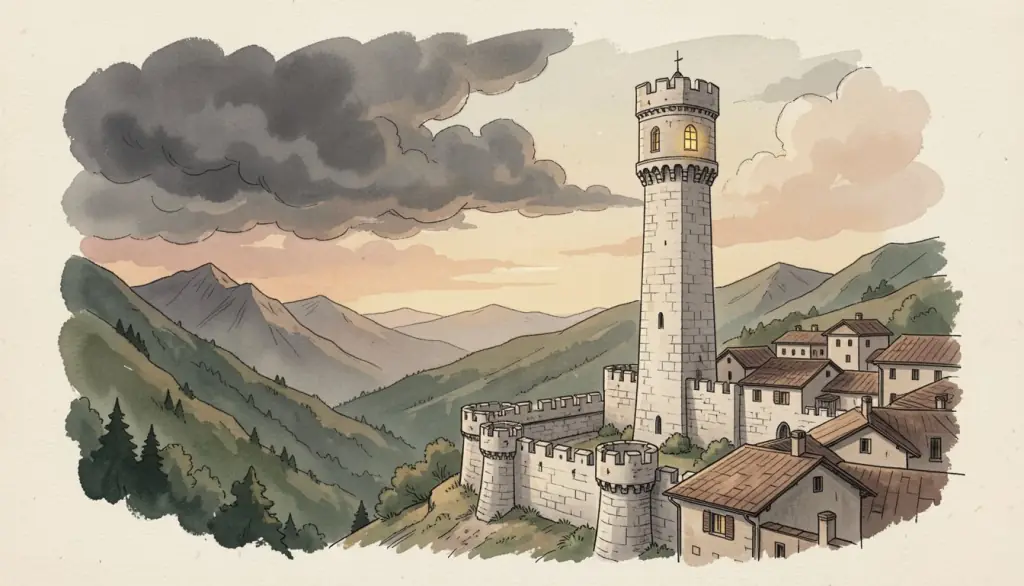
Thorongil: The Rival Who Was Aragorn
The most important event of Denethor's youth is the arrival of a stranger.
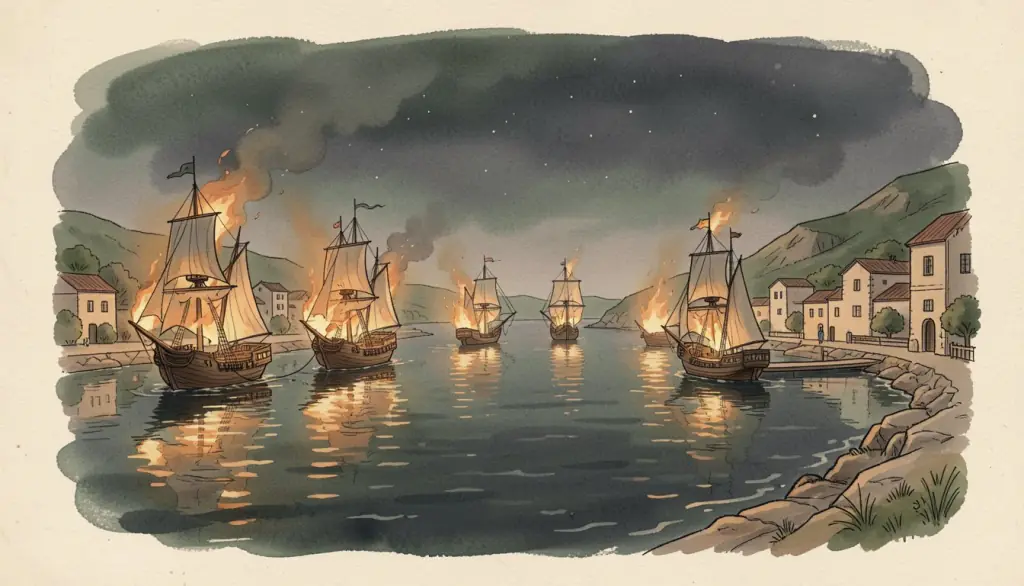
During the rule of Ecthelion II, a man came to Gondor who had already served King Thengel of Rohan. He was called Thorongil, "Eagle of the Star", because he was swift and keen-eyed and wore a silver star on his cloak. Nobody knew his true name or his birthplace. He became a great captain of Gondor and a trusted counsellor of the Steward, and at last he led a small fleet against the Corsairs of Umbar, burned a great part of their ships and overthrew the captain of the haven. At the moment of victory he sent word that other tasks called him, and he never came back to the city (Appendix A). Thorongil was Aragorn. For his side of the story, see Aragorn Explained.
Seen from Denethor's side, the episode is painful. Appendix A says that Denethor, the Steward's heir, was ever put second to the stranger in the hearts of men and in the esteem of his father. It also says the two were as alike as nearest kin, which is not surprising given that both carried the blood of Númenor nearly true. Denethor was born in 2930 and Aragorn in 2931, so the man everyone preferred was a year younger than he was.
Two further details from Appendix A shape everything that follows:
- Counsel against Saruman. Thorongil urged Ecthelion to trust Gandalf rather than Saruman. Years later Denethor would trust neither of them.
- Suspicion. Appendix A indicates that Denethor had guessed who Thorongil really was, and suspected that Thorongil and Mithrandir meant to supplant him.
That suspicion is the root of Denethor's coldness to Gandalf for the rest of his life. He believes, correctly, that the wizard has been preparing for the return of a king. He concludes, wrongly, that this is a plot against Gondor rather than for it. When in 3019 he refuses to step down for "an upstart", he is not speaking about a stranger. He is speaking about the captain his father had loved better than him.
Steward of Gondor: Thirty-Five Years of Rule
Ecthelion II died in 2984 and Denethor took up the white rod. For thirty-five years he governed a realm that was steadily shrinking under pressure from Mordor, and Tolkien gives him credit for doing it well.
He was a hard ruler but not a careless one. The defences that Gandalf finds in March 3019, the men labouring on the outer wall of the Pelennor, the garrisons and the held crossings at Osgiliath, are the work of his government. Gondor's captains were his sons, and he chose the two best soldiers in the realm. When the storm came, Minas Tirith still had an army, allies in the southern fiefs and a credible plan for resistance. That is Denethor's doing.
Finduilas and the Darkening
In 2976 Denethor married Finduilas, daughter of Prince Adrahil of Dol Amroth, the coastal fief whose princes claimed descent from Elvish blood. Appendix A gives her one of the saddest sentences in the appendices: she withered in the guarded city like a flower of the seaward vales set upon a barren rock. Minas Tirith, built of stone in the shadow of Mordor, was the wrong place for her, and she sickened under the threat from the East.
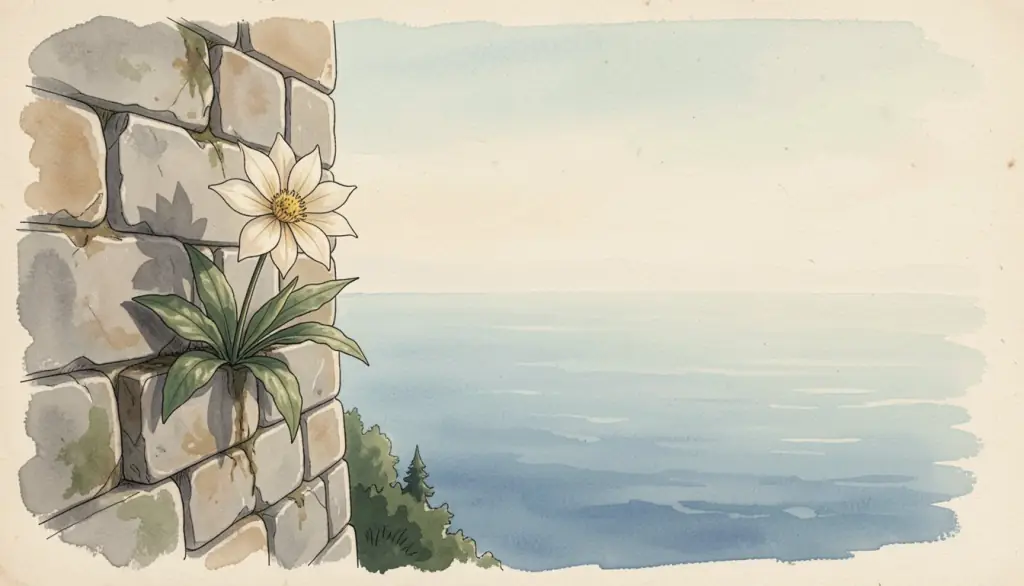
She died in 2988, when Boromir was ten and Faramir five. Appendix A records that after her death Denethor became grimmer and more silent. He would sit long alone in his tower, deep in thought, foreseeing that the assault of Mordor would come in his time.
The Palantír of Minas Anor
The palantíri were seven seeing-stones brought from Númenor by Elendil and his sons. One was kept in Minas Anor, the city later called Minas Tirith. Its twin in Minas Ithil was captured when that city fell and became Minas Morgul, and in time it passed to Sauron. Through that stone Sauron could reach any other stone whose user looked into it. For the history of the stones and of Elendil's realms, see Elendil Explained.
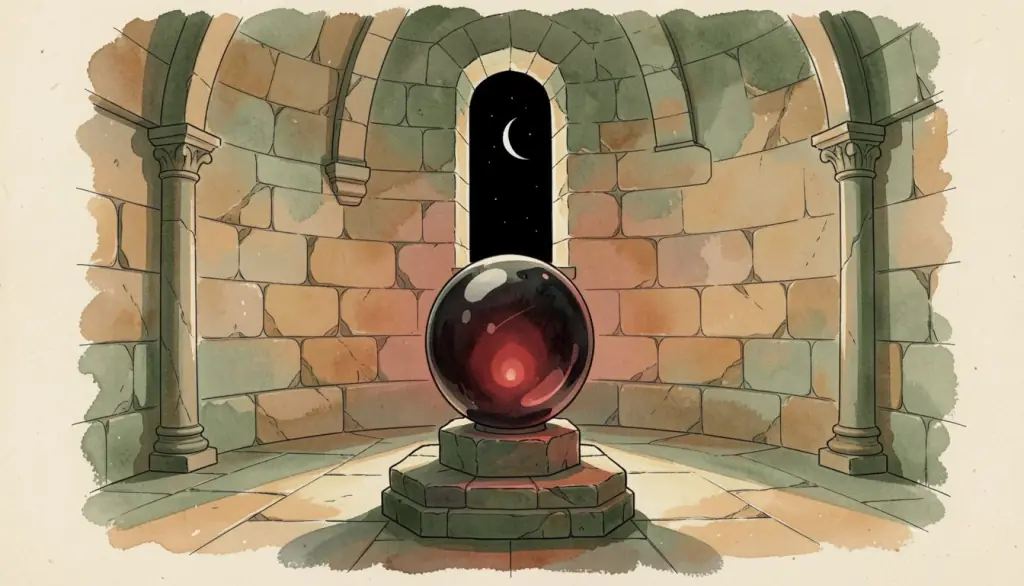
We keep the lore brief here, and three points are enough.
He had the right to use it. The Anor-stone belonged to the rulers of Gondor, and the Stewards inherited that right with the realm. Denethor was not a thief using a forbidden device, as Saruman was with the stone of Orthanc. He was the lawful keeper of the Stone, using it for the defence of his country.
He could not be mastered. Appendix A says it was believed afterwards that, needing knowledge, Denethor dared to look into the palantír, and that he learned much from it but bought the knowledge dearly, being aged before his time by his contest with the will of Sauron. In The Return of the King (book V, ch. 7, "The Pyre of Denethor") Gandalf explains that Denethor was too great to be subdued to the Dark Power, unlike Saruman. The Steward never became Sauron's servant.
He could be deceived. Gandalf's next point is the crucial one: Denethor saw nonetheless only those things which that Power permitted him to see. Sauron could not make him obey, so instead Sauron curated what he saw. Every vision was true, and every one was chosen to break hope. Unfinished Tales ("The Palantíri") adds that the Anor-stone was afterwards hard to use, because it showed little but the image of two aged hands withering in flame unless a mind of great strength turned it elsewhere.
Appendix A draws the conclusion: pride increased in Denethor together with despair, until he saw in all the deeds of that time only a single contest between the Lord of the White Tower and the Lord of Barad-dûr, and mistrusted everyone else who resisted Sauron unless they served him alone. That sentence describes Denethor's whole fall in advance. He is not wrong that the war is a contest. He is wrong to believe that he is the only one fighting it. For the contrast with Saruman's use of the Orthanc-stone, see Saruman Explained; for the power on the other side, see Sauron Explained.
Pippin and the Steward
Denethor appears in person for the first time when Gandalf brings Pippin into the hall of the White Tower on 9 March 3019 (The Return of the King, book V, ch. 1). Tolkien shows him through a hobbit's eyes, and the effect is formidable. Pippin sees an old man with a face like carved ivory, proud bones and dark, deep eyes, and is reminded less of Boromir than of Aragorn.
In his lap Denethor holds the great horn of his house, cloven in two. The halves had been found along the Anduin and brought to him. He questions Pippin closely about Boromir's death, and Pippin, moved by the old man's grief and stung by his pride, offers his sword and his service in payment of his debt to Boromir, who died defending him. Denethor accepts. A hobbit of the Shire swears fealty to the Steward of Gondor, and Denethor gives the oath in its formal words.
The audience is also a duel: Denethor tries to learn from Pippin what Gandalf is hiding. Afterwards Gandalf warns Pippin that Denethor is proud and subtle, a man of far greater lineage and power, though he is not called a king, and that he perceives much of what is in other men's minds. Gandalf also notes that Pippin said nothing of Aragorn, and that this was wise. Yet Denethor keeps his side of the oath: he gives the hobbit the black and silver livery of the Tower, and at the very end he releases Pippin from his service before he dies.
Faramir and the Siege of Gondor
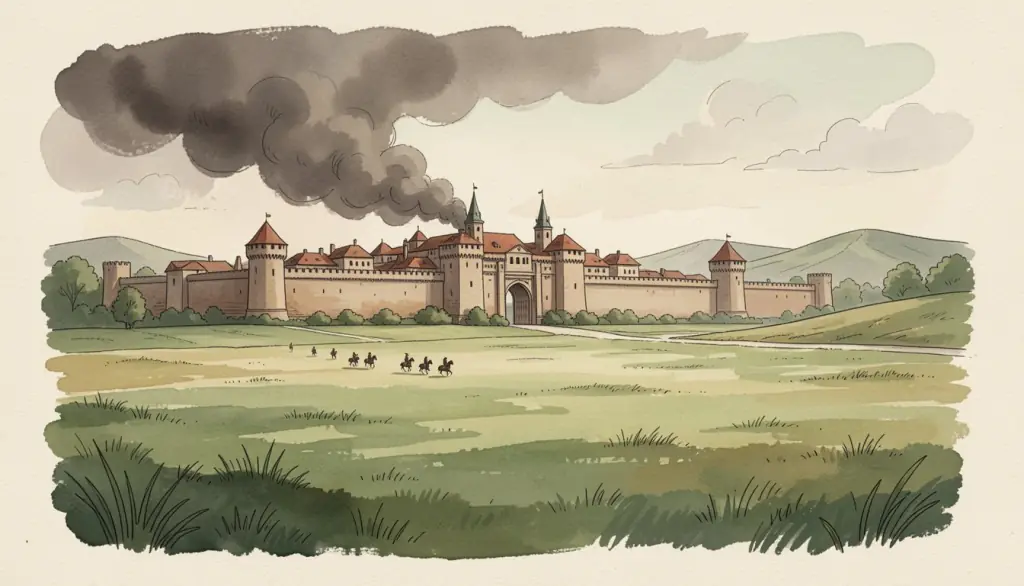
The darkest material about Denethor concerns his younger son, and it is in The Return of the King, book V, ch. 4, "The Siege of Gondor".
The return from Ithilien. On the Dawnless Day, 10 March, Faramir rides back across the Pelennor pursued by Nazgûl, and Gandalf drives them off. In the hall Faramir reports that he met Frodo and Sam in Ithilien, learned what they carried, and let them go on toward Mordor. Denethor already guesses the answer and is enraged. He says Boromir would have brought him the Ring, a mighty gift. Gandalf replies that Boromir would have kept it for himself, and that Denethor would not have known his son.
The exchange. Denethor tells Faramir that he wishes their places had been exchanged, that Boromir had lived and Faramir died. Faramir does not argue. He asks for his father's orders. It is the cruellest scene in the book between two good men, and Tolkien gives Denethor no excuse for it.
Osgiliath. Denethor then sends Faramir back to hold the river crossings at Osgiliath, against Faramir's own judgement that the outer defences cannot hold. Faramir goes. The defence fails, and in the retreat across the Pelennor Faramir is wounded and falls into a fever of the Black Breath, the sickness that touches those who face the Nazgûl. He is carried back to the city seemingly dying.
The breaking. Denethor's response is the turning point of his life. He has Faramir laid in a chamber of the Tower and sits beside him, and something in him gives way. He stops giving orders. The city is left to Gandalf and Prince Imrahil while the Steward watches his son.
The Pyre of Denethor
Chapter 7 of book V is one of the shortest and most terrible in the book. The siege is at its height, the Witch-king is at the Gate, and Pippin runs to find Gandalf.
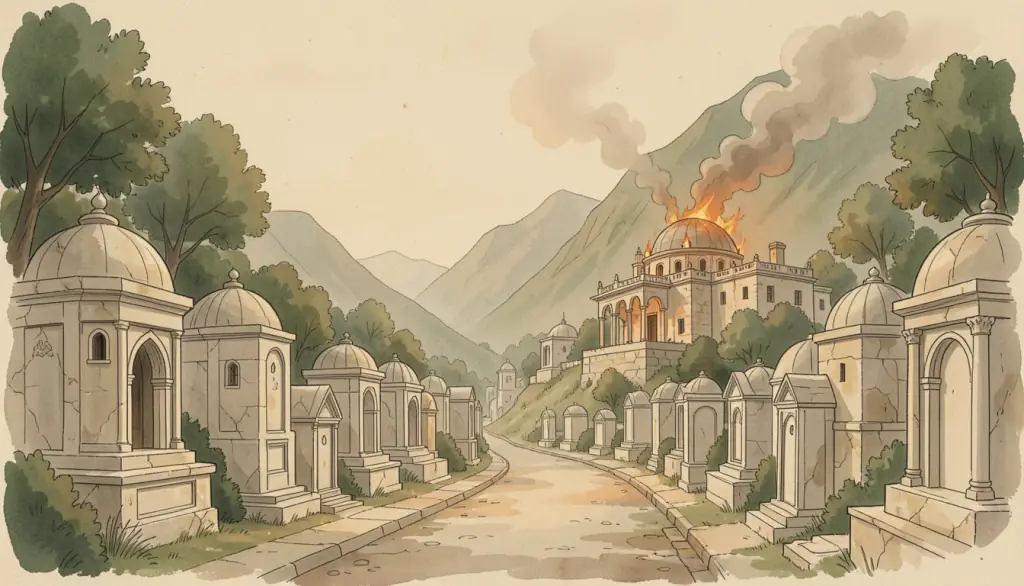
The decision. Denethor has decided that all hope is gone. He orders his servants to carry Faramir, still alive and burning with fever, down to Rath Dínen, the Silent Street where the Kings and Stewards of Gondor lie in their tombs, and into the House of the Stewards. There they are to build a pyre. He means to burn himself with his son, in the manner, as Gandalf will say, of the heathen kings of old under the shadow of the Dark Power.
Beregond. Pippin cannot stop it, but he can fetch help. Beregond, the guard of the Citadel who had befriended him, abandons his post to stand at the door of the House of the Stewards and prevent the servants from lighting the fire. He kills the porter who tries to stop him. It is a crime under the law of the city, and he commits it to save Faramir.
Gandalf. Pippin finds Gandalf at the Gate, where the wizard is facing the Witch-king. Gandalf turns away from the battle and rides to Rath Dínen. Tolkien makes clear that this choice costs something: Gandalf cannot be in two places, and others will die because he was not where the fighting was. He chooses to save one life in the tombs rather than many on the field.
The last argument. In the House of the Stewards, Denethor stands over his son with a sword. Gandalf takes Faramir from the pyre and rebukes the Steward: "Authority is not given to you, Steward of Gondor, to order the hour of your death." Denethor answers with the palantír. He reveals that he has been looking into the Stone, mocks Gandalf's hope, and tells him what he has seen: a fleet of black ships coming up the Anduin from the south. To Denethor that fleet is the Corsairs of Umbar and the end of Gondor. He also tells Gandalf that he knows of the Ranger of the North whom the wizard means to set in his place, and that he will not step down to be the "dotard chamberlain of an upstart".
The end. Denethor seizes a torch from a servant, breaks his white rod of office over his knee and casts it into the fire, lies down on the pyre and clasps the palantír to his breast. The fire takes him and the House of the Stewards with him. Gandalf, Beregond and Pippin carry Faramir out alive. Afterwards Gandalf explains to the others how Sauron worked on Denethor through the Stone, and the chapter closes on the cost of it.
The irony. The black ships were not the Corsairs. They were the fleet of Umbar captured by Aragorn at Pelargir, coming up the river with the Dúnedain and the men of the southern fiefs to relieve Minas Tirith. They arrived on the same day. Denethor saw a true image and drew the wrong conclusion from it, which is exactly what Gandalf said the Stone had been doing to him for years. The last thing the palantír showed him was Thorongil, coming back.
Denethor's Name and Language
Denethor, like everyone around him, spoke the Common Speech day to day. The noble houses of Gondor, however, named their children in Sindarin, as a mark of their descent from the Númenóreans who had been friends of the Elves. That is why the Steward's family has Elvish-looking names: Denethor, Ecthelion, Finduilas, Boromir, Faramir. Our guide to Westron, the Common Speech explains how the two languages divided the work in Gondor, and our guide to Adûnaic covers the older Númenórean tongue behind the royal line.
What Tolkien did and did not say. Tolkien printed no meaning for the name Denethor in The Lord of the Rings, and we do not offer one here. What can be said with sources is where the name comes from:
- An Elvish leader. In The Silmarillion (ch. 10), Denethor is a Nandorin Elf, son of Lenwë, who led his people over the Blue Mountains into Ossiriand and was slain on Amon Ereb in the First Battle of Beleriand. The Stewards of Gondor drew names from the old Elvish and Edain histories, and this is the oldest bearer of the name.
- An earlier Steward. Appendix A lists Denethor I, an earlier Ruling Steward in whose time the Uruks of Mordor swept across Ithilien and took Osgiliath. His son Boromir defeated them and regained Ithilien, but Osgiliath was left in ruins and its great stone bridge broken. Denethor II, father of a second Boromir, carried the name of that house tradition forward.
How to say it. By the stress rule in Appendix E, a three-syllable word whose second-last syllable is short and open takes the stress on the first: DE-ne-thor, with the th as in English "thin".
Titles and places from his world, with sources:
| Word or name | Meaning | Source |
|---|---|---|
| Gondor | Land of Stone | LotR |
| Minas Tirith | Tower of Guard (minas tower + tirith guard, watch) | LotR; Etymologies |
| Minas Anor | Tower of the Sun, the old name of Minas Tirith | LotR |
| Minas Ithil | Tower of the Moon, later Minas Morgul | LotR |
| palantír | that which looks far away (Quenya) | LotR; Unfinished Tales |
| Rath Dínen | the Silent Street (rath street + dínen silent) | LotR, book V, ch. 4 and 7 |
| Fen Hollen | the Closed Door, the gate to Rath Dínen | LotR, book V, ch. 4 and 7 |
| arandur | steward, literally king's servant (Quenya) | Unfinished Tales; Letters |
| voronwë | steadfastness, loyalty (Quenya); title of Mardil the first Steward | Appendix A; Unfinished Tales |
| Thorongil | Eagle of the Star, Aragorn's name in Gondor | Appendix A |
The Quenya word arandur is worth pausing on. It is the formal title behind the English "Steward", and it means "king's servant". Every Steward from Mardil to Denethor bore it. Denethor's tragedy fits into that one word: he could not bear, at the last, to be what his title said he was. To see any of these names written in Elvish letters, try our Tengwar name tool.
Books vs Films vs The Rings of Power
John Noble's Denethor in Peter Jackson's The Return of the King (2003) is a powerful performance, but the script gives him a much smaller and harsher role than the book does. The changes are large enough that it helps to list them. These are film choices, not book lore:
- The beacons. In the film Denethor refuses to call for aid, and Gandalf has Pippin climb the first beacon and light it himself. In the book the beacons are already burning when Gandalf and Pippin ride toward the city (book V, ch. 1), and Denethor has sent the Red Arrow to King Théoden of Rohan asking for help (book V, ch. 3, "The Muster of Rohan"). Book Denethor is the one organising Gondor's alliances.
- The meal and the song. The famous scene of Denethor eating while Pippin sings and Faramir rides out is a film creation. The book has no such meal and no such song.
- The charge at Osgiliath. The film shows Faramir leading a hopeless cavalry charge to retake Osgiliath on his father's orders. In the book Denethor sends Faramir to hold the river crossings, Faramir goes against his own judgement, and he is wounded in the retreat across the Pelennor. The order is harsh, but it is a defensive order, not a suicide mission.
- Abandoning the walls. In the film Denethor tells the soldiers to flee for their lives, and Gandalf strikes him down with his staff and takes command. In the book Denethor stops giving orders while he sits by Faramir, and command falls to Gandalf and Imrahil, but he never orders his men to abandon the city.
- The leap. In the film Denethor runs burning out of the tombs and throws himself from the prow of the citadel. In the book he lies down on the pyre inside the House of the Stewards and dies there.
- The palantír. The book's explanation for Denethor's despair, the seeing-stone and Sauron's selective visions, is almost entirely missing from the theatrical film. Without it, Denethor looks like a man who is simply mad or cruel, which is the opposite of how Tolkien built him.
What the film gets right, in our view: Denethor's favouritism toward Boromir, his cruelty to Faramir, and the fact that grief is at the centre of his collapse. What it loses: his intelligence, his competence as a ruler, his dignity with Pippin and, above all, the reason for his despair. The book's Denethor is defeated by an enemy. The film's Denethor seems to be defeated by himself.
The Rings of Power and The War of the Rohirrim
The Rings of Power is set in the Second Age, thousands of years before Denethor's birth. Gondor itself is founded only at the end of that age by Elendil and his sons, who do appear in the show. Denethor has not appeared in Seasons 1 to 3, and no casting for him has been announced. Season 3 premiered on Prime Video on 11 November 2026, with the finale due on 25 November; see our Season 3 preview.
The Lord of the Rings: The War of the Rohirrim (2024) tells the story of Helm Hammerhand in Third Age 2758 and 2759, nearly two centuries before Denethor was born. He is not in it. For the Rohan side of his story, see Théoden Explained and Éomer Explained.
How Tolkien Built Denethor
Denethor is built around three deliberate pairings, and seeing them explains why he is more than a villain.
1. Denethor and Théoden. Book V cuts between Minas Tirith and Rohan, and the two lords are set side by side. Both are old kings in all but name, both lose a son or heir, and both face despair. Théoden was poisoned by a counsellor, Wormtongue, and recovers when Gandalf breaks that hold; he rides to battle and dies well. Denethor has no Wormtongue. His counsellor is his own pride and a stone that shows only true things, and he is too proud to accept the help that saved Théoden. Tolkien even gives them parallel scenes with a hobbit swearing service: Merry to Théoden, Pippin to Denethor. Merry's lord treats him like a son. Pippin's lord treats him like a page.
2. Denethor and Saruman. Both are wise, both are lords of a great tower, and both look into a palantír and meet Sauron there. Saruman is mastered and becomes a servant. Denethor is not mastered and never betrays the West. Tolkien is careful to say so through Gandalf. But both end in ruin, because the Stone does not need to command a mind if it can starve it of hope.
3. Denethor and Aragorn. The two men were born a year apart, carry the same Númenórean blood and once served the same Steward. Both are lawful users of a palantír: Denethor in Minas Tirith, Aragorn with the stone of Orthanc. Aragorn looks into his stone once, deliberately, wrests it to his own will and uses it to show Sauron something false about himself. Denethor looks into his stone for years, in secret, and is shown true things that lie by selection. The contrast is precise: Aragorn uses the Stone to deceive Sauron, and Sauron uses the Stone to deceive Denethor.
Why Denethor Matters
Denethor matters because he is the book's portrait of despair as a sin of the wise.
Most of the characters who fail in The Lord of the Rings fail through desire. Boromir wants the Ring as a weapon; Saruman wants power; Gollum wants his precious. Denethor does not want the Ring. Gandalf says plainly that he was not subdued. What destroys him is the conviction that he knows how the story ends. Gandalf calls his last act pride and despair, and the two are one fault: the belief that because he can see further than anyone else, nothing exists beyond what he can see.
He is also the book's argument about what rule is for. Denethor is, by every measure the appendices give, an able ruler, and he has kept Gondor standing for thirty-five years. But he has come to treat the realm as his possession. When he breaks his white rod over his knee, he is not only killing himself. He is refusing to hand the office back to the king it belongs to. A Steward is a servant who keeps something for its rightful owner. Denethor, at the end, would rather destroy it than return it.
Our Take
Our view, stated plainly: Denethor is not a mad old man. He is the most intelligent person in Minas Tirith, defeated by an enemy who understood that intelligence is not the same as hope.
Everything Denethor believes on 15 March is supported by evidence. He has seen the hosts of Mordor through the Stone. He knows the Ring has gone east in the hands of a hobbit, which by any rational calculation is folly. He sees black ships coming up the river and knows the Corsairs sail black ships. His favourite son is dead and his other son is dying. A cool analyst, given those facts, might reach his conclusion. That is precisely Tolkien's point. Despair, in Tolkien's world, is not a failure of reasoning. It is reasoning that assumes it has all the facts. The facts Denethor lacks, Frodo's road, Aragorn at Pelargir, the Rohirrim at the Rammas, are exactly the ones Sauron has no interest in showing him.
Finally, it is worth noticing who saves the day in his chapter. Not a king or a wizard, but a hobbit who ran for help and a guard who broke the law to stand in a doorway. Denethor believed that the war was a contest between two lords in two towers. Book V answers him with Pippin and Beregond.
People Also Ask
Who is Denethor in Lord of the Rings?
Denethor II is the Ruling Steward of Gondor during the War of the Ring, the last of his line to rule. Born in 2930, he became Steward in 2984, fathered Boromir and Faramir, and burned himself to death in the House of the Stewards on 15 March 3019.
Why did Denethor go mad?
The book points to grief for his wife and for Boromir, pride in his office, and years of using the palantír, through which Sauron showed him only what fed despair. When Faramir seemed to be dying and black ships appeared on the Anduin, he gave up hope.
Did Denethor have a palantír?
Yes, the seeing-stone of Minas Anor in the White Tower. Appendix A says he was believed to have used it, and he dies clasping it. Gandalf explains that Sauron could not master him but showed him only what Sauron chose.
What was the rivalry between Denethor and Thorongil?
Thorongil was Aragorn in disguise, serving Denethor's father Ecthelion II. The people and the Steward preferred him, and Appendix A says Denethor was put second to him. Denethor suspected Thorongil and Mithrandir of plotting to supplant him.
How did Denethor die in the book?
He had a pyre built in the House of the Stewards in Rath Dínen to burn himself with Faramir. Beregond and Gandalf saved Faramir. Denethor broke his white rod, lay on the pyre holding the palantír and died in the flames.
Did Denethor jump off Minas Tirith?
Not in the book. The 2003 film has him run burning from the tombs and fall from the citadel. In Tolkien's text he dies on the pyre inside the House of the Stewards.
Did Denethor refuse to light the beacons?
No. In the book the beacons are already lit when Gandalf and Pippin arrive, and Denethor has sent the Red Arrow to Théoden asking Rohan for help. The refusal is a film invention.
Who were Denethor's wife and sons?
His wife was Finduilas of Dol Amroth, married in 2976, died in 2988. Their sons were Boromir, born 2978, and Faramir, born 2983. Prince Imrahil was Finduilas's brother.
How old was Denethor when he died?
He was born in 2930 and died on 15 March 3019, so he was about eighty-eight or eighty-nine, still strong because the blood of Númenor ran nearly true in him.
Is Denethor in The Rings of Power or The War of the Rohirrim?
No. Both are set long before his birth in 2930, and neither has featured him. On screen he appears in The Return of the King (2003), played by John Noble.
Learn the Language of Gondor's Names
Denethor ruled in the Common Speech, but the city around him was named in Sindarin: Minas Tirith, Rath Dínen, Fen Hollen, Osgiliath, Ithilien. Even the stone in his tower carries a Quenya name. To learn the languages behind those names, start with our free Elvish course, which teaches Sindarin and Quenya using words Tolkien actually wrote.
Related Reading
- Characters of Middle-earth: Who's Who in Tolkien's World
- Boromir Explained: Son of Denethor, the Horn of Gondor and the Fall at Parth Galen
- Faramir Explained
- Aragorn Explained: Strider, Thorongil and King Elessar
- Gandalf Explained
- Saruman Explained
- Sauron Explained
- Théoden Explained
- The Witch-king of Angmar
- Elendil Explained
- Men of Middle-earth
- Westron: The Common Speech of Middle-earth
People Also Ask
Who is Denethor in Lord of the Rings?
Denethor II is the Ruling Steward of Gondor during the War of the Ring, the twenty-sixth and last Ruling Steward of the House of Húrin. Born in Third Age 2930, he succeeded his father Ecthelion II in 2984. He was the father of Boromir and Faramir, governed Minas Tirith through the siege of March 3019, and burned himself to death in the House of the Stewards on 15 March 3019.
Why did Denethor go mad?
The books do not describe it as simple madness. Appendix A and The Return of the King show three causes working together: grief for his wife Finduilas and then for Boromir, pride in his office, and long use of the palantír of Minas Anor, through which Sauron showed him only things that fed despair. When Faramir was brought back seemingly dying and Denethor saw black ships coming up the Anduin, he gave up hope.
Did Denethor have a palantír?
Yes. The seeing-stone of Minas Anor was kept in the White Tower, and Appendix A says it was believed afterwards that Denethor had dared to use it. In The Return of the King, chapter The Pyre of Denethor, he dies clasping it, and Gandalf explains that Sauron could not master him but showed him only what Sauron wished him to see.
What was the rivalry between Denethor and Thorongil?
Thorongil was the name Aragorn used while serving Denethor's father Ecthelion II. The people of Gondor praised the stranger, Ecthelion valued his counsel, and Appendix A says Denethor was ever put second to him in men's hearts and his father's esteem. Denethor seems to have guessed who Thorongil really was and suspected him and Mithrandir of plotting to supplant him.
How did Denethor die in the book?
On 15 March 3019, while the Battle of the Pelennor Fields was fought below the city, Denethor had a pyre built in the House of the Stewards in Rath Dínen, meaning to burn himself with his wounded son Faramir. Beregond and Gandalf saved Faramir. Denethor broke his white rod, lay down on the pyre with the palantír in his hands, and died in the flames.
Did Denethor jump off Minas Tirith?
Not in the book. In the 2003 film The Return of the King, Denethor runs burning from the tombs and falls from the prow of the citadel. In Tolkien's text he lies down on the pyre inside the House of the Stewards and dies there; the building itself burns.
Did Denethor refuse to light the beacons?
No. That is a film invention. In the book the beacons of Gondor are already burning when Gandalf and Pippin ride toward Minas Tirith, and Denethor has also sent the Red Arrow to King Théoden asking for Rohan's help.
Who were Denethor's wife and sons?
His wife was Finduilas, daughter of Prince Adrahil of Dol Amroth, whom he married in 2976 and who died in 2988. Their sons were Boromir, born 2978, and Faramir, born 2983. Prince Imrahil of Dol Amroth was Finduilas's brother.
How old was Denethor when he died?
Appendix B gives his birth as Third Age 2930 and his death as 15 March 3019, so he was about eighty-eight or eighty-nine. That was not unusual for a man in whom the blood of Númenor ran nearly true, and he was still strong when he died.
Is Denethor in The Rings of Power or The War of the Rohirrim?
No. The Rings of Power is set in the Second Age and The War of the Rohirrim in Third Age 2758 and 2759, both long before his birth in 2930. Neither has featured him. On screen he appears in Peter Jackson's The Return of the King, played by John Noble.