Tolkien's Letters from Father Christmas: The Languages Behind Them
Try It Yourself — Free Elvish Tools
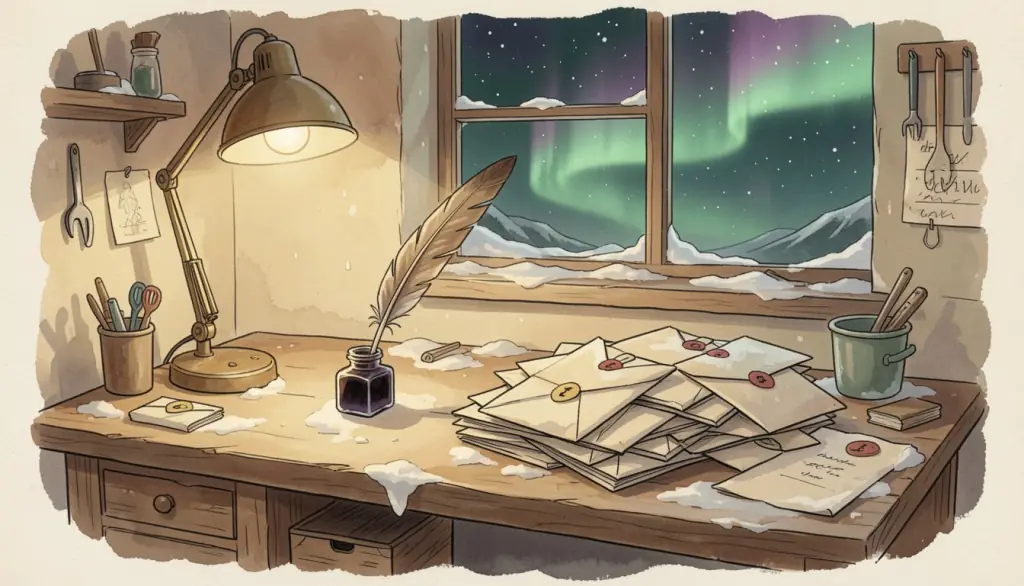
Quick Answer: Between 1920 and 1943 Tolkien wrote and illustrated a letter every Christmas to his children, signed by Father Christmas. They were first published in 1976 as The Father Christmas Letters, edited by Baillie Tolkien, and later as Letters from Father Christmas. The language story is in the voices. Father Christmas writes in a shaky hand. His helper, the North Polar Bear, scrawls in big clumsy letters and an alphabet of his own. Goblins have a script, and an elf secretary called Ilbereth writes elegantly. The name Ilbereth echoes Elbereth, the Elvish name of the star-queen, but the published word lists do not explain it. These are household inventions, written during the same years Tolkien was building Quenya, Sindarin and Tengwar.
Most people know Tolkien for The Hobbit and The Lord of the Rings. Fewer know that for more than twenty years he also wrote to his own children as Father Christmas. Each letter came with a drawing, a postmark and sometimes a stamp from the North Pole. The stories grew over the years into a small mythology with its own cast.
This guide is about the language side of those letters. It looks at how Tolkien used handwriting and invented alphabets as characterisation, who the Polar Bear and Ilbereth are, what can and cannot be said about their connection to his Elvish languages, and why the letters are a useful window onto how he worked. For his serious language work, see our overview Tolkien's Elvish Languages: A Complete Guide.
A note on method. The letters are under copyright and we do not reproduce them. We describe them and give only a few words where it helps. Where we are not sure of an exact detail, we say so rather than guess.
What the Letters Are
The first letter dates from Christmas 1920, when Tolkien's eldest son John was three. A letter in an unfamiliar hand arrived at the house, saying it was from Father Christmas, and it described a visit. Tolkien kept writing every year. As his family grew to four children, John, Michael, Christopher and Priscilla, so did the audience. The last letters of the series date to 1943.
The letters were not written to be printed. They were a family ritual, and the children were the readers. In 1976, three years after Tolkien's death, they were gathered and published as The Father Christmas Letters, edited by Baillie Tolkien, who was married to his son Christopher. A later edition appeared under the title Letters from Father Christmas, with more of the material.
| Detail | What is known |
|---|---|
| Years written | 1920 to 1943 |
| Written to | Tolkien's own children |
| Form | Letters with illustrations, some with envelopes and North Pole stamps |
| First published | 1976, as The Father Christmas Letters |
| Editor | Baillie Tolkien |
| Later edition | Letters from Father Christmas |
Across the years a cast builds up at the North Pole. Father Christmas himself is the narrator. The North Polar Bear is his helper, large, willing and a source of accidents. There are elves, snow-folk and, in some later letters, trouble from goblins. None of this belongs to Middle-earth. It is a separate household world, with its own comic logic.
What makes the letters interesting for a language reader is that Tolkien does not only tell these stories. He writes them in different hands.
Handwriting as a Character
"Mae govannen" — want to actually speak Elvish?
Try It Free →Look at the letters as objects and you see Tolkien thinking like a calligrapher. He had trained himself in several formal hands and he enjoyed writing as a craft. In the letters he gives each speaker a visibly different way of writing.
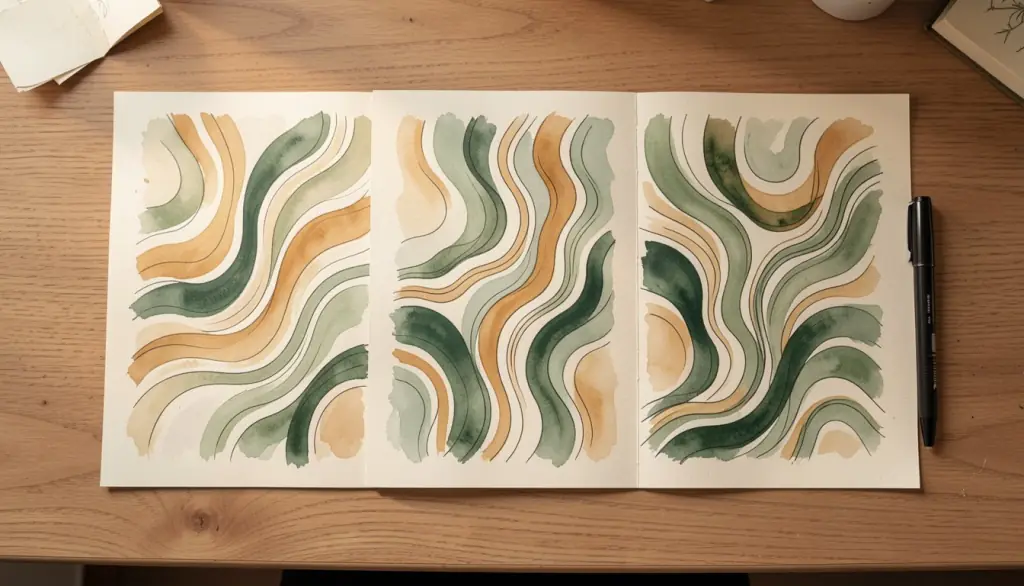
- Father Christmas writes with a wobble. In the story the old man is cold and getting on in years, so his hand shakes. The shakiness is part of the joke and part of the charm: the reader sees the age before reading a word.
- The North Polar Bear writes large and awkwardly, in the manner of a creature with paws. He is the comic voice, and his writing looks like a child's attempt to copy letters.
- Elves write more elegantly, and the letters give them a more careful script.
This matters because it is the same instinct that drives Tolkien's serious work. In Middle-earth, scripts also tell you who wrote something and when. Dwarves use runes, Elves and the Men of Gondor write in Tengwar, and a ring carries a verse in a different script again. A script in Tolkien is never neutral. It tells you about the people who used it.
In the letters he does this for fun, with ink and a shaky pen. In the legendarium he does it with real structure. For the real script system, read our Tengwar Alphabet Guide and Tolkien's Elvish Alphabet and Writing.
The North Polar Bear and His Alphabet
The Polar Bear is the best-loved voice in the letters. In the early letters he is a clumsy helper who is always in some kind of trouble. In later ones he writes parts of the letter himself, and his writing is a different matter from Father Christmas's.
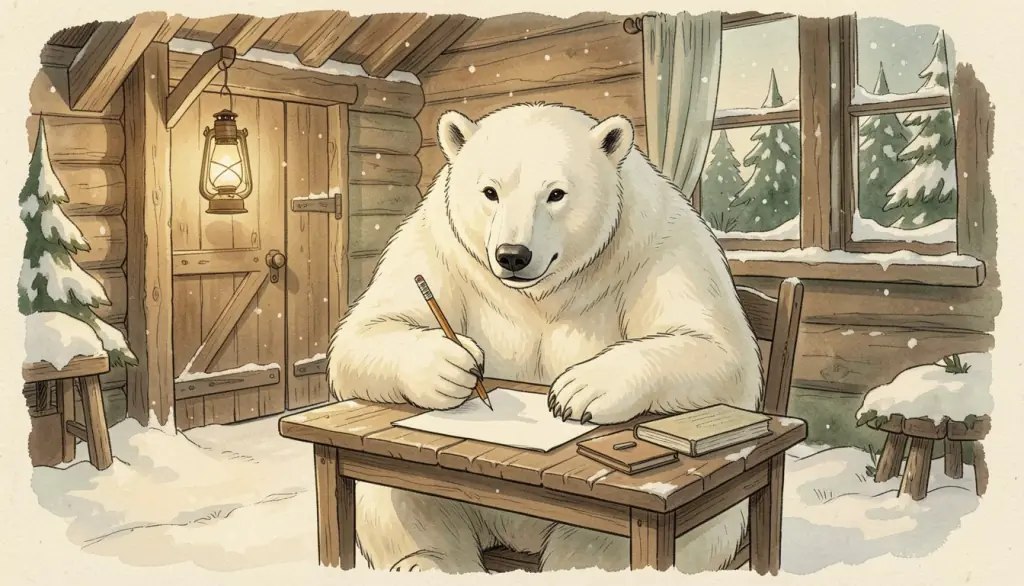
The detail worth noting here is that Tolkien does not simply make the Bear misspell English. He gives the Bear an alphabet of his own, one of the invented scripts that appear in the letters. The Polar Bear and the goblins both appear with scripts that are separate from the ordinary one the child reads. The editor of the book supplies translations, because the children needed Father Christmas to explain what the Bear had written.
We need to be careful here. We can say with confidence that the letters contain invented writing for the Polar Bear and for goblins, and that the published edition explains it. We are not going to reproduce the alphabets or build a grammar for them: the material is a few lines long, and anything beyond what is printed would be a guess.
Is the Bear's "Arctic" related to Quenya?
This is the question readers search for, so here is the careful answer.
Quenya was Tolkien's serious language, the Elvish tongue he had been working on since about 1915. By the time the first Father Christmas letter was written in 1920 he had been developing it for years.
In the 1929 letter the two meet. The Polar Bear signs off with one sentence in what he calls Arctic, the language spoken at the North Pole: Mára mesta an ni véla tye ento, ya rato nea. The letter itself gives the meaning, a goodbye until the next meeting and a hope that it will be soon. Readers of Tolkien's languages have long pointed out that this is Quenya in all but name. Mára is the Quenya adjective "good" and tye is the familiar Quenya "you", both in our own word list from Tolkien's later papers; the rest of the sentence fits the Quenya he was writing in the late 1920s.
So the honest answer is yes, with a limit. Tolkien lent his private Elvish to a bear in a children's letter, as a joke his children could not have recognised at the time. But Arctic is that one sentence. It has no grammar notes, no word list and no second example, and the forms belong to an earlier stage of Quenya than the one in The Lord of the Rings. Treat it as a glimpse, not as a source for learning Quenya.
| Question | What we can say |
|---|---|
| Does the Bear write in his own script? | Yes, the letters present one |
| Is that script explained in the book? | The published edition explains it for readers |
| Is Arctic the same as Quenya? | The one Arctic sentence (1929 letter) reads as the Quenya of that period |
| Can we reconstruct Arctic? | No. One sentence is all there is |
If you want real attested Quenya instead, start at Quenya for Beginners. To see how Tolkien's invented languages relate to each other, read Tolkien's Constructed Languages.
Goblins and Their Script
Goblins turn up in the letters too, and they are written with a script of their own. It is a children's-story goblin, not the goblin of the caves in The Hobbit. The letters give them a different place: they cause trouble at the North Pole, and the household story settles it in a comic way.
For a reader interested in Tolkien's languages, the point is the repeated device. Every group in the letters has its own way of writing. Father Christmas has a shaky hand, the Bear has his alphabet, the goblins have a script and the elves have an elegant one.
The Hobbit appeared in 1937, in the middle of the years the letters were written. It also uses writing as a plot device: the map and its moon-letters are read by Elrond. The two books share an idea. In both, the way something is written is part of the story. For the Hobbit's goblins and orcs in the wider mythology, see Orcs and Goblins in Middle-earth.
Ilbereth the Elf Secretary
The most interesting name for an Elvish reader is Ilbereth. In the later letters, an elf secretary helps Father Christmas with his correspondence and writes in an elegant script. The elf secretary is a different voice from the shaky old man and the clumsy bear.
Ilbereth and Elbereth
The name looks very like Elbereth. Elbereth is the Sindarin title of the star-queen in The Lord of the Rings, the Vala Varda. Hobbits and Elves cry it in danger, and the hymn A Elbereth Gilthoniel is sung in the Shire and in Rivendell. For the full story of that name, see Elbereth Meaning.
The resemblance is striking, and it is easy to say too much about it. Here is what the evidence allows.
| Name | Language | Meaning | Source |
|---|---|---|---|
| Elbereth | Sindarin | title of the star-queen, Varda | LotR |
| Gilthoniel | Sindarin | star-kindler, part of her title | LotR |
| elen | Quenya | star | LotR |
| silmë | Quenya | starlight | LotR, Etymologies |
| Ilbereth | not in the published word lists | no gloss we can cite | Father Christmas Letters |
We can say that the name Ilbereth looks like Elbereth and that Tolkien liked such echoes. We cannot say that Tolkien meant it as an Elvish name with a Quenya or Sindarin meaning, because we cannot cite a gloss for it. A name that looks Elvish is not the same thing as a name that is Elvish. The honest label is: a playful near-echo, meaning unattested.
It is also true that a secretary who writes beautifully fits an elf. In Tolkien's legendarium the Elves are the great writers. The Tengwar themselves were the work of Elves: Rúmil made the first letters and Fëanor reshaped them into the Tengwar, and the Elves of Middle-earth kept their records in them. An elf secretary in a children's story is a small joke on that idea.
Two Kinds of Language Play, Side by Side
It is worth stepping back, because the letters show something about how Tolkien worked.
By the time he began the letters he had already built the first drafts of Quenya and of the languages that became Sindarin. He had also begun working on writing systems. He wrote the first Father Christmas letter in 1920 and the last in 1943. In the years between he published The Hobbit and wrote most of The Lord of the Rings. The letters therefore ran in parallel with the serious work, not before it or after it.
That tells us two things.
First, the invention was a habit. Tolkien did not turn languages off when he wrote for children. The letters carry the same delight in how language looks and sounds. A child opening one saw a letter that looked different from every other, with unusual hands and strange writing. That is a small taste of the same pleasure that made him build Elvish.
Second, the two projects were different in kind. The Elvish languages were developed seriously over decades, with grammar, sound changes and histories. The letters' Arctic and goblin scripts were made for a story and a laugh. A grammarian of Quenya has plenty of material. A grammarian of the Polar Bear's alphabet has very little, and should not pretend otherwise.
| Quenya and Sindarin | The letters' invented writing | |
|---|---|---|
| Purpose | A real invented language family | A comic, household story voice |
| Audience | Tolkien himself, then the world | His children |
| Depth | Grammar, history, many words | Characterisation, a few samples |
| Study today | Linguistic scholarship | Mostly literary interest |
For where Tolkien's real language ideas came from, including Finnish and Welsh, read Tolkien, Finnish, Welsh and Elvish.
Why the Letters Matter to Language Learners
If you came here to learn Elvish, the Father Christmas letters will not teach you any. They are not a source of vocabulary and we would not draw words from them. But they teach three useful things.
- Tolkien thought in scripts. He wrote by hand, designed letters for fun and treated writing as a craft. That helps you understand why Tengwar is so carefully built.
- Names echo. He liked near-echoes, such as Ilbereth and Elbereth. When you see a name that looks Elvish, check whether it is attested before you treat it as Elvish.
- Not every invented word is a language. A playful alphabet for a polar bear is different from a language with grammar. Knowing the difference keeps you from building on guesses.
Where to Read More
The letters themselves are the best source, in the edition you can find: The Father Christmas Letters (1976) or the later Letters from Father Christmas. They include reproductions of the illustrations, which are half the pleasure. Our own pages cover Tolkien's real languages, and the Christmas season through an Elvish lens in Elvish Christmas and Yule Phrases.
People Also Ask
What are Tolkien's Letters from Father Christmas? Letters Tolkien wrote and illustrated for his children each Christmas from 1920 to 1943, as if from Father Christmas. They were first published in 1976 as The Father Christmas Letters, edited by Baillie Tolkien, and later reissued as Letters from Father Christmas.
Did Tolkien invent a language for the Father Christmas letters? He invented several voices rather than one language: an alphabet for the North Polar Bear, a script for goblins and an elegant hand for the elf secretary. They are playful, and they run alongside his serious Elvish work.
Who is Ilbereth in the Father Christmas letters? The elf secretary who appears in the later letters. The name looks like Elbereth, but the published Elvish word lists give no meaning for it, so treat the link as a playful echo.
Is the Polar Bear's Arctic writing Quenya? Very nearly. The single Arctic sentence in the 1929 letter uses Quenya words such as mára "good" and tye "you". It is one sentence, so it cannot be studied as a language.
Why is Father Christmas's handwriting shaky in the letters? Within the story the old man writes with cold, tired hands. Tolkien used handwriting as characterisation, giving each speaker a distinct way of writing.
Learn the Language Behind the Name
Elen "star" and silmë "starlight" are real Quenya words you met above, and Elbereth is a real Sindarin name. Try them in our Elvish translator, write your own name with the Tengwar name tool, or read how the writing system works in our reading and writing guide. To start from the beginning, try the free lessons at Learn Elvish.
Related Reading
People Also Ask
What are Tolkien's Letters from Father Christmas?
They are letters Tolkien wrote, illustrated and posted to his children each Christmas from 1920 to 1943, as if from Father Christmas at the North Pole. They were first published in 1976 as The Father Christmas Letters, edited by Baillie Tolkien, and later reissued as Letters from Father Christmas.
Did Tolkien invent a language for the Father Christmas letters?
He invented several voices rather than one language. The North Polar Bear writes in a clumsy alphabet of his own, goblins have a script, and an elf secretary writes in an elegant hand. The letters are playful, but they come from a man who was building real languages and scripts at the same time.
Who is Ilbereth in the Father Christmas letters?
Ilbereth is the elf secretary who appears in the later letters and writes in an elegant script. His name looks like Elbereth, the Elvish title of the star-queen in The Lord of the Rings. Tolkien's published Elvish word lists do not gloss Ilbereth, so any meaning is a guess.
Is the Polar Bear's Arctic writing Quenya?
It is very close to it. In the 1929 letter the Polar Bear writes one sentence in "Arctic", the language he says is spoken at the North Pole, and its words look like the Quenya of those years: mára "good" and tye "you" are both ordinary Quenya words. It is one sentence, not a language, so nobody can build a grammar from it.
Why is Father Christmas's handwriting shaky in the letters?
Within the story, the old man writes with cold, tired hands at the North Pole, so his writing wobbles. Tolkien used the hand as characterisation, giving Father Christmas, the Polar Bear and the elves each a distinct way of writing on the page.
Related Tags
Learn Elvish Free
39 free Elvish lessons, an AI tutor, and spaced repetition review — no credit card required.
Start Learning Free