
Glorfindel Explained: Balrog-slayer of Gondolin and Elf-lord of Rivendell
Try It Yourself — Free Elvish Tools
Quick Answer: Glorfindel is an Elf-lord of Rivendell who rescues Frodo on the road to the Ford of Bruinen in The Fellowship of the Ring. He is also the name of a lord of Gondolin who died killing a Balrog at the end of the First Age, and in essays written near the end of his life Tolkien decided the two were the same Elf, returned from the Halls of Mandos. In Third Age 1975 he foretold that the Witch-king would not fall by the hand of man. Peter Jackson's films leave him out and give his scene at the Ford to Arwen.
Glorfindel spends only a few pages on stage in The Lord of the Rings, and yet readers who meet him rarely forget him. An Elf on a white horse comes down the road at dusk, greets Aragorn in Elvish, puts a dying hobbit in his saddle, and sends him across a river while nine Ringwraiths close in. A chapter later Gandalf tells Frodo that what he saw at the Ford was not just a warrior but "one of the mighty of the Firstborn".
Then Glorfindel almost disappears. Behind those few pages sits one of the strangest histories in the legendarium: a duel with a Balrog in a story Tolkien first wrote during the First World War, a return from the dead he worked out only in his last years, and a prophecy that runs from Appendix A to the Pelennor Fields.
This guide sets out what the books say about Glorfindel, keeps the late and unpublished material clearly labelled, separates the film version from Tolkien's, and ends with our own reading of why such a minor character carries so much weight. For the place he lives, see Rivendell explained. For his lord and kinsman by service, see Elrond explained.
Glorfindel at a Glance
| People | Elf of the Noldor, born in Valinor in the Years of the Trees (late essays in The Peoples of Middle-earth) |
| Titles | Elf-lord of Rivendell; "one of the mighty of the Firstborn" (The Fellowship of the Ring, Book II, ch. 1); in the Gondolin story, lord of the House of the Golden Flower (The Book of Lost Tales Part Two) |
| Name | Sindarin Glorfindel, "golden-haired" (The Silmarillion, Appendix) |
| Pronunciation | glor-FIN-del, by the stress rules of LotR Appendix E |
| Lord in the First Age | Turgon, King of Gondolin |
| Lord in the Third Age | Elrond of Rivendell |
| Horse | Asfaloth (The Fellowship of the Ring, Book I, ch. 12) |
| Great deeds | Killed a Balrog at Cirith Thoronath during the flight from Gondolin (The Silmarillion, "Of Tuor and the Fall of Gondolin"); routed the Witch-king at the Battle of Fornost (Appendix A); saved Frodo at the Ford of Bruinen |
| Death | First Age, falling from the cliff with the Balrog he fought |
| Return | Restored to life in Valinor and later sent back to Middle-earth (late essays, The Peoples of Middle-earth) |
| First written | "The Fall of Gondolin", begun around 1917, published in The Book of Lost Tales Part Two (1984) |
| First published | The Fellowship of the Ring (1954) |
| Fate | Not recorded after the Council of Elrond; Tolkien does not say whether he sailed West |
| Film actor | None; Jackson's Fellowship gives his Ford scene to Arwen |
| Rings of Power actor | None; the character has not appeared in the show |
Glorfindel Timeline
"Mae govannen" — want to actually speak Elvish?
Try It Free →Third Age dates come from Appendices A and B of The Lord of the Rings. The year of Gondolin's fall comes from Tolkien's later annals of Beleriand, printed in The War of the Jewels. The rows about his birth, return and the date of his coming back to Middle-earth come from the late essays in The Peoples of Middle-earth, which give no fixed years.
| Age and year | Event |
|---|---|
| Years of the Trees | Born among the Noldor in Valinor (late essays) |
| End of the Years of the Trees | Goes into exile with the Noldor, following Turgon (late essays; The Silmarillion, "Of the Flight of the Noldor") |
| First Age | A lord of Gondolin, the hidden city of Turgon (The Silmarillion; The Book of Lost Tales Part Two) |
| First Age 510 | Fall of Gondolin. In the escape over Cirith Thoronath he kills a Balrog and dies with it; Thorondor recovers his body and the refugees raise a cairn (The Silmarillion, "Of Tuor and the Fall of Gondolin") |
| After his death | His spirit goes to the Halls of Mandos; he is released and re-embodied in Valinor (late essays) |
| Second Age, no fixed year | Sent back to Middle-earth; Tolkien's second essay prefers a return in the Second Age to his first idea of a return with the Istari |
| Third Age 1974 | The Witch-king takes Fornost; the North-kingdom of Arthedain ends (Appendix A) |
| Third Age 1975 | Battle of Fornost. Glorfindel comes from Rivendell; the Witch-king flees, and Glorfindel foretells he will not fall by the hand of man (Appendix A) |
| Third Age 3018, 18 October | Glorfindel finds Frodo's party at dusk on the Road (Appendix B) |
| Third Age 3018, 20 October | Escape over the Ford of Bruinen (Appendix B) |
| Third Age 3018, 25 October | Council of Elrond (Appendix B) |
| Third Age 3019, 15 March | The Witch-king is slain on the Pelennor Fields by Éowyn and Merry, fulfilling the prophecy (Appendix B) |
A note on sources: everything about Glorfindel's return from Mandos comes from two short essays Tolkien wrote around 1972 to 1973, published by Christopher Tolkien in 1996. They are Tolkien's own view, but he never revised the published books to include them.
Who Glorfindel Is
In the story most readers know, Glorfindel is a great Elf of Elrond's household; Strider names him as one who dwells in the house of Elrond (The Fellowship of the Ring, Book I, ch. 12).
Three facts define him:
- He is a High Elf of Valinor, not a Sindarin or Silvan lord. Gandalf calls him an Elf-lord "of a house of princes" and ties his power to his having lived in the Blessed Realm (The Fellowship of the Ring, Book II, ch. 1, "Many Meetings").
- He has already died once. Tolkien's final view, set out in his late essays, is that the Rivendell Glorfindel is the Balrog-slayer of Gondolin, who came back.
- He keeps meeting the Witch-king. He is there when Angmar is broken at Fornost and when the Nine come for the Ring at the Bruinen.
What he does not have is a large part: he speaks a few times, rides once, sits at a council, and is left in Rivendell. That brevity is part of his effect.
Relationships and Allegiances
Tolkien names no parents, spouse or children for Glorfindel. What he has instead are lords, comrades and enemies across two ages.
| Person | Relationship | Source |
|---|---|---|
| Turgon | King of Gondolin, whom he followed into exile and served | The Silmarillion; late essays |
| Ecthelion of the Fountain | Fellow captain of Gondolin; also died killing a Balrog | The Silmarillion, "Of Tuor and the Fall of Gondolin" |
| Tuor, Idril and the child Eärendil | The refugees he died defending on the mountain pass | The Silmarillion |
| Thorondor | King of Eagles, who brought up his body from the abyss | The Silmarillion |
| Olórin (Gandalf) | Friend in Valinor after his return, in Tolkien's late view | Late essays, The Peoples of Middle-earth |
| Elrond | Lord of Rivendell, whom he serves in the Third Age; son of the Eärendil he once saved | The Fellowship of the Ring |
| Eärnur | Captain of Gondor at Fornost, whom he stops from pursuing the Witch-king | Appendix A |
| The Witch-king of Angmar | The enemy he routs at Fornost and faces again at the Ford | Appendix A; The Fellowship of the Ring |
| Aragorn | Greeted by him on the Road as Dúnadan | The Fellowship of the Ring, Book I, ch. 12 |
| Frodo | Rescued by him and carried on Asfaloth | The Fellowship of the Ring, Book I, ch. 12 |
| Asfaloth | His horse | The Fellowship of the Ring, Book I, ch. 12 |
One line deserves a second look: the child Eärendil, whom Glorfindel died to protect above Gondolin, became the father of Elrond. In the Third Age Glorfindel serves the son of the boy he saved.
Gondolin and the House of the Golden Flower
Glorfindel's story starts in Gondolin, the hidden city Turgon built in a ring of mountains in Beleriand. For the city itself, see Gondolin, the Hidden City; here we follow only Glorfindel's part.
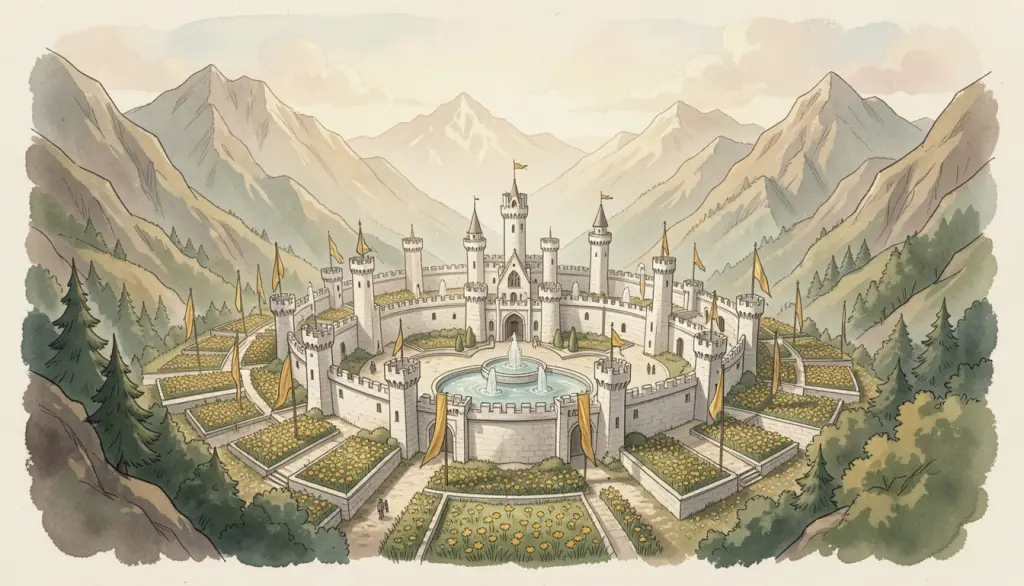
In Tolkien's earliest version, "The Fall of Gondolin", begun around 1917 and published by Christopher Tolkien in The Book of Lost Tales Part Two, the people of the city are organised in great houses, each with its own lord and emblem. Glorfindel leads the House of the Golden Flower; Ecthelion leads the House of the Fountain. The much shorter published Silmarillion names both as captains but does not lay out the houses.
When Morgoth finally attacks, the published Silmarillion gives the fall only a few paragraphs, and two deeds stand out. Ecthelion of the Fountain kills Gothmog, Lord of Balrogs, and dies with him. Glorfindel survives the sack and leads the rearguard of the refugees out of the burning city (The Silmarillion, "Of Tuor and the Fall of Gondolin").
The refugees escape by a secret way prepared by Idril, Turgon's daughter, with her husband Tuor, a Man, and their young son Eärendil. Turgon stays and dies in his tower.
Notice what kind of hero he is here: not a king, not a craftsman, not an oath-bound son of Fëanor, but a captain whose function is to get other people out alive. That is still true on the road to Rivendell, thousands of years later.
The Balrog at Cirith Thoronath
The refugees climb to Cirith Thoronath, the Eagles' Cleft, a narrow path high in the Encircling Mountains above a sheer fall. There they are ambushed by Orcs and a Balrog. Glorfindel holds the path. He fights the Balrog on a pinnacle of rock, and in the end both of them fall from the height into the abyss. Glorfindel dies, but the Balrog dies too, and the refugees are saved (The Silmarillion, "Of Tuor and the Fall of Gondolin").
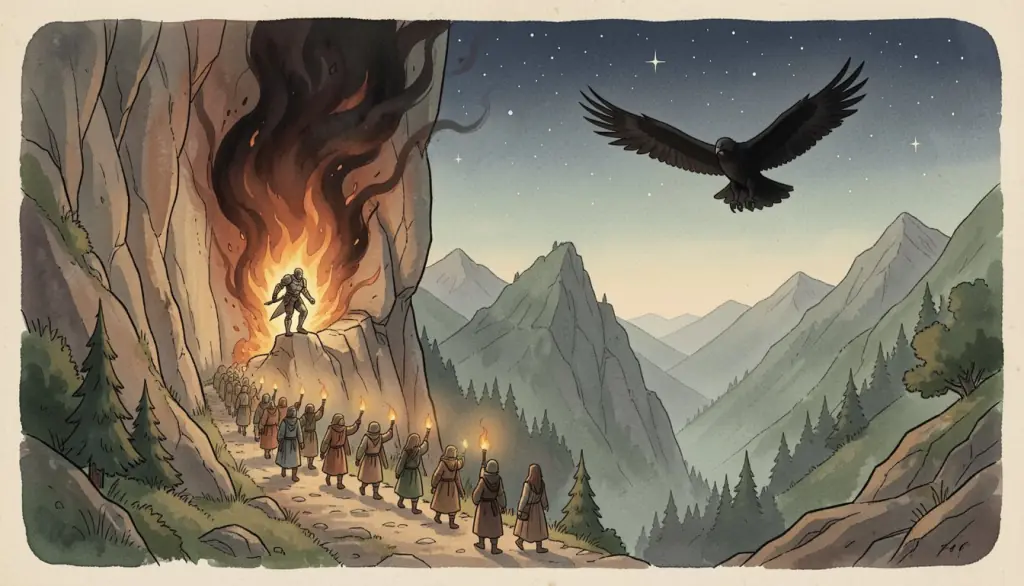
What follows is one of the gentlest images in that chapter. Thorondor, King of Eagles, comes to the rescue, and the eagles drive the Orcs back. Thorondor bears up Glorfindel's body from the depth, and the survivors build a cairn of stones over him on the pass. Tolkien adds that green turf grew there, and yellow flowers bloomed on it among the barren stones, until the world was changed. The flowers are a small, deliberate echo of the Golden Flower of his house.
The older version in The Book of Lost Tales Part Two, reprinted in the 2018 volume The Fall of Gondolin, tells the duel at greater length. The published Silmarillion keeps only the essentials: a held pass, a fall together, a cairn and flowers.
For the creatures themselves, see Balrogs of Middle-earth. The point for Glorfindel is simple. Three Balrog-slayers are named in Tolkien: Ecthelion at the fall of Gondolin, Glorfindel on the pass, and Gandalf on the peak above Moria. All three die in the act. Of the three, Glorfindel is the only Elf who comes back.
Mandos and the Return
How does an Elf who died in the First Age ride out of Rivendell at the end of the Third? For decades the honest answer was: we are not told. The answer comes from material Tolkien wrote at the very end of his life.
In Tolkien's mythology, Elves are bound to the world. A slain Elf's spirit goes to the Halls of Mandos in Valinor (see Valinor and the Undying Lands), where in time it may be allowed to return to bodily life. Tolkien worked over how this happened in Morgoth's Ring, including "Laws and Customs among the Eldar"; the Glorfindel essays assume the returned Glorfindel is the same person.
In the essays printed in The Peoples of Middle-earth (the section of "Last Writings" on Glorfindel), Tolkien argues that Glorfindel's case was special. Many exiled Noldor were under the Doom of Mandos for their rebellion. Glorfindel, in Tolkien's late reading, had gone with Turgon out of loyalty rather than rebellion, and he had laid down his life to save others. So his release from Mandos came relatively early, and he lived again in Valinor.
Tolkien adds a detail that ties two stories together: in Valinor Glorfindel became a friend and follower of Olórin, the Maia who would later go to Middle-earth as Gandalf. He also writes that Glorfindel's spiritual power grew, so the Elf who returned was greater than the Elf who fell. For Gandalf's side, see Gandalf's Elvish name, Mithrandir.
When did he come back? Tolkien's two essays differ. In the first he thought of Glorfindel coming to Middle-earth with the Istari, the Wizards, who arrived around Third Age 1000 (Appendix B). In the second he preferred an earlier return, in the Second Age, while Sauron's power was growing and the Elves of Eriador needed help. He did not settle on a year. What both essays agree on is that his return was purposeful, an act of help for the Elves of Middle-earth against Sauron, not an accident.
A caution: none of this is in The Lord of the Rings or The Silmarillion as published. It is Tolkien's own late reasoning in short, exploratory essays, so we have kept to their main conclusions and left out details a summary would have to guess at.
The Battle of Fornost and the Witch-king Prophecy
Glorfindel's first recorded Third Age deed comes in Appendix A. For centuries the Witch-king of Angmar, chief of the Nazgûl, made war on the Dúnedain of Arnor, and in Third Age 1974 he took Fornost, ending Arthedain. In 1975 a fleet from Gondor under Eärnur, the King's heir, came north, joined the Elves of Lindon under Círdan and what was left of the Dúnedain, and destroyed the Witch-king's army at the Battle of Fornost. From Rivendell came Glorfindel with a company of Elves.
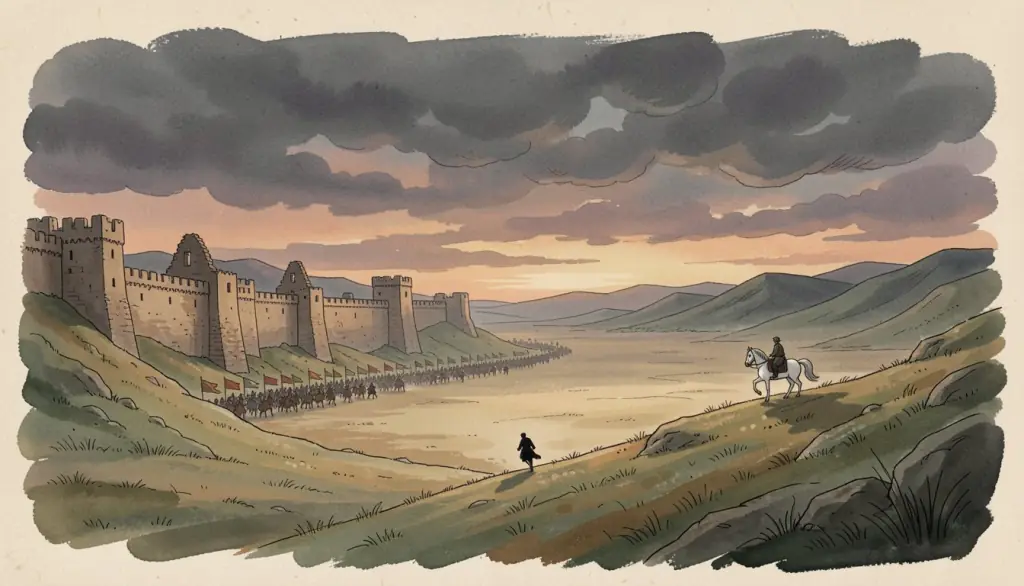
The Witch-king rides out to face Eärnur, and Eärnur's horse cannot endure him and bears its rider away. Then Glorfindel comes up, and the Witch-king turns and flees into the gathering dark and is not found. Eärnur wants to ride after him. Glorfindel stops him, saying the Witch-king will not return to this land, that his doom is far off, and that "not by the hand of man will he fall" (Appendix A).
The prophecy is famous because of how it comes true. On 15 March 3019, on the Pelennor Fields before Minas Tirith, the Witch-king is brought down by Merry, a hobbit, whose blade from the Barrow-downs cuts him behind the knee, and by Éowyn, a woman of Rohan, who strikes the killing blow (The Return of the King, Book V, ch. 6). Neither is a man in the narrow sense.
Glorfindel's words are foresight, not a curse. On the Pelennor the Witch-king boasts to Éowyn that no living man may hinder him, like a creature trusting the letter of his doom; Tolkien never says whether he knew Glorfindel's words. Either way, the doom is fulfilled more than a thousand years later by the two people nobody expected.
For the Witch-king's own story, from Angmar to Minas Morgul, see our guide to the Witch-king of Angmar. For the Nine as a group, see the Nazgûl, Ringwraiths explained.
The Ford of Bruinen
Glorfindel's great scene is "Flight to the Ford", the last chapter of Book I. Frodo has been stabbed on Weathertop with a Morgul-knife, and Aragorn is leading the hobbits toward Rivendell with the Black Riders hunting them.
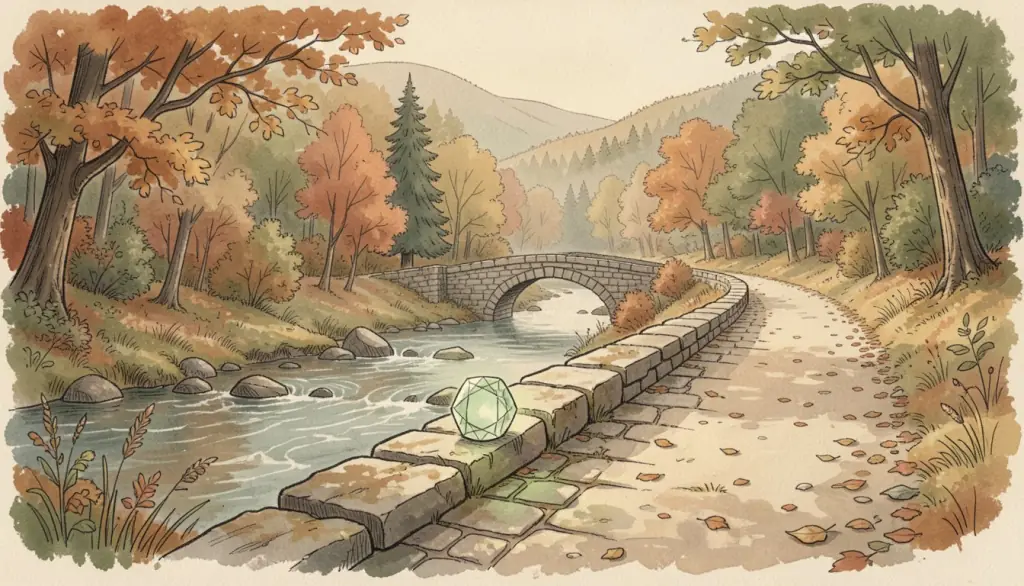
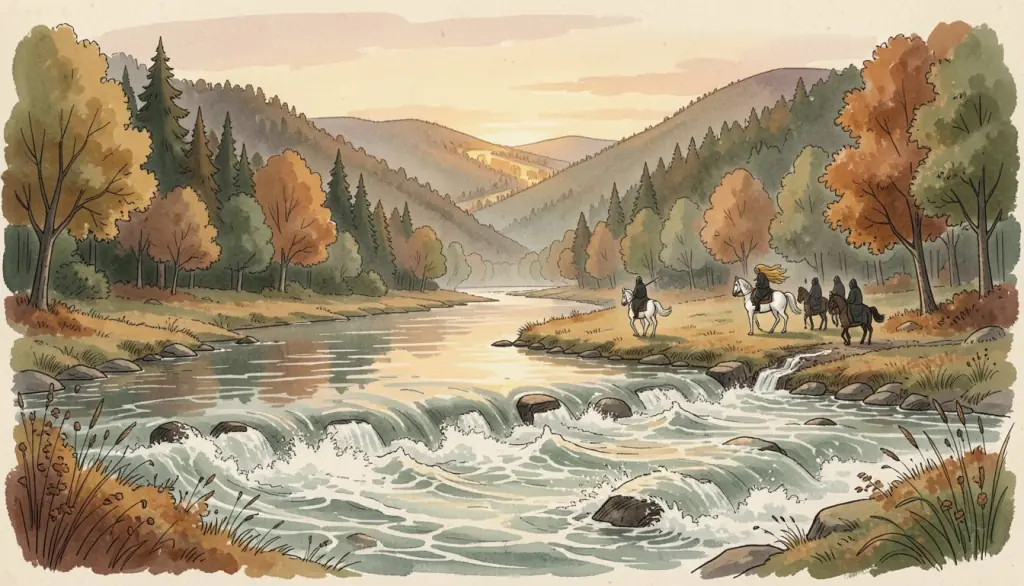
On the Last Bridge over the Hoarwell, Aragorn finds a pale green jewel, a beryl, an elf-stone, a sign left there by Glorfindel. Later, at dusk on the Road, a white horse comes into view with a rider whose golden hair streams in the wind, and the bridle of the horse flickers with gems. The rider greets Aragorn in Elvish: Ai na vedui Dúnadan! Mae govannen! (The Fellowship of the Ring, Book I, ch. 12).
Tolkien does not translate the first part in the text. Dúnadan is "Man of the West", a name for Aragorn's people, and Mae govannen means "well met", the standard Sindarin greeting; we explain it in Mae Govannen: Meaning and Use. We give no translation for Ai na vedui, because the book leaves it untranslated.
Glorfindel explains that Elrond sent riders out in several directions when news of the Nine reached Rivendell, and that he himself had found Riders on the Road and driven some of them off. He sees at once how badly Frodo is hurt. He puts Frodo on Asfaloth, shortens the stirrups, and tells him that if the Riders come, the horse will carry him on ahead of the others.
At the Ford the Riders catch up. Asfaloth, at a cry from Glorfindel, Noro lim, noro lim, Asfaloth!, races ahead and carries Frodo across the river. Tolkien does not translate the cry in the text; lim is Sindarin for "quick, swift". On the far bank Frodo turns and defies the Nine. As they ride into the water to take him, the river rises in a great flood, with what look like white horses on the waves, and sweeps them away.
In the moment before he faints, Frodo sees beyond the Riders a shining figure of white light, and behind it smaller shadowy shapes waving flames. Those are Glorfindel, Aragorn and the hobbits, driving the last of the Riders into the water with fire.
Who raised the flood? Not Glorfindel. In "Many Meetings" Gandalf explains that the river was under Elrond's command, and that he himself added the white horses to the waves. Glorfindel's part was to get Frodo to the water and drive the Nine into it.
Glorfindel in Rivendell: Many Meetings and the Council
When Frodo wakes in Rivendell, he asks Gandalf about the shining figure. Gandalf's answer is the key passage on Glorfindel (Book II, ch. 1, "Many Meetings").
Gandalf says that Frodo saw Glorfindel for a moment as he is "upon the other side", in the unseen world into which the Ring had half drawn the wounded hobbit. He explains that those Elves who have dwelt in the Blessed Realm live at once in both worlds, and that against both the seen and the unseen they have great power. Then he gives his verdict: Glorfindel is "one of the mighty of the Firstborn", an Elf-lord of a house of princes.
Read with hindsight, this passage is why the two Glorfindels had to be one: an Elf of Valinor with power in the unseen world fits the Balrog-slayer far better than a minor Elf who happened to share his name.
At the Council of Elrond (Book II, ch. 2), when Tom Bombadil is suggested as a keeper, Glorfindel argues against it, foreseeing that in the end, if all else fell, Bombadil too would fall, last as he was first, and then night would come. He also raises the idea of casting the Ring into the depths of the Sea, which Gandalf rejects. He reasons like someone who has seen the long history of the world.
The most telling moment comes when the Company is chosen (Book II, ch. 3, "The Ring Goes South"). Elrond is unwilling to send Merry and Pippin. Gandalf argues for friendship over strength, with Glorfindel as his example: even an Elf-lord such as he could not storm the Dark Tower or open the road to the Fire by his own power. So the mightiest Elf in Rivendell stays behind, and the Ring goes south with two hobbits who have no power at all.
After that, The Lord of the Rings says nothing more about him. Tolkien does not tell us whether he rode to war, whether he left with Elrond at the end of the Third Age, or what became of him in the Fourth Age.
The "Two Glorfindels" Question
Is the Elf of Rivendell the Elf of Gondolin? The name and the golden hair are the same, and Gandalf's description fits a lord of Valinor, but until 1996 nobody outside the Tolkien family could point to Tolkien's own answer. The history runs like this:
- Around 1917 Tolkien wrote "The Fall of Gondolin", with Glorfindel of the Golden Flower dying in a duel with a Balrog.
- In the late 1930s, drafting The Lord of the Rings, he needed a great Elf to meet Frodo on the road and used the name Glorfindel. The early drafts are in The Return of the Shadow (The History of Middle-earth, vol. 6).
- In 1954 The Fellowship of the Ring was published with Glorfindel in it. The Gondolin story was still unpublished.
- In 1972 to 1973 Tolkien faced the question directly in two short essays. He acknowledged that the name had been taken over from the old Gondolin legend when he was writing The Lord of the Rings. Rather than rename either, he made them the same person and built the explanation of Mandos described above.
- In 1977 The Silmarillion was published, with Glorfindel's death on the pass.
- In 1996 Christopher Tolkien published the essays in The Peoples of Middle-earth.
One of Tolkien's arguments in the essays is about naming. Among the Eldar, he reasons, a name borne by a great and famous figure would not lightly be given to another Elf of importance. If two great lords called Glorfindel had existed, the coincidence would need explaining; one Glorfindel who died and returned is the simpler account.
Is the matter settled? Tolkien's own last word is clear: one Glorfindel. It was never put into a revised published text, so a strict reader of the printed books can only say they do not decide it. But "Many Meetings" points the same way, and no Tolkien text argues for two. When we say Glorfindel of Rivendell is the Balrog-slayer, we mean it is Tolkien's final, documented view.
Glorfindel's Name and Language
Glorfindel is a Sindarin name meaning "golden-haired". The Appendix to The Silmarillion, which lists the elements of names, cites Glorfindel as an example of both parts:
| Element | Language | Meaning | Source |
|---|---|---|---|
| glor- | Sindarin | golden, related to glaur, gold of light or colour | The Silmarillion, Appendix, entry laurë; Unfinished Tales; The Etymologies |
| laurë | Quenya | gold, golden light (not the metal) | The Silmarillion, Appendix |
| find | Sindarin | tress, single hair | The Silmarillion, Appendix, entry find-; The Etymologies |
| findë | Quenya | hair | The Silmarillion |
The point Tolkien makes with laurë is a careful one: the word means the golden colour of light, the gold of Laurelin, the Golden Tree of Valinor, not the metal gold, for which Sindarin has malt and Quenya malta. Glorfindel's hair is golden as sunlight is golden. The same element appears in Quenya names such as Laurelin, and the hair element in the names of other Noldor, for example Finrod and Finduilas.
Why does a Noldo born in Valinor carry a Sindarin name? Because the Noldor who settled in Beleriand adopted Sindarin as their daily speech and used Sindarin forms of their names. Glorfindel is in good company: Turgon, Fingon and many other exiled princes are known by Sindarin or Sindarin-shaped names. The books give only the Sindarin form for him.
How to say it. By the stress rule in Appendix E, a three-syllable name is stressed on the second-to-last syllable when that syllable is long, and a short vowel followed by two consonants counts as long. In Glorfindel the middle syllable fin is followed by nd, so the stress falls there: glor-FIN-del. Asfaloth, by contrast, has a short middle syllable followed by a single consonant, so the stress moves back: AS-fa-loth.
Around him are other Sindarin names: Imladris, Rivendell, "deep dale of the cleft"; Bruinen, which the book also calls the Loudwater; Cirith Thoronath, the Eagles' Cleft. To read these names yourself, our beginner's guide to Sindarin is the place to start, and Elvish character names and their meanings puts Glorfindel next to Legolas, Galadriel and Elrond.
Books vs Films vs The Rings of Power
Peter Jackson's The Fellowship of the Ring (2001)
In the film Glorfindel does not appear. Arwen finds the hobbits, takes the dying Frodo on her horse, outrides the Nazgûl to the Ford, and the flood rises as she calls on the water. These are the film's choices, not Tolkien's:
- Arwen at the Ford. In the book Arwen is not on the Road at all; she is in Rivendell, and Frodo first sees her at the feast in "Many Meetings".
- The rider. In the book Glorfindel puts Frodo on Asfaloth and sends him on alone; the film puts Arwen in the saddle with him.
- The flood. In the book Elrond commands the river and Gandalf adds the white horses. The film shows the water answering Arwen.
- The Elvish. Arwen's lines in the scene are film Sindarin written by David Salo, not Tolkien's sentences. Our post on Arwen's Elvish quotes translated goes through them line by line.
The change is reasonable for a film: it gives Arwen, whose love story sits mostly in the appendices, a reason to be on screen early, and it avoids introducing a powerful character who would then vanish. The cost is Gandalf's explanation of the shining figure, and with it the idea that the Elves of Valinor live in two worlds at once. Glorfindel does not appear in the Hobbit trilogy either.
Ralph Bakshi's animated film (1978)
The earlier animated Lord of the Rings gave his scene to Legolas instead. The impulse is the same: use a character the audience will see again.
The Rings of Power
The Rings of Power is set in the Second Age, which by Tolkien's later preference could be Glorfindel's time back in Middle-earth, but he did not appear in Seasons 1 and 2.
Season 3 premiered on Prime Video on 11 November 2026 with four episodes; episodes 5 and 6 are due on 18 November and episodes 7 and 8 on 25 November. No Season 3 casting announcement we have seen names a Glorfindel, and anything online about "Glorfindel in Rings of Power" should be treated as speculation unless it comes from the show itself. For what the season has confirmed about its languages, see our Rings of Power Season 3 Elvish preview.
There is also a practical obstacle. The show adapts The Lord of the Rings and its appendices, while Glorfindel's death is told in The Silmarillion and his return only in The Peoples of Middle-earth. A Second Age Glorfindel on screen would have to be built mostly from invention.
What the films get right, in our view: the speed and danger of the ride, and the sense that Rivendell has powers the Nazgûl fear. What they lose: the quiet joke of the Council, where the mightiest Elf in the room is left behind in favour of two hobbits.
How Tolkien Built Glorfindel
Glorfindel is a good case study in how Tolkien wrote, because the character was assembled over more than fifty years from pieces that were not designed to fit.
First, a heroic death. The Glorfindel of "The Fall of Gondolin" belongs to the earliest layer of the mythology. His purpose is to die well: to hold a pass, take a demon with him, and be honoured with a cairn and flowers.
Second, a name reused. Writing The Lord of the Rings, Tolkien needed an Elf who could ride against the Nine without seeming foolish, and he reached for a name he already had. His invented history was a store of names he drew on as the story needed them.
Third, a hint left open. Gandalf's words in "Many Meetings" give Glorfindel a power that only makes full sense in the light of Valinor. Whether Tolkien had already decided on one Glorfindel when he wrote them, we do not know, but the passage could bear the later explanation.
Fourth, a late reconciliation. In his last years Tolkien made the pieces fit, not by changing the published text but by reasoning about how his world worked: how slain Elves return, what the Doom of Mandos meant for different exiles, why the Valar might send help. He treated his own earlier books as historical sources to be explained rather than drafts to be corrected.
Fifth, a prophecy that does double duty. The Fornost prophecy explains why the Witch-king fears nothing from men, sets up the Pelennor Fields, and connects Glorfindel to the Nine before he meets them at the Ford.
The result links the ages: Glorfindel saves the child Eärendil, serves Eärendil's son Elrond, and rescues Frodo, who will later carry the light of Eärendil in Galadriel's phial.
Our Take
Our view, stated plainly: Glorfindel is Tolkien's best argument for the Fellowship, and he works precisely because he is wasted. He has killed a Balrog, broken Angmar and come back from the dead, and the book uses him for exactly one rescue and then leaves him at home.
We think that works as if deliberate. Tolkien shows us Glorfindel at the Ford so we know what Elvish power looks like in use, then has Gandalf say that this power cannot do what the quest needs. The Ring cannot be fought to Mordor. Glorfindel's absence from the Company is the book's quiet thesis, and every reader who asks "why didn't they just send Glorfindel?" is asking the question Tolkien wanted asked.
That is why Jackson's change, defensible as it is, costs more than it seems: with Arwen in his place, nobody in Rivendell is obviously too strong to take along, so the choice of hobbits looks like necessity rather than wisdom.
On the "two Glorfindels" question, we come down firmly on Tolkien's side. His late solution is not a patch; it improves the story. A lord who died holding a pass for refugees, was pardoned for loyalty, and was sent back to hold the road again for a dying hobbit is a better character than two unrelated Elves with the same hair. If you read only one of Tolkien's late essays, make it this one, then reread "Flight to the Ford" knowing who the rider on the white horse really is.
People Also Ask
Who is Glorfindel in Lord of the Rings?
Glorfindel is an Elf-lord of Rivendell who rides out on Elrond's orders to find Frodo, Aragorn and the hobbits on the Great East Road. He puts the wounded Frodo on his horse Asfaloth and helps drive the Black Riders into the flood at the Ford of Bruinen. Gandalf later calls him one of the mighty of the Firstborn. He appears in The Fellowship of the Ring, Book I, chapter 12, and at the Council of Elrond.
Is Glorfindel the same Elf who fought the Balrog in Gondolin?
In Tolkien's final view, yes. He reused the name of the Gondolin Balrog-slayer when writing The Lord of the Rings, and around 1972 to 1973 he wrote two essays, published in The Peoples of Middle-earth, deciding they were one Elf: slain in the First Age, restored in Valinor, and sent back to Middle-earth.
Why is Glorfindel not in the Lord of the Rings movies?
Peter Jackson's 2001 film gave his role at the Ford of Bruinen to Arwen, and Glorfindel does not appear at all. Ralph Bakshi's 1978 animated film had given the same scene to Legolas. Both changes use a character the audience already knows in place of one who appears only briefly.
How did Glorfindel come back from the dead?
In Tolkien's late essays, his spirit went to the Halls of Mandos after his death. Because he had followed Turgon into exile out of loyalty and gave his life to save the refugees of Gondolin, he was released early, lived again in Valinor, and was later sent back to Middle-earth. This comes from late writing printed in The Peoples of Middle-earth, not from The Lord of the Rings.
What did Glorfindel prophesy about the Witch-king?
After the Battle of Fornost in Third Age 1975, he told Eärnur not to pursue the Witch-king, saying his doom was far off and that he would not fall by the hand of man (Appendix A). The Witch-king was destroyed on the Pelennor Fields in 3019 by Éowyn and Merry.
What does the name Glorfindel mean?
It is Sindarin for "golden-haired": glor-, golden in the sense of light or colour, plus find, a tress of hair. The Silmarillion's appendix of name elements gives the meaning. By Tolkien's stress rules it is said glor-FIN-del.
How powerful is Glorfindel?
He is among the most powerful Elves of the Third Age. Gandalf says Elves who lived in the Blessed Realm dwell in both worlds at once, and that Frodo saw Glorfindel at the Ford as he is on the other side. Tolkien's late essays say his spiritual power grew after his return. Even so, Gandalf says he could not storm the Dark Tower by his own power.
Why didn't Glorfindel join the Fellowship?
Gandalf argued that friendship mattered more than strength, and that even an Elf-lord such as Glorfindel could not storm the Dark Tower or open the road to the Fire by his own power (The Fellowship of the Ring, Book II, ch. 3). The mission needed secrecy, so Merry and Pippin went instead.
What is Glorfindel's horse called?
Asfaloth, a white Elvish horse. Glorfindel puts Frodo on Asfaloth's back and the horse carries him across the Ford of Bruinen ahead of the Black Riders. In Jackson's film Arwen rides the horse instead.
Is Glorfindel in The Rings of Power?
No. He did not appear in Seasons 1 and 2, and no Season 3 casting announcement we have seen names him. Season 3 premiered on 11 November 2026, with its last episodes due on 25 November. His Gondolin story and his return from Mandos are not in the books the show adapts.
Learn the Language of Rivendell
Glorfindel's name, his greeting to Aragorn and his cry to Asfaloth are all Sindarin, the everyday Elvish of Rivendell. To learn the language behind them, start with our free Elvish course, which teaches Sindarin and Quenya using words Tolkien actually wrote.
Related Reading
- Characters of Middle-earth: Who's Who in Tolkien's World
- Elrond Explained
- Balrogs of Middle-earth
- The Witch-king of Angmar
- The Nazgûl: Ringwraiths Explained
- Gondolin: The Hidden City
- Rivendell Explained
- Elves of Middle-earth
- Valinor and the Undying Lands
- Galadriel Explained
- Arwen's Elvish Quotes Translated
People Also Ask
Who is Glorfindel in Lord of the Rings?
Glorfindel is an Elf-lord of Rivendell who rides out on Elrond's orders to find Frodo, Aragorn and the hobbits on the Great East Road. He puts the wounded Frodo on his horse Asfaloth and helps drive the Black Riders into the flood at the Ford of Bruinen. Gandalf later calls him one of the mighty of the Firstborn. He appears in The Fellowship of the Ring, Book I, chapter 12, "Flight to the Ford", and at the Council of Elrond.
Is Glorfindel the same Elf who fought the Balrog in Gondolin?
In Tolkien's final view, yes. When he wrote The Lord of the Rings he reused the name of the Glorfindel who died fighting a Balrog during the fall of Gondolin. Around 1972 to 1973 he wrote two short essays, published in The Peoples of Middle-earth, in which he decided they were one and the same Elf: slain in the First Age, restored in Valinor, and later sent back to Middle-earth.
Why is Glorfindel not in the Lord of the Rings movies?
Peter Jackson's 2001 film gave Glorfindel's role at the Ford of Bruinen to Arwen, who carries Frodo on her horse and faces the Ringwraiths. Glorfindel does not appear at all. Ralph Bakshi's 1978 animated film had earlier given the same scene to Legolas. Both changes use a character the audience already knows in place of one who appears only briefly in the book.
How did Glorfindel come back from the dead?
In Tolkien's late essays, Glorfindel's spirit went to the Halls of Mandos after his death in the First Age. Because he had followed Turgon into exile out of loyalty and had given his life to save the refugees of Gondolin, he was released early and given bodily life again in Valinor. Later he was sent back to Middle-earth. This is from unpublished late writing printed in The Peoples of Middle-earth, not from The Lord of the Rings.
What did Glorfindel prophesy about the Witch-king?
After the Battle of Fornost in Third Age 1975, Glorfindel told Eärnur not to pursue the fleeing Witch-king, saying his doom was far off and that he would not fall by the hand of man. More than a thousand years later the Witch-king was destroyed on the Pelennor Fields by Éowyn, a woman, and Merry, a hobbit. The prophecy is in Appendix A of The Lord of the Rings.
What does the name Glorfindel mean?
Glorfindel is Sindarin for "golden-haired". It joins glor-, the Sindarin form related to Quenya laurë, golden light or colour, with find, a tress or lock of hair. The Silmarillion's appendix of name elements gives the meaning. By Tolkien's stress rules it is said glor-FIN-del.
How powerful is Glorfindel?
He is among the most powerful Elves in the Third Age. Gandalf says that Elves who have lived in the Blessed Realm dwell in both worlds at once, and that Frodo saw Glorfindel at the Ford as he is on the other side, a shining figure. In his late essays Tolkien wrote that Glorfindel's spiritual power had grown after his return from Valinor. Still, Gandalf says even he could not storm the Dark Tower by his own power.
Why didn't Glorfindel join the Fellowship?
When the Company was chosen, Gandalf argued that friendship mattered more than strength. Even an Elf-lord such as Glorfindel, he said, could not storm the Dark Tower or open the road to the Fire by his own power. The mission depended on secrecy, not force, so Merry and Pippin went instead of a great warrior. This is in The Fellowship of the Ring, Book II, chapter 3, "The Ring Goes South".
What is Glorfindel's horse called?
His horse is Asfaloth, a white Elvish horse. Glorfindel puts Frodo on Asfaloth's back and the horse carries him across the Ford of Bruinen ahead of the Black Riders. In Peter Jackson's film Arwen rides the horse instead.
Is Glorfindel in The Rings of Power?
No. Glorfindel did not appear in the first two seasons of The Rings of Power, and no Season 3 casting announcement we have seen names him. Season 3 premiered on 11 November 2026, with its last episodes due on 25 November. The Gondolin story and Tolkien's late essays on Glorfindel are not in The Lord of the Rings or its appendices, the books the show adapts.
Related Tags
Learn Elvish Free
39 free Elvish lessons, an AI tutor, and spaced repetition review — no credit card required.
Start Learning Free