Samwise Gamgee Explained: Gardener, Ring-bearer and Mayor of the Shire
Try It Yourself — Free Elvish Tools
Quick Answer: Samwise Gamgee is the hobbit gardener of Bag End who goes with Frodo Baggins to destroy the One Ring. He was born in Third Age 2980 (Shire Reckoning 1380), son of Hamfast "the Gaffer" Gamgee. He fights off Shelob, carries the Ring for a short time when he thinks Frodo is dead, rescues him from Cirith Ungol and helps him up Mount Doom. Afterwards he marries Rose Cotton, restores the Shire with Galadriel's gift, serves seven terms as Mayor, finishes the Red Book and, by tradition, sails West in 1482 as the last of the Ring-bearers.
Samwise Gamgee begins The Lord of the Rings as a servant listening under a window and ends it as the man who closes the book. In between he does the one thing nobody else in the story manages: he holds the Ring, is tempted by it, and gives it back without being asked. Tolkien called him "the chief hero" of the story in a letter, and readers have argued about that phrase ever since.
This guide sets out what the books say about Sam, from Bagshot Row to the Grey Havens, with dates from the Appendices and chapter references for every scene. Adaptation material is kept in its own section, and our own reading of the character is marked as interpretation. For his people as a whole, start with our guide to the hobbits of Middle-earth. For the wider cast, see Characters of Middle-earth.
Samwise Gamgee at a Glance
| People | Hobbit of the Shire, of a working family in Hobbiton |
| Full name | Samwise Gamgee; "Master Samwise" in his later years; his children appear in Appendix C as Gardner |
| Real Westron name | Banazîr Galbasi, shortened to Ban (The Lord of the Rings, Appendix F) |
| Born | Third Age 2980, Shire Reckoning 1380 (Appendix B; Appendix C) |
| Father | Hamfast Gamgee, "the Gaffer", gardener at Bag End |
| Mother | Bell Goodchild (Appendix C) |
| Wife | Rose Cotton, married spring 1420 |
| Children | Thirteen, beginning with Elanor the Fair (Appendix C) |
| Occupation | Gardener at Bag End; later Mayor of the Shire |
| Ring-bearer | Briefly, from Shelob's Lair to the Tower of Cirith Ungol, March 3019 |
| Mayor | Seven terms, Shire Reckoning 1427 to 1476 (Appendix B) |
| Fate | Rode to the Grey Havens in 1482 and passed over Sea, according to a tradition from Elanor (Appendix B) |
| First appearance | The Fellowship of the Ring, Book I, ch. 1 (mentioned); ch. 2, "The Shadow of the Past" (on stage) |
| Film actor | Sean Astin (Peter Jackson's trilogy, 2001 to 2003) |
Samwise Gamgee Timeline
"Mae govannen" — want to actually speak Elvish?
Try It Free →Dates come from Appendix B ("The Tale of Years") and the narrative itself. Shire Reckoning (S.R.) runs 1,600 years behind the Third Age count, so S.R. 1380 is Third Age 2980. The Shire dated the Fourth Age from S.R. 1422.
| Age and year | Event |
|---|---|
| Third Age 2980 (S.R. 1380) | Samwise born in Hobbiton (Appendix B) |
| Third Age 3018, April | Gandalf returns; Sam is caught listening under the study window (The Fellowship of the Ring, Book I, ch. 2) |
| Third Age 3018, 23 September | Frodo leaves Bag End with Sam and Pippin (Appendix B) |
| Third Age 3018, 25 October | Council of Elrond; Sam is found hiding and named Frodo's companion (Book II, ch. 2) |
| Third Age 3019, January to February | The Fellowship stays in Lothlórien; Sam looks in the Mirror and receives Galadriel's box |
| Third Age 3019, 26 February | Breaking of the Fellowship; Sam goes with Frodo (Appendix B) |
| Third Age 3019, 12 to 13 March | Shelob's Lair; Frodo is stung and captured; Sam takes the Ring |
| Third Age 3019, 14 March | Sam rescues Frodo from the Tower of Cirith Ungol and returns the Ring |
| Third Age 3019, 25 March | The Ring is destroyed in Mount Doom |
| Third Age 3019, April | The Ring-bearers are honoured on the Field of Cormallen |
| S.R. 1419, 3 November | Battle of Bywater; the Shire is cleared of ruffians (Appendix B) |
| S.R. 1420 | Sam plants Galadriel's gift; marries Rose Cotton in the spring (The Return of the King, Book VI, ch. 9) |
| S.R. 1421, 25 March | Elanor the Fair born |
| S.R. 1421, 29 September | Frodo sails from the Grey Havens; Sam receives the Red Book |
| S.R. 1427 | Will Whitfoot resigns; Sam elected Mayor for the first time (Appendix B) |
| S.R. 1436 | King Elessar meets his friends at the Brandywine Bridge and gives Sam the Star of the Dúnedain (Appendix B) |
| S.R. 1476 | Sam ends his seventh and last term as Mayor, aged ninety-six |
| S.R. 1482, Mid-year's Day | Rose dies |
| S.R. 1482, 22 September | Sam rides out from Bag End, gives the Red Book to Elanor and, by tradition, sails West |
Family and Relationships
Sam comes from a family of working hobbits, not gentry. Appendix C gives the Gamgee tree in more detail than most readers expect, and the Cotton family of Bywater is bound into it twice over.
| Relation | Name | Notes |
|---|---|---|
| Father | Hamfast Gamgee, the Gaffer | Gardener at Bag End for decades; lives at Number 3, Bagshot Row |
| Mother | Bell Goodchild | Named only in Appendix C |
| Brothers | Hamson, Halfred | Hamson works as a roper in Tighfield, the family trade Sam brags about |
| Sisters | Daisy, May, Marigold | Marigold marries into the Cotton family |
| Wife | Rose Cotton | Daughter of Farmer Tolman Cotton of Bywater |
| Eldest child | Elanor the Fair | Born 25 March 1421; later married Fastred of Greenholm |
| Other children | Frodo, Rose, Merry, Pippin, Goldilocks, Hamfast, Daisy, Primrose, Bilbo, Ruby, Robin, Tolman | Appendix C; Goldilocks marries Faramir Took, son of Pippin |
| Master and friend | Frodo Baggins | Sam's employer, and the person he will not leave |
| Teacher | Bilbo Baggins | Taught Sam his letters and his love of old tales |
Sam's children carry the names of the Fellowship's hobbits and of Bilbo, so the family tree is itself a memorial to the quest. Elanor's descendants become the Fairbairns of the Towers, Wardens of Westmarch, who keep the Red Book (Appendix B; Prologue, "Note on the Shire Records").
Who Samwise Gamgee Is
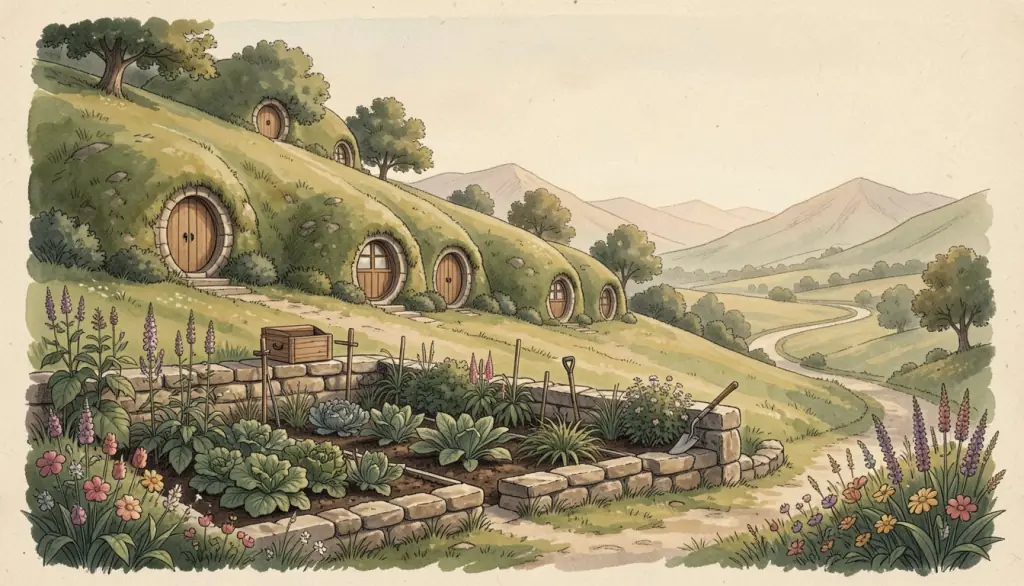
Sam is the gardener at Bag End, a hobbit in his late thirties when the story starts, born twelve years after Frodo. He is not a relation of the Bagginses and not a gentleman hobbit. His father calls Frodo "Mr. Frodo," and so does Sam to the end of the book.
He is also something unusual in the Shire: a working hobbit who reads. The Gaffer complains in the Green Dragon that Mr. Bilbo has "learned him his letters" (The Fellowship of the Ring, Book I, ch. 1). Bilbo filled his head with stories of Elves and dragons, and when we first hear Sam talk, in "The Shadow of the Past," he is arguing with the miller's son, Ted Sandyman, about walking trees seen in the North Farthing. Sam is the one hobbit in the pub who believes the rumours.
Sam is earthy and practical, worried about pans, rope and ponies, and also the hobbit with the most longing for the world outside the Shire. He wants to see Elves. That wish is the first thing he confesses and, in a sense, the last thing granted to him.
The Gardener of Bag End
Sam enters the plot by accident. In "The Shadow of the Past" Gandalf tells Frodo the history of the Ring in the study at Bag End, and hears something outside. He reaches through the window and hauls Sam in by the ear. Sam has been "eavesdropping," which he denies in the most Sam-like way possible: he was only trimming the grass border under the window, and he heard a deal about Elves (The Fellowship of the Ring, Book I, ch. 2).
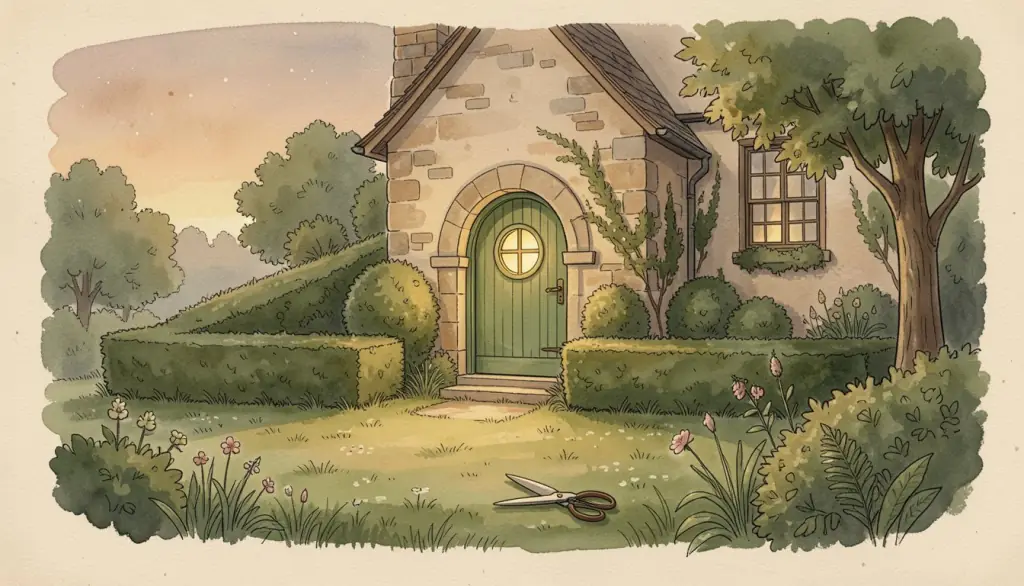
Gandalf's punishment is to send him with Frodo, and Sam is overjoyed, because he might see Elves.
There is a second layer. In "A Conspiracy Unmasked" (Book I, ch. 5) we learn that Sam had been reporting to Merry and Pippin for months. The friends had guessed Frodo meant to leave, and Sam was their spy in the house. When Frodo protests, Sam's answer is that Gandalf told him to look after Frodo, and that is what he has been doing. The loyalty is already there, mixed with a good deal of cheerful scheming.
Before they set out, Sam's longing is answered once. On the road through the Woody End the hobbits meet Gildor Inglorion and his company of High Elves (Book I, ch. 3, "Three is Company"). Sam walks among the Elves in a daze. The next morning he tells Frodo that the Elves were not what he expected, older and younger at once, and that he now feels he has something to do before the end. The gardener has found his errand.
The Road to Rivendell
In the Old Forest it is Sam who suspects Old Man Willow and keeps his head when Merry and Pippin are trapped (Book I, ch. 6). On the Barrow-downs he is taken with the others, and he receives one of the ancient blades that Tom Bombadil gives the hobbits from the barrow's hoard (Book I, ch. 8). In Bree he buys a half-starved pony from Bill Ferny, names him Bill, and takes care of him all the way to the gate of Moria (Book I, ch. 11). Sam's tenderness toward that pony is one of Tolkien's quiet ways of showing his nature: he looks after whatever is put in his charge.
He also carries a store of Bilbo's verse. Near Weathertop he recites the poem of Gil-galad, which he had learned from Bilbo (Book I, ch. 11, "A Knife in the Dark"). By the stone trolls of the Trollshaws he makes up a comic song about a troll on the spot (Book I, ch. 12, "Flight to the Ford"). Half old lore, half pub humour: that is Sam.
At Rivendell Sam is not invited to the Council of Elrond. He hides in a corner anyway. When Frodo offers to take the Ring to Mordor, Sam jumps up to protest that Frodo cannot go alone. Elrond's answer is dry: it seems hardly possible to separate the two of them, even when one is summoned to a secret council and the other is not (The Fellowship of the Ring, Book II, ch. 2). Sam becomes a member of the Nine, alongside companions such as Gimli and Boromir, by refusing to stay out of the room.
Sam and the Elves of Lothlórien
In Lothlórien Sam's wish to see Elves is fulfilled most completely, and he receives the gift that shapes the rest of his life.
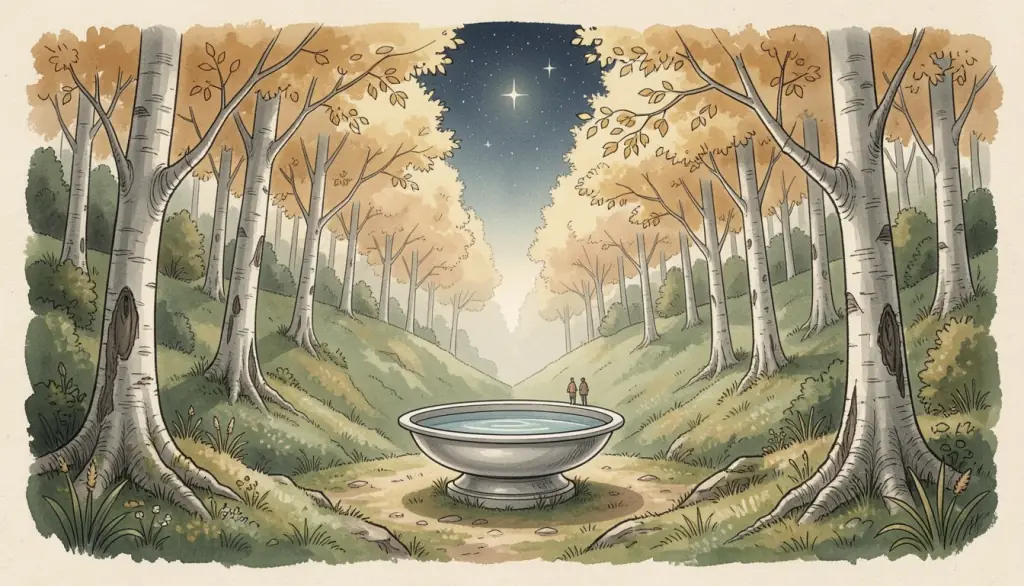
Sam's first reaction to the Golden Wood is the most often quoted thing he says about Elves: he feels as if he were inside a song (The Fellowship of the Ring, Book II, ch. 6). The Elves are no longer a story to him; he is walking around in one.
Then comes the Mirror. Galadriel invites Frodo and Sam to look into her silver basin (Book II, ch. 7). Sam, who had hoped for Elf-magic, sees the Shire being dug up: trees falling, a tall chimney of red brick, and his old father being turned out of Bagshot Row. His first impulse is to go home. His second, and the one he acts on, is to stay with Frodo, going home "by the long road" or not at all. Sam is shown what may be coming and chooses the quest over his own family anyway.
At the parting Galadriel gives each member of the Fellowship a gift (Book II, ch. 8, "Farewell to Lórien"). Sam's is the humblest: a small box of plain grey wood, with a single silver rune on the lid. She tells him the rune stands for her own name, and may also stand for "garden" in his tongue. Inside is earth from her orchard. She tells him it will not help him on the road, but if he comes home at last, it may give him a garden that few in Middle-earth will match. Our Galadriel guide sets this gift beside the others.
Sam also takes a coil of grey Elven-rope from Lórien. Rope runs in his family, whose relations are ropers in Tighfield, and in the Emyn Muil the rope saves the hobbits and then, to Sam's delight, comes loose by itself when he tugs it (The Two Towers, Book IV, ch. 1, "The Taming of Sméagol").
The Breaking of the Fellowship
At Parth Galen Frodo slips away to go to Mordor alone (The Fellowship of the Ring, Book II, ch. 10). While the others scatter, Sam stops to think, guesses the plan, and runs for the boats. He leaps after a boat sliding away apparently empty and, unable to swim, has to be hauled out by his hair by the invisible Frodo. It is the only time in the book that Frodo is outwitted, and by the hobbit everyone took for the slow one.
Sam, Gollum and the Moment on the Stairs
Sam never trusts Gollum. Privately he names the two sides of him "Slinker" and "Stinker" (Book IV, ch. 3), and he is right that one of them is plotting. The problem is that Sam's suspicion, however accurate, leaves no room for the other one.
Sam also cooks. In Ithilien he persuades a reluctant Gollum to catch two rabbits and stews them, complaining that there are no potatoes (The Two Towers, Book IV, ch. 4, "Of Herbs and Stewed Rabbit"). Minutes later Faramir's rangers arrive, and Sam sees the oliphaunt he had only known from a Shire rhyme. At Henneth Annûn it is Sam who blurts out the existence of the Ring to Faramir (Book IV, ch. 5), the worst slip of his journey, which Faramir forgives because he chooses not to take it.
Then come the stairs. Resting before the climb, Frodo and Sam talk about stories, and Sam wonders what sort of tale they have fallen into (Book IV, ch. 8, "The Stairs of Cirith Ungol"). He imagines people one day asking to hear about Frodo and the Ring. Frodo laughs and says the tale has left out one of its chief characters: "Samwise the stouthearted."
While they sleep, Gollum returns from his errand and looks at them. Tolkien writes that for a moment he looked like an old, weary hobbit, and he reaches out to touch Frodo's knee. Sam wakes, sees Gollum "pawing at master," and speaks roughly. The moment passes and does not return. Tolkien's narration makes it plain this was a real chance, and that Sam did not see it. It is the darkest thing Sam does, and he never knows he did it.
Shelob and the Choices of Master Samwise
The climax of The Two Towers belongs to Sam; our guide to giant spiders covers Shelob herself. Gollum leads the hobbits into the tunnel of Torech Ungol, Shelob's Lair, and leaves them there (Book IV, ch. 9). Frodo uses the phial of Galadriel and Sting to drive Shelob back for a while. Then, outside the tunnel, she takes him, and Gollum attacks Sam from behind.
Sam throws Gollum off and turns to find Frodo bound in spider-cords (Book IV, ch. 10, "The Choices of Master Samwise"). What follows is one of the few full battle scenes Tolkien gives to a hobbit. Sam picks up Sting, wounds Shelob in the foot, and then, as she lowers her body to crush him, drives the blade into her belly with her own weight on it. When she gathers for another attack he raises the phial, and words come to him in a language he does not know, a cry to Elbereth. The light blazes, and Shelob flees.
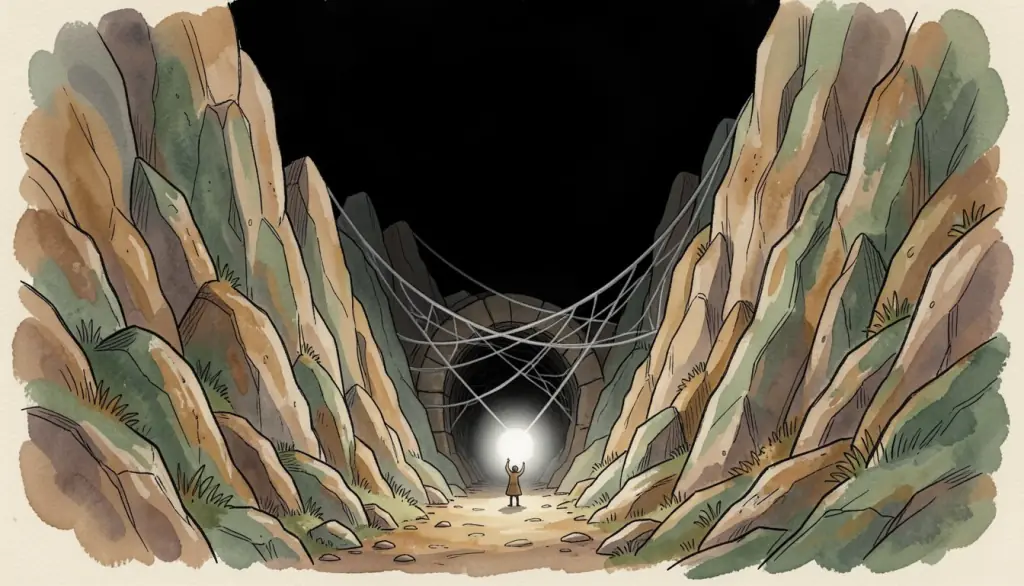
The Elvish is Sindarin: A Elbereth Gilthoniel o menel palan-diriel, le nallon sí di'nguruthos! A tíro nin, Fanuilos!, roughly "O Elbereth Star-kindler, gazing afar from heaven, to you I cry here beneath the horror of death. O look on me, Everwhite." Our Elbereth guide breaks the line down word by word. Sam has heard Elves sing to Elbereth in the Shire and in Rivendell, and the invocation rises in him without his choosing it.
Then the choices of the chapter title. Sam believes Frodo is dead. He argues with himself, aloud and in his head: stay with the body, follow Gollum for revenge, or take the Ring and finish the job alone. He decides that the quest matters more than his grief, takes the Ring from Frodo's neck, and turns toward Mordor.
Within minutes he hears Orcs. Wearing the Ring, he follows them and overhears Shagrat and Gorbag: Frodo is not dead, only stunned by Shelob's poison, and they are carrying him to the tower. The book ends there, with Sam shut outside the gate. Tolkien's last line of the volume is famous for its bluntness: Frodo was alive but taken by the Enemy.
Sam the Ring-bearer
For about a day, Samwise Gamgee carries the One Ring, a fact easy to skip and central to understanding him. For the Ring itself, see how the One Ring was made.
Climbing toward the Tower of Cirith Ungol, Sam feels the Ring's pull grow (The Return of the King, Book VI, ch. 1, "The Tower of Cirith Ungol"). Tolkien gives us his temptation in full. Sam sees himself as Samwise the Strong, Hero of the Age, marching with a flaming sword across a darkened land, and turning the valley of Gorgoroth into a garden of flowers and trees. It is a gardener's fantasy: the Ring offers Sam exactly what he loves, on an impossible scale.
What saves him, Tolkien says, is his plain hobbit sense. Deep down Sam knows he is not big enough for such a burden even if the visions were not a trick. One small garden of a free gardener is all he needs, not a garden swollen to a realm, and he does not want other people's hands to do his work. Sam's limits are his armour.
He then storms the tower almost alone. The Orcs have been killing each other over Frodo's mithril-coat, and Sam takes advantage of the chaos. Lost and desperate on the stairs, he sings a song of his own about the stars beyond the shadow, and from above, Frodo answers. Sam strikes down the Orc who is whipping Frodo and frees him.
Then he gives the Ring back. Frodo, half-mad with the loss, calls him a thief before he recovers himself. Sam feels a moment's reluctance and hands it over anyway. Gandalf once said Bilbo was the only one who had ever truly given the Ring up of his own will; Sam, who carried it into Mordor itself, joins that very short list, and Frodo, at the end, could not.
Across Mordor to Mount Doom
In Mordor (Book VI, ch. 2 and 3) Sam rations the food and water, finds Orc gear to disguise them, and does the thinking while Frodo sinks under the weight.
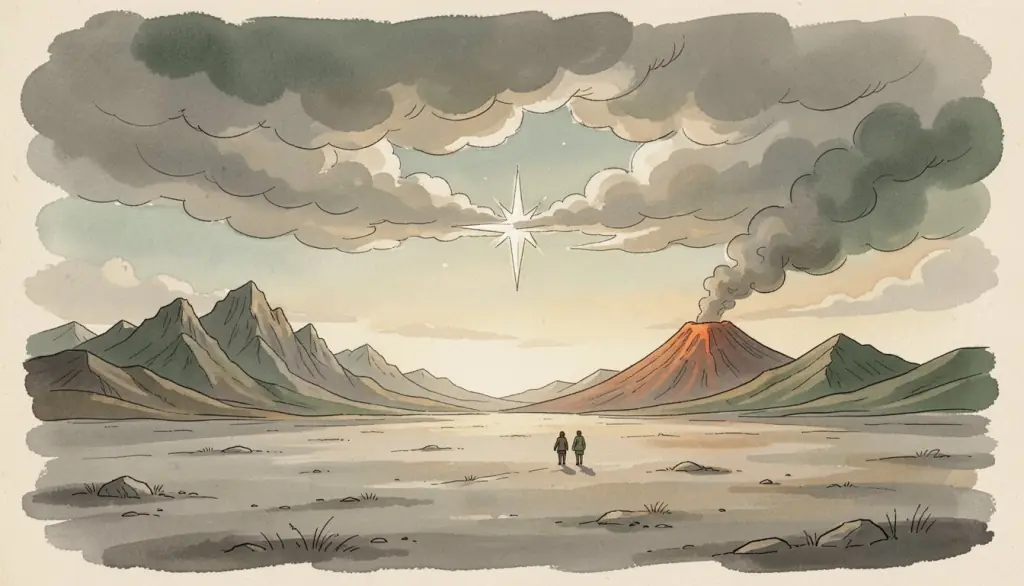
One night in the Morgai, Sam sees a white star glinting through the clouds above the mountains (Book VI, ch. 2, "The Land of Shadow"). He understands, suddenly, that the Shadow is only a small and passing thing, and that light and high beauty lie forever beyond its reach. He sleeps without fear, and from then on his hope no longer depends on whether they survive.
On the slopes of Mount Doom Frodo can no longer walk. Sam cannot take the Ring from him; he knows Frodo would not allow it and that it would be wrong to try. So he takes Frodo instead. His words are among the best known in the book: "I can't carry it for you, but I can carry you" (Book VI, ch. 3, "Mount Doom"). He finds Frodo light to lift, which Tolkien leaves unexplained.
When Gollum attacks for the last time, Sam has him at sword-point. He could kill him and would be justified. He does not. He sees, for a moment, something of what Frodo saw: the misery of a creature the Ring has destroyed. Sam's pity on the mountain is partial and grudging, and it is enough. The creature he spared is the one who, a few minutes later, takes the Ring into the fire.
Cormallen and the Return
After the eruption, eagles carry Frodo and Sam out of the ruin. Sam wakes in Ithilien and finds Gandalf at his bed. His first question is whether everything sad is going to come untrue (Book VI, ch. 4, "The Field of Cormallen"). Gandalf laughs, and Sam hears in it the sound of every joy he has ever known.
At the Field of Cormallen the armies of the West greet the two hobbits in Sindarin: Cuio i Pheriain anann! Aglar'ni Pheriannath!, "Long live the Halflings! Glory to the Halflings!" Pheriannath is a mutated form of Periannath, the Sindarin plural for halflings. A minstrel then sings the tale of Frodo of the Nine Fingers and the Ring of Doom, and Sam weeps for joy. The wish he made on the stairs, to be in a tale, has come true in front of him.
The homeward chapters bring Sam back to the scene he saw in the Mirror. In "The Scouring of the Shire" (Book VI, ch. 8) the hobbits find the Shire ruled by Sharkey's men, the old mill pulled down, a new one belching smoke, and the trees along the road felled. Bagshot Row has been dug up and the Gaffer moved out. The Mirror's vision has come true almost exactly. Sam fights at the Battle of Bywater, but Tolkien gives him a quieter role than Merry and Pippin, who lead the rising: Sam's part is closer to home, at Farmer Cotton's farm where he finds Rosie safe. He is also at Bag End when Saruman is killed by Wormtongue at the door. Our guide to Westron explains how the hobbits' own speech is rendered in these chapters.
Galadriel's Gift and the Year 1420
The last chapter of the book (Book VI, ch. 9, "The Grey Havens") gives Sam his reward, and it comes from Lórien.
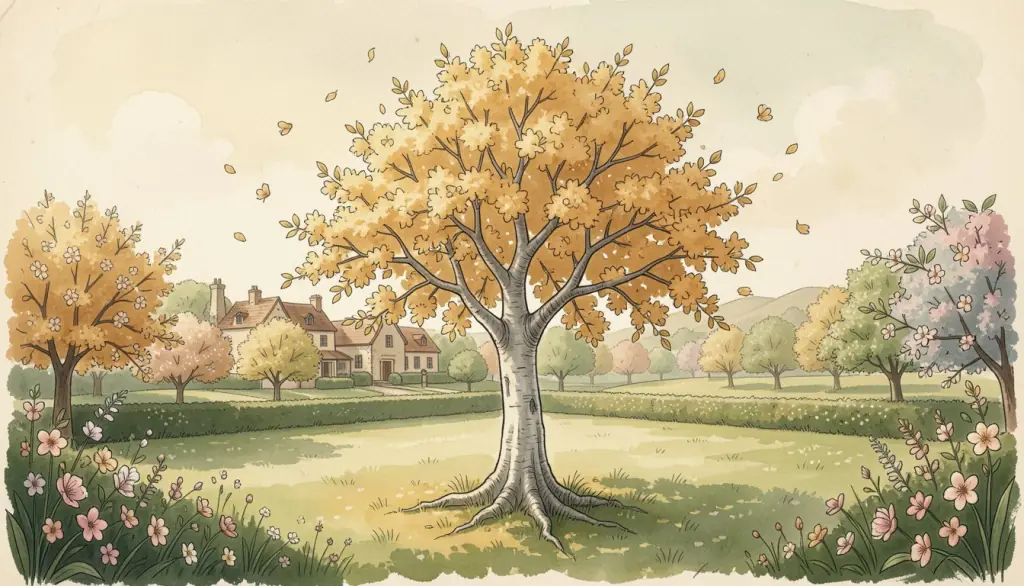
Sam opens Galadriel's box at last and finds a soft grey dust with a seed in the middle, like a small nut with a silver shell. Frodo advises him to make the gift go as far as it can. Sam plants saplings wherever special or beloved trees had been destroyed and puts a grain of the dust in the soil at the root of each. He walks to the Three-Farthing Stone and throws the rest to the wind. The nut he plants in the Party Field, where Bilbo's party tree had been cut down.
The result is the year 1420. The saplings grow as if time were in a hurry. The tree in the Party Field becomes a mallorn, with silver bark and golden flowers in spring, the only mallorn west of the Mountains and east of the Sea, and folk come from far to see it. The harvest is enormous, the young hobbits very nearly bathe in strawberries and cream, and many of the children born that year are fair and golden-haired, a hair colour rare among hobbits. The Sindarin word mallorn means "golden tree," from mal, gold, and orn, tree; our post on the Elvish word for tree traces it.
In the spring of 1420 Sam marries Rose Cotton. Tolkien says the year was famous for its weddings, and that nobody was surprised by this one. Frodo asks them to live at Bag End with him. On 25 March 1421, the anniversary of the Ring's destruction, their first child is born. Frodo suggests the name Elanor, after the golden flower Sam had seen in the grass of Lothlórien. The Sindarin elanor is glossed "sun-star," a small golden star-shaped flower. Our guide to the Elvish word for flower has more of Lórien's flower-names.
Mayor of the Shire and the Red Book
Frodo cannot stay. In September 1421 he asks Sam to ride with him, and at the Grey Havens Sam learns that Frodo is leaving Middle-earth with Bilbo, Gandalf and the Keepers of the Three Rings. Frodo explains that he tried to save the Shire and it has been saved, but not for him. Sam must stay, because he is needed: Frodo foresees that Sam will be Mayor, will raise a family, and will keep alive the memory of the age that has passed.
Before he leaves, Frodo gives Sam the Red Book, with its last pages left blank for Sam to fill (Book VI, ch. 9). Sam rides home, comes into Bag End where Rose sets little Elanor on his lap, and says the last words of the novel: "Well, I'm back."
Appendix B fills in the next sixty years. In S.R. 1427 Will Whitfoot resigns and Samwise is elected Mayor of the Shire. He is re-elected again and again, seven times in all, and finishes his last term in 1476 at the age of ninety-six. In 1436 King Elessar comes north to the Brandywine Bridge to meet his friends, gives Master Samwise the Star of the Dúnedain, and makes Elanor a maid of honour to Queen Arwen.
The Red Book is the other half of his legacy. Bilbo began it, Frodo continued it, and Sam finished it, and The Lord of the Rings presents itself as an English rendering of that memoir (Prologue, "Note on the Shire Records"). Inside the fiction, every reader is reading something Sam handed on.
Tolkien also wrote an epilogue in which Sam answers his children's questions from the Red Book. He cut it before publication; Christopher Tolkien printed it in Sauron Defeated, so it stands outside the published book.
Sailing West: The Last of the Ring-bearers
At the Havens Frodo had told Sam that he too was a Ring-bearer, if only for a little while, and that his time might come. Appendix B is the only place where that promise is kept.
In 1482 Rose dies on Mid-year's Day. On 22 September, Bilbo's and Frodo's birthday, Master Samwise rides out from Bag End. He comes to the Tower Hills, where he is last seen by Elanor, and gives her the Red Book. Among the Fairbairns, Appendix B says, a tradition was handed down from Elanor that Samwise passed the Towers and went to the Grey Havens, and passed over Sea, last of the Ring-bearers.
Tolkien frames it as family tradition, not a scene the narrator witnessed, a restraint that fits a hobbit who never claimed more than he could carry. The departure itself follows the same road Frodo took; our guide to the Grey Havens covers the harbour, and Valinor and the Undying Lands explains where the ships go. Sam was a mortal, and Tolkien explained in his letters that the voyage West did not make the hobbits immortal; it gave them healing and peace before the end.
Samwise Gamgee's Names and Languages
Samwise. Old English samwís, "half-wise, simple." Appendix F explains that Tolkien chose it to translate Sam's real Westron name, Banazîr, shortened to Ban, which carried the same meaning. The name is a gentle joke that the story reverses: the "half-wise" gardener ends up seeing more clearly than many of the great. Our article on Frodo's Elvish name sets Samwise beside the other hobbit names.
Gamgee. Sam's Westron family name is Galbasi, which Appendix F derives from a village name. Tolkien translated it through an imagined English place-name, Gamwich, pronounced "Gammidge," which wore down to Gamgee.
Hamfast. The Gaffer's name translates Westron Ranugad, shortened to Ran, which meant something like "stay-at-home." Tolkien rendered it with Old English hámfæst, which means the same. The father who never leaves home and the son who goes to Mordor are named for exactly that difference.
Elvish. Sam does not speak Elvish in any real sense. He knows songs, phrases and names, and he loves the sound. The one long Elvish speech he makes, the cry to Elbereth, comes to him unbidden in Shelob's Lair. The Elvish words around him are Sindarin: Elbereth ("Star-Queen"), mallorn, elanor, and Periannath, the word the hosts of the West use for his people at Cormallen. For the wider picture of who spoke what in the War of the Ring, see our guide to the languages of Middle-earth and our article on what language the Elves speak.
Books vs Films vs The Rings of Power
Peter Jackson's trilogy (2001 to 2003) gives Sam, played by Sean Astin, more screen time than almost anyone, and much of what it does is faithful: the eavesdropping, Bill the pony, the Mirror, the rope, Parth Galen, Shelob, the tower, "I can't carry it for you," the wedding and the last line. Several well-known moments, though, are inventions of the films:
- Osgiliath. In The Two Towers (2002) Faramir takes Frodo and Sam to Osgiliath, where a Nazgûl nearly takes the Ring. None of this is in the book; book Faramir lets them go from Henneth Annûn. Sam's speech about the "great stories" in Osgiliath borrows ideas from the book's conversation on the stairs but is written for the film.
- Frodo sends Sam away. In The Return of the King (2003) Gollum frames Sam by scattering the lembas, and Frodo sends him home on the stairs of Cirith Ungol. In the book Frodo never doubts Sam this way, and Sam never leaves him.
- Shelob's timing. The book's Shelob chapters close The Two Towers; the film moves them into The Return of the King.
- The Scouring of the Shire. The films leave it out. Sam's Mirror vision is shown but never fulfilled, so the payoff of Galadriel's gift and the mallorn in the Party Field disappears with it.
- The Ring-bearer's temptation. Sam carries the Ring in the film, but his tower temptation, the garden of Gorgoroth, is not shown.
Amazon's The Rings of Power is set in the Second Age, thousands of years before Sam's birth in Third Age 2980, and Sam does not appear in it. Its nomadic Harfoot families are the show's own creation; Tolkien names Harfoots as one of three early hobbit strains in the Prologue but tells no Second Age stories about them. Season 3 premiered on Prime Video on 11 November 2026; see our Rings of Power Season 3 preview for what has been confirmed about it. Nothing in that confirmed material involves Samwise, and given the period, nothing could.
How Tolkien Built Samwise
Three ingredients stand out, and Tolkien was open about each.
The batman. Humphrey Carpenter's biography records Tolkien saying that Sam was a reflection of the English soldier he had known in 1914 to 1918: the privates and batmen, officers' servants, whom he judged superior to himself. Tolkien served as an officer on the Somme, and every officer had a soldier servant. The relationship of Frodo and Sam, master and man becoming equals under fire, follows that pattern closely, including the "Mr. Frodo" that Sam never drops.
The rustic register. Sam's speech is Tolkien's English rendering of a working-class Shire dialect, as Appendix F explains. He says "taters," calls his master "Mr. Frodo," and quotes the Gaffer's sayings. The plain register makes him comic early and makes his courage feel unadorned in Mordor.
The love story underneath. In a long 1951 letter to the publisher Milton Waldman (Letter 131), Tolkien called the simple, rustic love of Sam and his Rosie, "nowhere elaborated," essential to understanding Sam's character, and called Sam the chief hero. Rosie appears in only a handful of pages, but Sam thinks of her in Mordor and goes looking for her during the Scouring. Tolkien kept that thread deliberately thin: it is the home Sam is fighting to get back to, not a romance for the page.
The result is a character built for contrast: the lowest-ranking member of the Fellowship and the only one besides Frodo to reach Mount Doom; the one who most wants to go home and the one who refuses every chance to turn back. Tolkien gave him the first meeting with Elves in the Woody End and the last words of the book, and that placement is not an accident.
Our Take
Our view, stated plainly: Samwise Gamgee is not the hero of The Lord of the Rings because he is loyal; he is the hero because he is the only character who carries the Ring into Mordor, where it is strongest, and gives it up without being made to. Loyalty is the quality everyone remembers, and it is real, but loyalty alone is what makes Sam miss Gollum's repentance on the stairs. What makes him great is the tower: one gardener, alone, offered a world, choosing a single garden.
That reading also explains why we think the Scouring of the Shire is essential to Sam rather than an epilogue. The Mirror shows him the felled trees in Book II. He carries Galadriel's earth through Mordor without opening it. He comes home to the exact scene he was shown, and he fixes it with the gift he was given. Cut that, as the films did, and Sam's arc becomes a story about devotion to Frodo. Keep it, and it becomes Tolkien's argument that small, patient work is the only real answer to ruin.
We would also defend Sam's failure on the stairs as the most important flaw Tolkien wrote. A Sam who was simply right about Gollum would be less interesting and less true. Tolkien lets his best character close a door that might have stayed open, and then lets the same character's grudging pity on Mount Doom save the world. Read Book IV, chapter 8 and Book VI, chapter 3 together, and you have the whole of Sam in two scenes.
People Also Ask
Who is Samwise Gamgee?
Samwise Gamgee is a hobbit of the Shire, the gardener at Bag End and Frodo Baggins's companion on the quest to destroy the One Ring. He fights Shelob, briefly carries the Ring, rescues Frodo from Cirith Ungol and helps him reach Mount Doom, then becomes Mayor of the Shire.
Was Sam a Ring-bearer?
Yes, briefly. When Sam believes Frodo is dead in Shelob's Lair, he takes the Ring to finish the quest himself. He carries it until he rescues Frodo in the Tower of Cirith Ungol and gives it back. Frodo later tells him he was a Ring-bearer, if only for a little while, and Appendix B calls him the last of the Ring-bearers.
Did Samwise Gamgee go to the Undying Lands?
Appendix B records a tradition from his daughter Elanor that he did. After his wife Rose died in Shire Reckoning 1482, Sam rode to the Grey Havens and passed over Sea, the last of the Ring-bearers.
Who did Sam marry?
Sam married Rose Cotton, called Rosie, the daughter of Farmer Tolman Cotton of Bywater, in the spring of 1420 by Shire Reckoning. Their first child, Elanor the Fair, was born on 25 March 1421.
How many children did Sam and Rosie have?
Thirteen, according to the family tree in Appendix C: Elanor, Frodo, Rose, Merry, Pippin, Goldilocks, Hamfast, Daisy, Primrose, Bilbo, Ruby, Robin and Tolman.
What did Galadriel give Sam?
A small box of plain grey wood marked with a single silver rune, holding earth from her orchard. After the war Sam scatters the earth across the Shire where trees had been cut down and plants the one seed inside it, a mallorn, in the Party Field.
What does the name Samwise mean?
Samwise comes from Old English samwís, meaning half-wise or simple. In Appendix F Tolkien explains that it translates Sam's real Westron name, Banazîr, which carried the same sense.
Was Sam Gamgee the Mayor of the Shire?
Yes. Appendix B says Samwise was first elected Mayor in Shire Reckoning 1427, when Will Whitfoot resigned. He was elected seven times in all and left office in 1476, at the age of ninety-six.
Is Samwise Gamgee the real hero of The Lord of the Rings?
Tolkien himself called him the chief hero in a 1951 letter, Letter 131 in The Letters of J.R.R. Tolkien. Frodo bears the burden, but Sam's loyalty, practical sense and refusal to give up are what get the Ring to Mount Doom.
Who plays Samwise Gamgee in the films?
Sean Astin plays Sam in Peter Jackson's Lord of the Rings trilogy (2001 to 2003). Sam does not appear in Amazon's The Rings of Power, which is set in the Second Age, thousands of years before he was born.
Learn the Elvish Sam Heard
Sam never learned Elvish properly, but he loved the sound of it, and the words around his story, from Elbereth to mallorn and elanor, are real Sindarin. Our free Elvish course teaches Sindarin and Quenya from the words Tolkien actually wrote, so you can read the cry in Shelob's Lair the way Sam could not.
Related Reading
- Characters of Middle-earth: Who's Who in Tolkien's World
- Hobbits of Middle-earth
- Frodo Baggins Explained: The Ring-bearer in the Books and Films
- Bilbo Baggins Explained: The Hobbit Who Found the Ring
- Gimli Explained: The Dwarf of the Fellowship
- Boromir Explained: Son of Denethor and the Horn of Gondor
- Galadriel Explained
- Elbereth Meaning: Varda, the Star-Queen
- Giant Spiders of Middle-earth: Ungoliant, Shelob and the Mirkwood Spiders
- Frodo's Elvish Name and Meaning
- Lothlórien Explained
- Westron: The Common Speech of Middle-earth
- The Grey Havens (Mithlond)
- How Was the One Ring Made?
- Lord of the Rings Elvish Phrases
People Also Ask
Who is Samwise Gamgee?
Samwise Gamgee is a hobbit of the Shire, the gardener at Bag End and Frodo Baggins's companion on the quest to destroy the One Ring. He fights Shelob, briefly carries the Ring, rescues Frodo from Cirith Ungol and helps him reach Mount Doom, then becomes Mayor of the Shire.
Was Sam a Ring-bearer?
Yes, briefly. When Sam believes Frodo is dead in Shelob's Lair, he takes the Ring to finish the quest himself. He carries it until he rescues Frodo in the Tower of Cirith Ungol and gives it back. Frodo later tells him he was a Ring-bearer, if only for a little while, and Appendix B calls him the last of the Ring-bearers.
Did Samwise Gamgee go to the Undying Lands?
Appendix B records a tradition from his daughter Elanor that he did. After his wife Rose died in Shire Reckoning 1482, Sam rode to the Grey Havens and passed over Sea, the last of the Ring-bearers.
Who did Sam marry?
Sam married Rose Cotton, called Rosie, the daughter of Farmer Tolman Cotton of Bywater, in the spring of 1420 by Shire Reckoning. Their first child, Elanor the Fair, was born on 25 March 1421.
How many children did Sam and Rosie have?
Thirteen, according to the family tree in Appendix C: Elanor, Frodo, Rose, Merry, Pippin, Goldilocks, Hamfast, Daisy, Primrose, Bilbo, Ruby, Robin and Tolman.
What did Galadriel give Sam?
A small box of plain grey wood marked with a single silver rune, holding earth from her orchard. After the war Sam scatters the earth across the Shire where trees had been cut down and plants the one seed inside it, a mallorn, in the Party Field.
What does the name Samwise mean?
Samwise comes from Old English samwís, meaning half-wise or simple. In Appendix F Tolkien explains that it translates Sam's real Westron name, Banazîr, which carried the same sense.
Was Sam Gamgee the Mayor of the Shire?
Yes. Appendix B says Samwise was first elected Mayor in Shire Reckoning 1427, when Will Whitfoot resigned. He was elected seven times in all and left office in 1476, at the age of ninety-six.
Is Samwise Gamgee the real hero of The Lord of the Rings?
Tolkien himself called him the chief hero in a 1951 letter, Letter 131 in The Letters of J.R.R. Tolkien. Frodo bears the burden, but Sam's loyalty, practical sense and refusal to give up are what get the Ring to Mount Doom.
Who plays Samwise Gamgee in the films?
Sean Astin plays Sam in Peter Jackson's Lord of the Rings trilogy (2001 to 2003). Sam does not appear in Amazon's The Rings of Power, which is set in the Second Age, thousands of years before he was born.