Gimli Explained: The Dwarf of the Fellowship in the Books and Films
Try It Yourself — Free Elvish Tools
Quick Answer: Gimli son of Glóin is the Dwarf of the Fellowship of the Ring. Born in Third Age 2879 to one of Thorin Oakenshield's companions, he comes to Rivendell with his father, is chosen by Elrond to represent the Dwarves, and travels through Moria and Lothlórien, where Galadriel gives him three strands of her hair. He becomes the closest friend of the Elf Legolas, fights at Helm's Deep and the Black Gate, and after the war rules the Glittering Caves of Aglarond. Appendix A reports a tradition that he sailed West with Legolas.
Gimli is the Fellowship member whose mind changes most. He arrives at Rivendell carrying his people's grudges: against the Elves of Mirkwood, who had locked up his father, and against Elves in general, who in Dwarvish memory have been proud and unreliable allies. He leaves Middle-earth, if the tradition is true, on an Elvish ship, beside an Elvish friend, out of love for an Elvish lady. No one else in The Lord of the Rings travels that far inside himself.
Peter Jackson's films made him the company's comic relief. The book Gimli is funnier in quieter ways and much more serious underneath. This guide follows him through the books, explains his names and the Khuzdul he speaks, keeps the films in their own section, and ends with our own reading, marked as interpretation.
For his people as a whole, see Dwarves of Middle-earth; for their royal house, Durin and the Line of Durin. For every major figure of the story in one place, start with our Characters of Middle-earth hub.
Gimli at a Glance
| People | Dwarf of Durin's Folk, the Longbeards (Appendix A, "Durin's Folk") |
| Home | Erebor, the Lonely Mountain, restored under Dáin II after 2941; later Aglarond in Rohan |
| Father | Glóin, member of Thorin's company in The Hobbit |
| Mother | Not named by Tolkien |
| Wider family | Uncle Óin; father's cousins Balin and Dwalin; a distant cousin of Thorin Oakenshield and Dáin Ironfoot |
| Born | Third Age 2879 (Appendix B) |
| Role | Representative of the Dwarves among the Nine Walkers (The Fellowship of the Ring, book II, ch. 3) |
| Weapon | An axe; Tolkien gives it no name |
| Famous words | Baruk Khazâd! Khazâd ai-mênu! at Helm's Deep (The Two Towers, book III, ch. 7) |
| Gift from Galadriel | Three strands of her hair (The Fellowship of the Ring, book II, ch. 8) |
| Closest friend | Legolas of Mirkwood |
| Later title | Lord of the Glittering Caves (Appendix A) |
| Fate | Said to have sailed West with Legolas after Elessar's death, Fourth Age 120 (Appendices A and B) |
| Film actor | John Rhys-Davies (The Lord of the Rings trilogy, 2001 to 2003), who also voiced Treebeard |
| Rings of Power | Does not appear |
Gimli Timeline
"Mae govannen" — want to actually speak Elvish?
Try It Free →Dates are from Appendix B, "The Tale of Years", unless noted. Fourth Age events after the war are given in the Appendices with few exact years.
| Age and year | Event |
|---|---|
| Third Age 2879 | Gimli son of Glóin is born |
| Third Age 2941 | Glóin goes with Thorin and Bilbo on the Quest of Erebor; Smaug dies; Battle of Five Armies; Dáin II becomes King under the Mountain. Gimli is not one of the company |
| Third Age 2989 | Balin leaves Erebor for Moria, with Óin, Gimli's uncle, and Ori |
| Third Age 2994 | Balin perishes and the colony in Moria is destroyed |
| Third Age 3018 | Glóin and Gimli travel to Rivendell, partly because of a messenger from Mordor who had come to Dáin asking about Bilbo |
| Third Age 3018, 25 October | Council of Elrond |
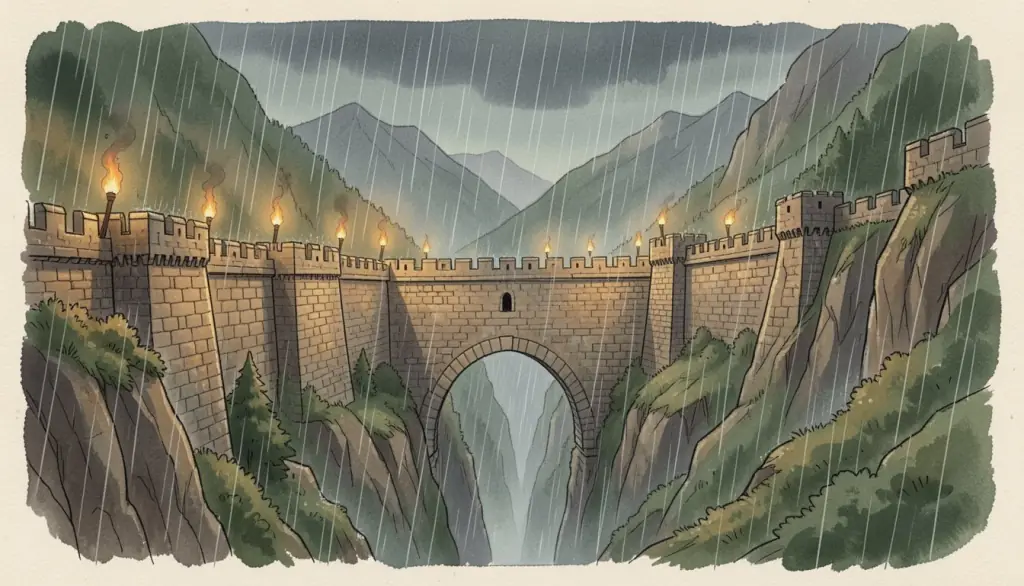
| Third Age 3019, 15 January | Bridge of Khazad-dûm; Gandalf falls; the company comes to the Mirrormere and the eaves of Lórien |
| Third Age 3019, 26 February | Breaking of the Fellowship at Amon Hen; Gimli, Legolas and Aragorn begin the hunt across Rohan |
| Third Age 3019, 3 to 4 March | Battle of the Hornburg (Helm's Deep); Gimli's count reaches forty-two |
| Third Age 3019, 8 March | Gimli enters the Paths of the Dead with Aragorn's Grey Company |
| Third Age 3019, 15 March | Battle of the Pelennor Fields |
| Third Age 3019, 25 March | Battle at the Black Gate; the Ring is destroyed |
| Third Age 3019, summer | On the journey home Gimli shows Legolas the Glittering Caves; the friends later visit Fangorn |
| Fourth Age | Gimli brings Dwarves of Erebor south and becomes Lord of the Glittering Caves; they forge new gates for Minas Tirith |
| Fourth Age 120 | King Elessar dies; Legolas sails West, and "it is said" Gimli goes with him |
Who Gimli Is
Gimli is a Dwarf of the Longbeards, the house of Durin, the eldest of the Seven Fathers of the Dwarves. He belongs to the generation that grew up after the Lonely Mountain was won back from Smaug. His father Glóin was one of Thorin's twelve companions, so Gimli spent his youth among Dwarves who had seen a dragon die, a king fall and a realm restored.
Three facts define him before the story begins. He is a Dwarf of Erebor, of a people newly rich and secure. He is kin to the royal house through a younger son of a king, with rank but no claim to a throne. And he has a personal reason to distrust Elves: his father had been a prisoner in Thranduil's halls (The Hobbit, ch. 8 and 9).
Tolkien never describes Gimli's face in detail. What he describes, again and again, is his voice: blunt, quick to take offence, quick to laugh, and capable of sudden poetry about stone.
Family and Relationships
Gimli's ancestry is set out in the family tree of Durin's Folk in Appendix A. The rest of the table comes from the main story.
| Person | Relation | Read more |
|---|---|---|
| Glóin | Father; member of Thorin's company; speaks at the Council of Elrond | Dwarves of Middle-earth |
| Óin | Uncle; went to Moria with Balin and died there | This post, "Moria" |
| Balin and Dwalin | His father's first cousins, sons of Fundin | Durin and the Line of Durin |
| Thorin Oakenshield and Dáin II | Distant cousins of the royal line | Durin and the Line of Durin |
| Legolas | Companion of the Fellowship, closest friend, companion on the last voyage | Legolas Explained |
| Galadriel | The Lady of Lórien, to whom he is devoted for the rest of his life | Galadriel Explained |
| Thranduil | Legolas's father, who once imprisoned Glóin | Thranduil Explained |
| Éomer | First a rival over Galadriel's honour, then a comrade whose life Gimli saves | Rohirric, the Language of Rohan |
| Peregrin Took | The hobbit Gimli pulls from under a dead troll at the Black Gate | Hobbits of Middle-earth |
Tolkien never names Gimli's mother or says that Gimli married. Appendix A does record Gimli's remark that Dwarf-women are few, probably no more than a third of the whole people.
Before the Fellowship: A Son of Erebor
Gimli does not appear in The Hobbit. His father does, as one of the twelve Dwarves who arrive at Bilbo's door at Bag End, and Gimli was about sixty-two when Thorin's company set out in 2941. The book never says why he stayed behind, and we should not guess.
What we can say is what he grew up with: after the Battle of Five Armies, Dáin Ironfoot ruled a restored kingdom under the Mountain and Dale was rebuilt beside it. Gimli's pride in craft belongs to that confident generation.
He also grew up with a wound. In 2989 Balin led a company, Gimli's uncle Óin among them, to retake Moria; after a few years the messages stopped. When Glóin and Gimli set out for Rivendell in 3018, nobody in Erebor knew what had become of Balin's colony, and a messenger from Mordor had been asking Dáin uncomfortable questions about a hobbit and a ring (The Fellowship of the Ring, book II, ch. 1 and 2).
The Council of Elrond and the Nine Walkers
At the Council, Glóin speaks for the Dwarves. He tells of Balin's expedition and its silence, and of the messenger who offered Dáin rings and friendship in return for news of Bilbo (The Fellowship of the Ring, book II, ch. 2, "The Council of Elrond"). Gimli's moment comes in the next chapter, "The Ring Goes South".
When Elrond chooses the company, he names Legolas for the Elves and Gimli for the Dwarves. He then warns them that they are free to turn back. Gimli answers with the line that sums up his character better than any description: "Faithless is he that says farewell when the road darkens." Elrond replies that no one should vow to walk in the dark who has not seen the nightfall, and the exchange is left there, unresolved. Gimli keeps his word anyway.
The choice is deliberate. Elrond picks nine walkers to match the Nine Riders, and the company now holds a Dwarf of Erebor and an Elf of Mirkwood, two peoples whose last close dealings, in The Hobbit, had involved a dungeon.
Caradhras and the Mountains of Moria
As the company climbs toward the Redhorn Pass, Gimli looks at the three great peaks above Moria and names them in his own tongue: Barazinbar, the Redhorn, which the Elves call Caradhras, and beyond it Zirakzigil and Bundushathûr, Silvertine and Cloudyhead (The Fellowship of the Ring, book II, ch. 3). For Gimli this is not wild country but the old landscape of his people, known by name to Dwarves who had never seen it.
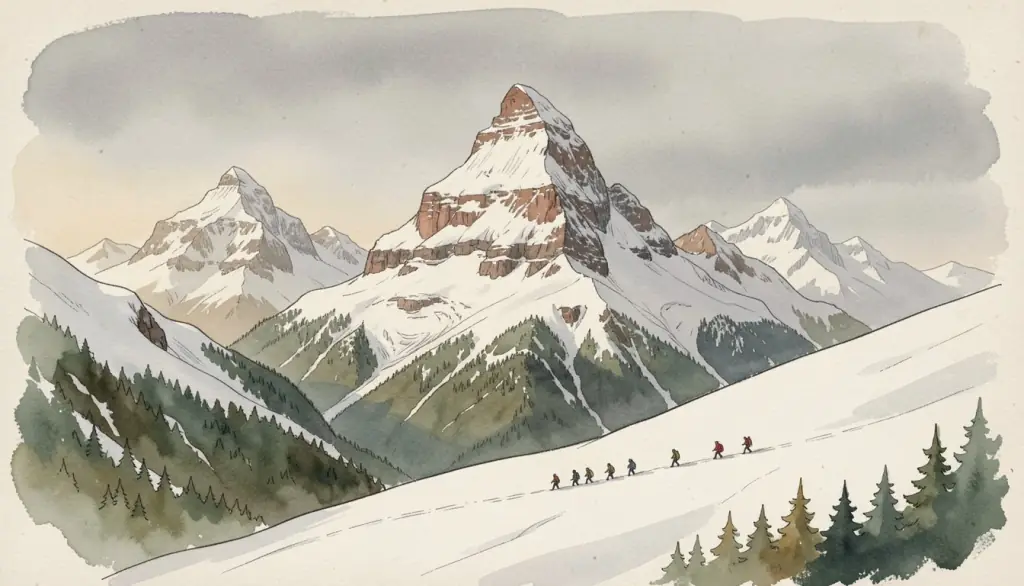
The pass defeats them. Snow and the malice of Caradhras drive the company back, and Gandalf turns to the road no one else wants: through the mines of Moria. Gimli alone is glad: Khazad-dûm is his people's greatest work, and he still hopes to find Balin there.
Moria: The Song of Durin and Balin's Tomb
Inside Moria, Gimli is at home in a way none of his companions are. He walks without fear in the dark and judges the old halls with a craftsman's eye. In a great hall in the dark, he chants the Song of Durin, the Dwarves' lay of their first father: Durin's waking in the young world, his naming of the nameless hills, the crown of stars he saw in the lake, and the glory of Khazad-dûm before the fall (The Fellowship of the Ring, book II, ch. 4, "A Journey in the Dark"). It is the only long Dwarvish poem in the book, and Tolkien gives it to Gimli.
The same chapter ends in the Chamber of Mazarbul, with a white tomb inscribed in runes. Gandalf reads it: Balin son of Fundin, Lord of Moria. Gimli casts his hood over his face. His father's cousin is dead, and the next chapter's reading of the Book of Mazarbul tells how the rest of the colony died, Óin among them, taken by the Watcher in the Water. For the runes on that tomb and in the book, see Cirth and the Angerthas.
The company's hope for Gandalf ends soon after at the Bridge of Khazad-dûm, against Durin's Bane, the Balrog that drove Durin's Folk from their home. See Balrogs of Middle-earth.
The Mirrormere
When the company comes out of the East-gate into the Dimrill Dale, grieving and pursued, Gimli does something that looks strange in the circumstances. He insists on going down to the lake below the gate, and Frodo and Sam go with him. This is Kheled-zâram, the Mirrormere, the lake where Durin first looked and saw a crown of stars reflected above his head. Gimli bends over the still water and sees the crown too, and names it (The Fellowship of the Ring, book II, ch. 6, "Lothlórien").
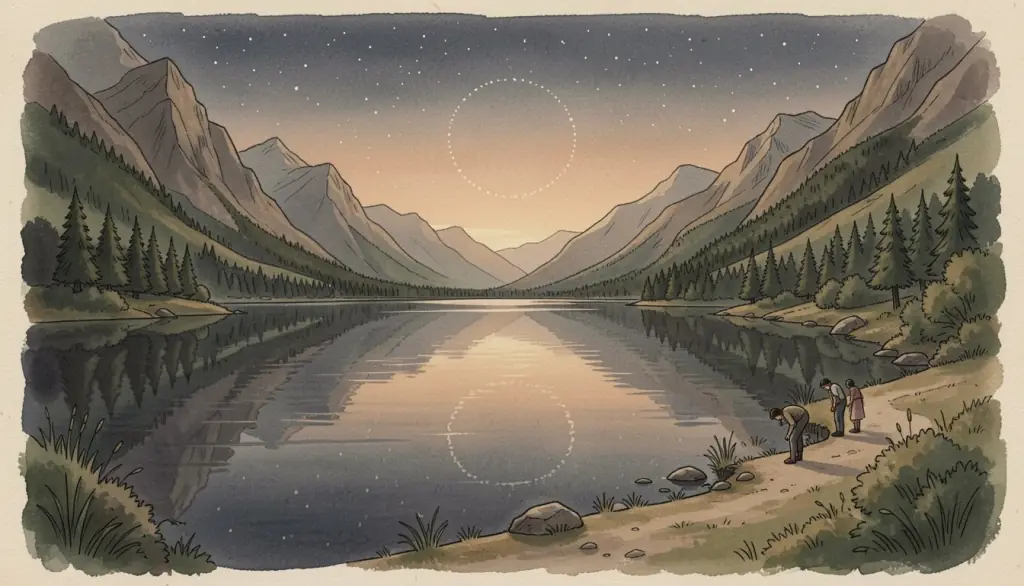
This small pilgrimage shows what Gimli is. Having just lost his kin, his guide and his people's hope of return, he turns aside, under threat, to see the one thing the Balrog cannot take: the sign of Durin's waking.
Lothlórien: The Blindfold and the Lady
The company reaches Lothlórien still raw, and the old enmity flares at once. The Elves of Lórien, led by Haldir, will admit a Dwarf only blindfolded. Gimli refuses to be treated as a prisoner. Legolas, for his part, does not want to be blindfolded like a Dwarf. Aragorn ends the quarrel by having the whole company blindfolded alike (The Fellowship of the Ring, book II, ch. 6).
The decisive moment comes in the next chapter, when the company stands before Galadriel and Celeborn in Caras Galadhon. Celeborn, hearing that the Dwarves had stirred up the evil of Moria again, says he would have barred the whole company from his land had he known. Galadriel answers differently. She speaks the names of Durin's country in Gimli's own tongue, the Mirrormere and the springs of the Silverlode, Kheled-zâram and Kibil-nâla, and the halls of Khazad-dûm, and she speaks of them as a place of beauty and sorrow, not of folly (The Fellowship of the Ring, book II, ch. 7, "The Mirror of Galadriel").
Gimli, who had come in ready for scorn, looks into her eyes and seems to find love and understanding in the heart of an enemy. From that moment he is hers.
Galadriel does not argue or apologise; she honours what he loves, in words that show she knows it. For the land where it happened, see Lothlórien Explained; for the Lady herself, see Galadriel Explained.
Galadriel's Gift: Three Strands of Hair
At the parting in "Farewell to Lórien" (The Fellowship of the Ring, book II, ch. 8), Galadriel gives each member of the company a gift. When she comes to Gimli and asks what a Dwarf would ask of the Elves, he says he wants nothing, only to have looked on her and heard her gentle words. Pressed, he asks for a single hair of her head, and says plainly that he does not command it, he only names his desire because she bade him.
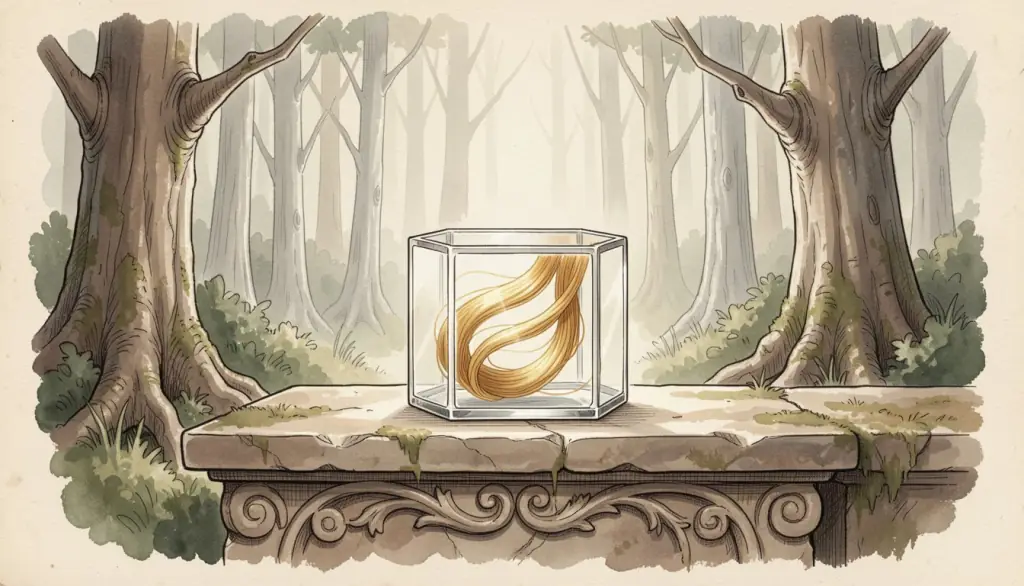
She gives him three. She also gives him a prophecy: "your hands shall flow with gold, and yet over you gold shall have no dominion." Gimli says he will set the hairs in imperishable crystal as an heirloom of his house, a pledge of goodwill between the Mountain and the Wood until the end of days. When the boats leave, he weeps, and tells Legolas that he has taken his worst wound in this parting, by looking at what he loved for the last time.
Readers of Unfinished Tales know why the scene carries extra weight. In "The History of Galadriel and Celeborn", Tolkien wrote that Fëanor, greatest of the Noldor, asked Galadriel three times for a tress of her hair in Valinor and was refused every time. A Dwarf of Erebor receives freely, three times over, what Fëanor could not win by asking. That text was published after Tolkien's death, but the contrast fits: Fëanor's story is about possession, and Gimli's request is its opposite. For Fëanor, see Fëanor and the Silmarils.
The prophecy is fulfilled in the Appendices. Gimli becomes a lord with his own people and wealth, yet the only treasure the books ever show him keeping is a gift of three hairs.
The River, Amon Hen and the Three Hunters
After Lórien, Gimli and Legolas share a boat down the Anduin, and the friendship that began in Caras Galadhon starts to grow in small exchanges on the water. At Amon Hen the Fellowship breaks: Frodo and Sam cross the river alone, Boromir falls defending Merry and Pippin, and the two hobbits are carried off by orcs.
Aragorn chooses to follow the captives, and Gimli and Legolas go with him. The three hunters run across the plains of Rohan for days, hardly stopping (The Two Towers, book III, ch. 1 and 2). It is one of the great physical feats of the book, and Gimli, short-legged and armoured, keeps up.
Gimli and Éomer: A Quarrel About the Lady
On the plains the hunters meet Éomer and his riders (The Two Towers, book III, ch. 2, "The Riders of Rohan"). Éomer speaks of the Lady of the Golden Wood as a sorceress who snares those who see her. Gimli at once threatens him, axe in hand, and Aragorn has to stand between them. The quarrel is put off, not settled: Éomer lends the travellers horses, and Gimli rides behind Legolas on Arod, not trusting himself to a horse of his own.
The quarrel is funny, but it shows that Gimli's devotion is not a private sentiment: he will fight a captain of Rohan for her honour. It is settled only at the end of the war, by courtesy.
Soon after, in Fangorn, the hunters meet an old man in white. Gimli, taking him for Saruman, raises his axe, and it falls from his hand when the stranger speaks: it is Gandalf, returned (The Two Towers, book III, ch. 5). For the forest, see Ents and Huorns.
Helm's Deep: Baruk Khazâd and the Count
At the Battle of the Hornburg Gimli has his finest hour as a warrior (The Two Towers, book III, ch. 7, "Helm's Deep"). Early in the fight, orcs break out of a culvert and drag Éomer down. Gimli leaps out of the shadows with the battle-cry of his people, Baruk Khazâd! Khazâd ai-mênu!, and cuts the attackers down. Appendix F translates the cry as "Axes of the Dwarves! The Dwarves are upon you!" He uses it to save the man who had insulted his Lady. For the language itself, see our Khuzdul guide.
Through the night, Gimli and Legolas keep count of the orcs each one kills. By the end Gimli has forty-two and Legolas forty-one, and Gimli is pleased about it for the rest of the book. He also takes a blow to the head, which he dismisses as a scratch. The game is how two soldiers keep each other going through a night they do not expect to survive.
The Glittering Caves of Aglarond
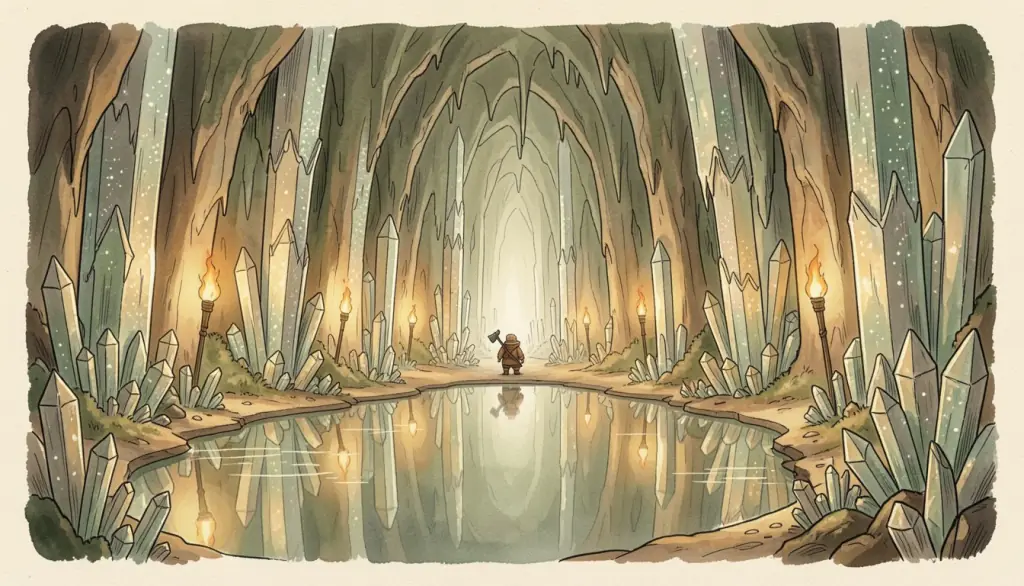
After the battle comes the passage that most readers remember as Gimli's own (The Two Towers, book III, ch. 8, "The Road to Isengard"). Behind Helm's Deep lie great caverns that the Men of Rohan use as storehouses and refuges. Gimli has been inside them, and he cannot stop talking about them.
He describes glittering halls, pools that mirror the roofs and veins of ore lit by torchlight, and Legolas is astonished: he has never heard Gimli speak like this. Gimli is also indignant. Men, he says, use these wonders to store things in, and Dwarves would tend them with care, tapping a flake of stone in a long day's work rather than quarrying.
The friends make a bargain. If they both survive, Legolas will come with Gimli to see the caves, and Gimli will go with Legolas into Fangorn. They keep both promises. In "Many Partings" (The Return of the King, book VI, ch. 6), as the company passes Helm's Deep on the way home, Legolas goes into the caves with Gimli and comes out silent, saying only that Gimli alone could find fit words to speak of them.
The name Aglarond is Sindarin. Tolkien translates it as "the Glittering Caves". The two parts are recognisable Sindarin words: aglar, "glory, brilliance, splendour", and rond, "a vaulted or arched roof, a vaulted chamber or cavern". Gimli's caves carry an Elvish name, and his love for them is what brings an Elf inside.
The Paths of the Dead
When Aragorn takes the Paths of the Dead under the Dwimorberg, Gimli goes with him (The Return of the King, book V, ch. 2, "The Passing of the Grey Company"). Gimli, who walked calmly through Moria, is overcome with dread here and comes last of all, while Legolas is untroubled. The dark of the Dead is not the honest dark of stone, and Gimli can tell the difference.
The Grey Company comes out into the south, rides to Pelargir, and with the Army of the Dead takes the fleet of the Corsairs. Gimli and Legolas sail up the Anduin with Aragorn and fight on the Pelennor Fields.
Minas Tirith, the Black Gate and the Field of Cormallen
In "The Last Debate" (The Return of the King, book V, ch. 9), Gimli and Legolas walk together through Minas Tirith while the captains confer. Gimli judges the city as a mason would. There is good stonework here, he says, and some that is less good, and he offers to bring the masons of the Mountain to improve it. Legolas, in the same scene, would bring Elves to plant gardens. Both offers come true after the war.
At the Black Gate, Pippin kills a troll and is buried beneath it. It is Gimli who finds him afterwards, recognising a hobbit's foot under the carcass and pulling him out (The Return of the King, book VI, ch. 4, "The Field of Cormallen"). The Dwarf who once wanted nothing to do with Elves ends the war celebrated alongside them on the Field of Cormallen.
The war also cost Gimli's people dearly: Appendix B records that on 17 March 3019 King Dáin fell before the Gate of Erebor in the Battle of Dale, while Gimli was fighting in the south.
Many Partings: The Morning and the Evening
The quarrel with Éomer is finally resolved in "Many Partings" (The Return of the King, book VI, ch. 6). Éomer, having now seen Arwen, holds her the fairest lady living. Gimli, rather than reaching for his axe, concedes graciously: Éomer has chosen the Evening, Gimli says, while his own love is given to the Morning, to Galadriel. Arwen is called Evenstar; Galadriel belongs to the elder, earlier light. The two warriors part as friends.
It is a small scene with a large meaning. The quarrel that began with threats on the plains ends in a courtly exchange of compliments. Gimli has learned the manners of the Elves without losing his own loyalty, which is exactly the change Galadriel made possible in Lórien.
Lord of the Glittering Caves
The Appendices tell the rest. After the fall of Sauron, Gimli brought south part of the Dwarf-folk of Erebor and became Lord of the Glittering Caves (Appendix A, "Durin's Folk"). He and his people did great works in Gondor and Rohan. For Minas Tirith they forged new gates of mithril and steel to replace those broken by the Witch-king of Angmar.
This fulfils his offer in "The Last Debate" and Galadriel's prophecy: gold flows through his hands, yet the act the Appendices record is a gift to someone else's city. The Dwarf who once suspected every Elf of pride builds the gates of the King of Men.
Meanwhile Legolas brings Elves to Ithilien, so the two friends settle within reach of each other and of Aragorn.
Sailing West: Gimli and the Grey Ship
The last mention of Gimli is the last note of Appendix A. After the death of King Elessar in Fourth Age 120, Legolas built a grey ship and sailed down Anduin and over the Sea. The Appendix adds that, it is said, Legolas took Gimli son of Glóin with him because of their great friendship, greater than any that has been between Elf and Dwarf.
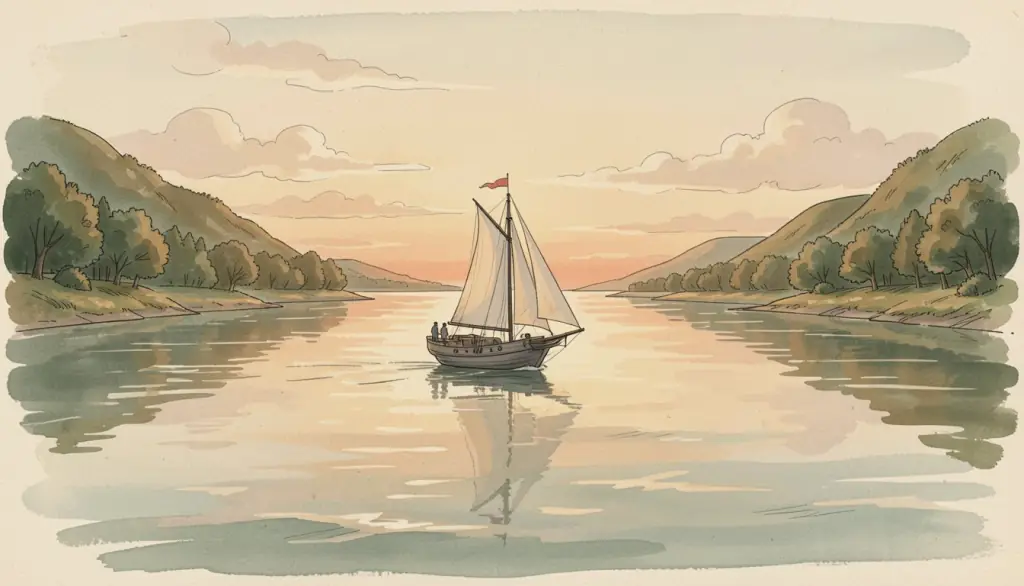
The Appendix at once marks how strange this would be, for a Dwarf to leave Middle-earth, the Eldar to receive him and the Lords of the West to permit it, and then suggests a reason. Gimli may have gone out of desire to see again the beauty of Galadriel, who had sailed at the end of the Third Age, and it may be that she, being mighty among the Eldar, obtained this grace for him.
Three points are worth keeping straight:
- It is a tradition, not an eyewitness account. The text says "it is said". Tolkien deliberately leaves a margin of doubt.
- It would make Gimli unique. No other Dwarf in the books is said to have gone West. For what lay at the end of that voyage, see Valinor and the Undying Lands, and for the harbour, The Grey Havens.
- It does not make him immortal. In the "Akallabêth" Tolkien insists that the Undying Lands do not change the nature of mortals who come there. Gimli would have been about 260 when he sailed, and the books say nothing of his end.
The Silmarillion ("Of Aulë and Yavanna") says Dwarves after death go to halls of Mandos set apart for them. Where Gimli's road ended, the books do not say.
Gimli's Names and Language
The name Gimli. Gimli is not a Khuzdul name. Appendix F explains that the Dwarves kept their own language secret and gave themselves "outer names" in the speech of the Men among whom they lived. Since Tolkien rendered the language of the northern Men of Dale with Old Norse, the Dwarves' outer names are Norse in form. Most of the Dwarf-names of The Hobbit, including Glóin and Óin, come from the list of dwarves in the Old Norse poem Völuspá. Gimli's name is not in that list; in the same poem Gimlé is the name of a gold-roofed hall where the worthy dwell after the end of the world. Tolkien never published his own gloss of the name, so we will not offer one.
His true name. Like every Dwarf, Gimli would have had an inner name in Khuzdul, known only to his own people. The books never reveal it, not even for a member of the Fellowship. Appendix F says the Dwarves did not even carve their true names on their tombs.
The Khuzdul Gimli speaks. Almost every word of Khuzdul in the main text of The Lord of the Rings comes from Gimli or concerns Moria:
| Khuzdul | Meaning | Where |
|---|---|---|
| Baruk Khazâd! Khazâd ai-mênu! | "Axes of the Dwarves! The Dwarves are upon you!" (Appendix F) | Gimli at Helm's Deep |
| Khazad-dûm | The Dwarves' name for Moria, "Dwarrowdelf" | Throughout book II |
| Barazinbar | The Redhorn, Caradhras | Gimli in "The Ring Goes South" |
| Zirakzigil | Silvertine, Celebdil | Gimli in "The Ring Goes South" |
| Bundushathûr | Cloudyhead, Fanuidhol | Gimli in "The Ring Goes South" |
| Kheled-zâram | The Mirrormere | Gimli at the lake; Galadriel in Caras Galadhon |
| Kibil-nâla | The springs of the Silverlode | Galadriel in Caras Galadhon |
We give only the meanings Tolkien supplied; the rest of the attested vocabulary is in our Khuzdul guide.
Elvish around Gimli. He passes through the gate whose Elvish riddle opens Moria; see Speak, Friend, and Enter.
Books vs Films vs The Rings of Power
Peter Jackson's films (2001 to 2003). John Rhys-Davies plays Gimli, and also voices Treebeard. The films keep his major beats and add a great deal:
- At the Council Gimli strikes the Ring with his axe, and the axe shatters. This is invented.
- Comic material such as "nobody tosses a Dwarf" and a drinking contest with Legolas in the extended edition of The Return of the King is invented. The book Gimli is witty, but rarely the butt of the joke.
- The count at Helm's Deep survives, but the numbers and the staging differ, and it becomes a running joke.
- Galadriel's gift of three hairs appears only in the extended edition of The Fellowship of the Ring; the theatrical cut drops it.
- Lines about Elves and Dwarves fighting side by side that the films give Gimli are new dialogue.
- Left out: Gimli's chanting of the Song of Durin, his pilgrimage to the Mirrormere, his Aglarond speech and his rescue of Pippin under the troll. Several of these are the scenes that make him more than comic in the book.
The Hobbit films (2012 to 2014). Gimli does not appear, but in The Desolation of Smaug Glóin's captured belongings include a picture of his young son, which Legolas mocks. This is a film joke, not a Tolkien scene. For the Elvish of those films, see Elvish in The Hobbit Films.
The Rings of Power. Gimli does not appear and cannot: the series is set in the Second Age, thousands of years before his birth. Its Dwarves are the Durins of Khazad-dûm and their kin, and nothing about Gimli has been announced. For what the show's Dwarven rings are, see The Rings of Power Explained.
How Tolkien Built Gimli
Gimli is assembled from pieces Tolkien already had.
From The Hobbit, a father. The Dwarves of The Hobbit came first. When Tolkien needed a Dwarf for the sequel's company, making him the son of one of Thorin's companions tied the two books together and gave the new hero a ready-made history: a father who had been Thranduil's prisoner, an uncle lost in Moria, a king in a restored Mountain.
From the Elder Days, a grudge. The distrust between Elves and Dwarves has a long history in Tolkien's legendarium. The Silmarillion's "Of the Ruin of Doriath" tells how Dwarves of Nogrod killed King Thingol over the Nauglamír and sacked his kingdom; those Dwarves were not of Durin's line, but the memory poisoned both peoples. Against that, the Second Age gave an example of friendship: the Doors of Durin, made by the Dwarf Narvi, with signs drawn by Celebrimbor of Eregion. Gimli and Legolas are placed between those two memories, and they choose the second.
From contrast, a partner. Gimli is Legolas's mirror: stone against tree, the earth-loving Dwarf against the sea-longing Elf, each strongest where the other struggles.
From courtesy, a conversion. The most original thing Tolkien does with Gimli is to change him without a battle. His prejudice is not beaten out of him; it is dissolved by a Lady who speaks his language and honours his home. That is unusual in heroic fiction, and it is the moral centre of his story.
Our Take
Our view, stated plainly: Gimli is the most transformed character in The Lord of the Rings, and the films, for all their affection, hid it. Frodo is broken, Aragorn is revealed, Sam is ennobled, but none of them changes his loyalties. Gimli does. He walks into Lórien ready to resent being blindfolded and walks out weeping for a Lady he will defend against a Marshal of Rohan. He ends it rebuilding a city of Men and sharing his greatest treasure, the caves, with an Elf.
What we find most persuasive is that Tolkien never asks Gimli to stop being a Dwarf. He does not learn to love trees; he learns to love a friend who loves trees. He does not give up stone; he builds Gondor's gates. His conversion is from suspicion to generosity, not from one people's values to another's. That is a more adult idea of reconciliation than most fantasy offers, and it is why the comic film Gimli, however enjoyable, is a smaller character than the book's.
If you read only three Gimli passages, read his answer to Elrond in "The Ring Goes South", his Aglarond speech in "The Road to Isengard", and the last note of Appendix A. Between a Dwarf who will not say farewell when the road darkens and a Dwarf on an Elven ship lies the whole of his story.
People Also Ask
Who is Gimli in Lord of the Rings?
Gimli son of Glóin is a Dwarf of Durin's Folk from the Lonely Mountain and the Dwarves' member of the Fellowship. He becomes devoted to Galadriel, the closest friend of Legolas, and after the war Lord of the Glittering Caves of Aglarond.
Who is Gimli's father?
Glóin, one of Thorin Oakenshield's twelve companions in The Hobbit. Father and son come to Rivendell together in 3018. Tolkien never names Gimli's mother.
How old is Gimli in The Lord of the Rings?
He was born in Third Age 2879 (Appendix B), so he is 139 at the Council of Elrond. If he sailed West after Elessar's death, he was about 260.
Is Gimli related to Thorin Oakenshield?
Distantly. He descends from Borin, a younger son of King Náin II, so he is a cousin of the royal line, not an heir. Balin and Dwalin are his father's cousins and Óin is his uncle.
What gift did Galadriel give Gimli?
He asked for one hair of her head and she gave him three, foretelling that gold would flow through his hands but have no dominion over him.
How did Gimli and Legolas become friends?
Galadriel's courtesy in Lothlórien broke Gimli's distrust of Elves, and Legolas softened in turn. Shared danger in Rohan, at Helm's Deep and on the Paths of the Dead did the rest.
What does Gimli shout at Helm's Deep?
Baruk Khazâd! Khazâd ai-mênu!, which Appendix F translates as "Axes of the Dwarves! The Dwarves are upon you!"
What are the Glittering Caves of Aglarond?
The caverns behind Helm's Deep. Gimli praises them after the battle and later brings Dwarves of Erebor to live there as their lord. Aglarond is Sindarin for "the Glittering Caves".
Did Gimli go to the Undying Lands?
Appendix A says, as a tradition ("it is said"), that he sailed West with Legolas, perhaps by Galadriel's grace. If true, he is the only Dwarf the books say ever went West.
Is Gimli in The Hobbit or The Rings of Power?
Not in The Hobbit book, where only his father appears; the Hobbit films add a picture of him as a joke. He does not appear in The Rings of Power, set thousands of years before his birth.
Learn the Languages Around Gimli
Khuzdul was kept secret, so only a handful of its words survive. The Elvish that surrounds Gimli's story is far richer: Aglarond, Lothlórien, Caras Galadhon and the names of the Lady he served are all Sindarin or Quenya. To learn those languages from words Tolkien actually wrote, start with our free Elvish course, or try a phrase in the Elvish translator.
Related Reading
- Characters of Middle-earth: Who's Who in Tolkien's World
- Dwarves of Middle-earth: Aulë, Durin's Folk, Moria and Erebor
- Durin and the Line of Durin
- Khuzdul: The Complete Guide to Tolkien's Dwarven Language
- Legolas Explained: Prince of Mirkwood and Elf of the Fellowship
- Galadriel Explained
- Lothlórien Explained
- Thranduil Explained
- Balrogs of Middle-earth
- Cirth and the Angerthas: Tolkien's Runes
- Speak, Friend, and Enter: The Doors of Durin in Elvish
- The Lord of the Rings Appendices Guide
- Frodo Baggins Explained
- Samwise Gamgee Explained
- Boromir Explained
- Bilbo Baggins Explained
People Also Ask
Who is Gimli in Lord of the Rings?
Gimli is a Dwarf of Durin's Folk from the Lonely Mountain, the son of Glóin, and the Dwarves' member of the Fellowship of the Ring. He goes through Moria and Lothlórien, becomes devoted to Galadriel and the lifelong friend of the Elf Legolas, fights at Helm's Deep and the Black Gate, and after the war becomes Lord of the Glittering Caves of Aglarond.
Who is Gimli's father?
His father is Glóin, one of the twelve Dwarves who went with Thorin Oakenshield and Bilbo on the Quest of Erebor in The Hobbit. Glóin and Gimli travel together to Rivendell in 3018, and Glóin speaks at the Council of Elrond about Balin's lost colony in Moria. Tolkien never names Gimli's mother.
How old is Gimli in The Lord of the Rings?
Appendix B gives his birth as Third Age 2879, so he is 139 at the Council of Elrond in 3018. By Dwarf reckoning that is a mature warrior, not a young one. If the tradition that he sailed West after King Elessar's death is true, he left Middle-earth at about 260.
Is Gimli related to Thorin Oakenshield?
Yes, distantly. Both belong to Durin's Folk. Gimli descends from Borin, a younger son of King Náin II, through Farin, Gróin and Glóin, so he is a cousin of the royal line rather than an heir. Balin and Dwalin are his father's first cousins, and Óin is his uncle.
What gift did Galadriel give Gimli?
When Galadriel asked what gift he wanted, Gimli at first asked for nothing, then asked for a single hair of her head. She gave him three, and foretold that gold would flow through his hands but have no power over him. Gimli said he would set the hairs in crystal as an heirloom of his house.
How did Gimli and Legolas become friends?
They began with the old distrust between Elves and Dwarves, sharpened because Legolas's father had imprisoned Gimli's father. The change came in Lothlórien, where Galadriel's courtesy won Gimli over and Legolas softened toward him. After that they shared a boat, the hunt across Rohan, Helm's Deep and the Paths of the Dead, and promised to show each other the Glittering Caves and Fangorn.
What does Gimli shout at Helm's Deep?
He shouts Baruk Khazâd! Khazâd ai-mênu!, the battle-cry of the Dwarves. Appendix F of The Lord of the Rings translates it as "Axes of the Dwarves! The Dwarves are upon you!" It is the longest piece of Khuzdul, the Dwarves' secret language, in the main text.
What are the Glittering Caves of Aglarond?
They are the great caverns behind Helm's Deep in Rohan. Gimli describes them after the battle as more beautiful than anything he has seen, and after the war he brings Dwarves from Erebor to live there and becomes Lord of the Glittering Caves. Aglarond is Sindarin; Tolkien translates it as "the Glittering Caves".
Did Gimli go to the Undying Lands?
Appendix A records a tradition, introduced with "it is said", that Legolas took Gimli with him when he sailed West after the death of King Elessar, and that Galadriel may have obtained this grace for him. If true, Gimli is the only Dwarf the books say ever went West. Tolkien does not describe his arrival or his end.
Is Gimli in The Hobbit or The Rings of Power?
Not in The Hobbit book, where only his father Glóin appears. The Hobbit films add a joke in which Glóin shows a picture of his young son. Gimli does not appear in The Rings of Power, which is set in the Second Age, thousands of years before he was born.