Théoden Explained: King of Rohan, Wormtongue's Shadow and the Ride to the Pelennor
Try It Yourself — Free Elvish Tools
Quick Answer: Théoden son of Thengel is the seventeenth King of the Mark, the horse-lords' realm of Rohan. Born in Gondor in Third Age 2948, he became king in 2980 and ruled for 39 years. In old age he sank into weakness and gloom under the counsel of Gríma Wormtongue, Saruman's agent, until Gandalf roused him at Edoras in March 3019 (The Two Towers, "The King of the Golden Hall"). He then led his people to victory at Helm's Deep, rode to the relief of Minas Tirith and fell on the Pelennor Fields on 15 March 3019, crushed beneath his horse when the Witch-king attacked (The Return of the King, "The Battle of the Pelennor Fields"). Rohan remembered him as Théoden Ednew, "the Renewed" (Appendix A).
Théoden has the strangest arc of any king in The Lord of the Rings. When we meet him he is already finished: bent over a staff, sitting in a dim hall, listening to a man whose advice is slowly killing him. Within a fortnight he has ridden at the head of his army twice, beaten Saruman, refused Saruman's voice to his face and died in the greatest cavalry charge of the age. No other character changes so much so fast, and Tolkien gives him only a handful of chapters to do it.
This guide follows what the books actually say, from his birth in Gondor to his barrow at Edoras. It keeps the Peter Jackson films in a separate section and is plain about what they invented, above all the famous possession scene, which is not in the book. For the full cast around him, start with Characters of Middle-earth; for the people he ruled, see Men of Middle-earth.
Théoden at a Glance
| People | Man of Rohan, of the House of Eorl (LotR, Appendix A, "The House of Eorl") |
| Title | Seventeenth King of the Mark, last king of the Second Line |
| Epithet | Théoden Ednew, "the Renewed" (Appendix A) |
| Father | Thengel, sixteenth King of the Mark |
| Mother | Morwen of Lossarnach, a lady of Gondor (Appendix A) |
| Son | Théodred, killed at the Fords of Isen on 25 February 3019 (Appendix B) |
| Sister's children | Éomer and Éowyn, raised in his house |
| Born | Third Age 2948, in Gondor (Appendix A) |
| King | 2980 to 3019 |
| Died | 15 March 3019, on the Pelennor Fields (Appendix B) |
| Age at death | 70 or 71 |
| Seat | The golden hall of Meduseld at Edoras |
| Horse | Snowmane |
| Sword | Herugrim |
| Banner | A white horse on a field of green |
| First appearance | The Two Towers, book III, ch. 6, "The King of the Golden Hall" |
| Film actor | Bernard Hill (The Two Towers, 2002; The Return of the King, 2003) |
Théoden Timeline
"Mae govannen" — want to actually speak Elvish?
Try It Free →Dates come from Appendices A and B of The Lord of the Rings unless another source is named.
| Age and year | Event |
|---|---|
| Third Age 2510 | Eorl the Young rides to Gondor's aid at the Field of Celebrant; the land of Calenardhon is given to his people and becomes Rohan |
| 2758 to 2759 | The Long Winter; Helm Hammerhand, ninth king, dies, and the First Line of kings ends |
| 2943 | Thengel, living in Gondor, marries Morwen of Lossarnach |
| 2948 | Birth of Théoden in Gondor |
| 2953 | Thengel returns to Rohan as king after his father Fengel dies; Théoden comes with him as a small child |
| 2963 | Birth of Théodwyn, Théoden's youngest sister |
| 2980 | Death of Thengel; Théoden becomes the seventeenth King of the Mark |
| 2991 | Birth of Éomer, son of Théodwyn and Éomund |
| 2995 | Birth of Éowyn |
| 3002 | Éomund is killed by Orcs; Théodwyn dies soon after; Théoden takes their children into his house |
| 3019, 25 February | First Battle of the Fords of Isen; Théodred is killed |
| 3019, 2 March | Gandalf comes to Edoras and heals Théoden; the Rohirrim ride west against Saruman |
| 3019, 3 to 4 March | Battle of the Hornburg at Helm's Deep |
| 3019, 5 March | Théoden reaches Isengard; parley with Saruman |
| 3019, 10 March | The Dawnless Day; the Muster of Rohan rides from Harrowdale |
| 3019, 15 March | Battle of the Pelennor Fields; death of Théoden |
| 3019, summer | His body is carried home and laid in a barrow at Edoras (The Return of the King, "Many Partings") |
Who Théoden Is
Rohan is a young kingdom by the standards of Middle-earth. It began in Third Age 2510, when Eorl the Young led the Éothéod down from the north to save Gondor at the Field of Celebrant and received the empty province of Calenardhon as his reward (Appendix A). Théoden is the seventeenth of them.
Two things define him before the War of the Ring begins:
- He is half Gondorian by upbringing. He was born in Gondor, to a Gondorian mother, while his father served the Steward there. He came to Rohan only as a small child (Appendix A).
- He is a family man who has outlived his family. By 3019 his wife is gone, his sister and her husband are dead, and his only son is about to be killed. The household around him in Meduseld is made up of his sister's children and his servants.
Family and the House of Eorl
Appendix A, "The House of Eorl", lists every king from Eorl to Éomer and gives short notes on the later ones. Théoden's family is well recorded in that section.
| Person | Relation | Read more |
|---|---|---|
| Thengel | Father; sixteenth king, who lived long in Gondor | This post, "Born in Gondor" |
| Morwen of Lossarnach | Mother; a lady of Gondor | Appendix A |
| Théodwyn | Youngest sister; mother of Éomer and Éowyn | This post, "A Household of Orphans" |
| Théodred | Only son; Second Marshal of the Mark, killed at the Fords of Isen | This post, "Théodred at the Fords" |
| Éomer | Sister-son; Third Marshal of the Mark, then eighteenth king | Éomer Explained |
| Éowyn | Sister-daughter; slayer of the Witch-king | Éowyn Explained |
| Gríma son of Gálmód | Chief counsellor; Saruman's agent | Saruman Explained |
| Háma | Doorward of Meduseld; killed at Helm's Deep | The Two Towers, "Helm's Deep" |
| Eorl the Young | Founder of the house | Rohirric: The Language of Rohan |
| Helm Hammerhand | Ninth king, for whom Helm's Deep is named | This post, "Helm's Deep" |
Tolkien's lineage is organised into "lines". The First Line runs from Eorl to Helm Hammerhand, who died in the Long Winter with both his sons. The Second Line begins with Helm's sister-son Fréaláf and ends with Théoden. When Éomer, another sister-son, takes the throne in 3019, Appendix A starts a Third Line with him. Théoden is therefore the last king of a dynasty, and the second time in Rohan's history that the crown passes to a sister's son after a king loses his own heirs.
Born in Gondor
Appendix A tells the story of Thengel, Théoden's father, in a few lines. As a young man he left Rohan, where his father Fengel was a greedy and quarrelsome king, and served the Steward of Gondor, winning honour there. He married late, in 2943, to Morwen of Lossarnach. Théoden was born to them in Gondor in 2948, the only son among their children.
When Fengel died in 2953, the Rohirrim called Thengel home, and he went, unwillingly by Appendix A's account. Théoden came to Rohan at about five years old.
Thengel's court had a visitor whom later readers will recognise. Appendix A records that a stranger called Thorongil, "eagle of the star", served Thengel as a captain before passing on to Gondor; this was Aragorn in disguise, and the Tale of Years places those errantries between 2957 and 2980. The appendix does not say that Théoden and Thorongil knew each other, and we will not invent a friendship it never mentions. But it is a neat irony that the king who later greets Aragorn as a stranger at his own gates grew up in a hall where Aragorn had already served. For that part of Aragorn's life, see Aragorn Explained.
Thengel died in 2980, and Théoden became king at thirty-two.
A Household of Orphans
The years between 2980 and 3019 are almost blank in the books. Appendix A gives one family event that shapes everything later. Théodwyn, Théoden's youngest and best-loved sister, married Éomund of Eastfold, a Marshal of the Mark. Éomund was killed by Orcs in 3002, riding against them with too few men, and Théodwyn died soon after. Théoden took their two children, Éomer and Éowyn, into his house and called them son and daughter (Appendix A).
So when the War of the Ring reaches Rohan, Meduseld holds three young people who all look to Théoden as a father: his own son Théodred, his nephew Éomer and his niece Éowyn. All three are capable, and all three are, in different ways, held back by the old man in the chair. Éomer is kept from fighting the Orcs he can see; Éowyn is kept tending a king she watches sink; Théodred carries the defence of the west alone.
The Shadow of Wormtongue
By the time the Fellowship breaks at Parth Galen, Théoden has been under Gríma's influence for years. Gríma son of Gálmód is a Man of Rohan, a counsellor at court, and secretly in Saruman's pay. Gandalf later lays the whole thing out: Gríma has whispered caution, fear and suspicion into the king's ears, turned him against his own captains and kept him from seeing that the real enemy sat in Orthanc (The Two Towers, "The King of the Golden Hall").
What the book does not say is just as important. It never describes a spell cast into Théoden, or a spirit living inside him. Saruman's arts are behind the whole affair, but what we see on the page is a man worn down by age and by a voice he trusts. The cure that Gandalf applies is not a counterspell. It is truth, fresh air and a sword in the king's hand.
Théodred at the Fords
The war reaches Rohan before Gandalf does. Saruman's forces strike at the Fords of Isen, the crossing that guards the Mark's western border, where Théoden's son Théodred, the Second Marshal, holds the line. On 25 February 3019, the day before Boromir dies at Parth Galen, Théodred is killed in the First Battle of the Fords of Isen (Appendix B).
The book reports the death rather than showing it. The news reaches Edoras at about the same moment as Gandalf and his companions, and it is one of the first things Théoden is told after he wakes. He has lost his heir to the enemy his counsellor told him was a friend.
The King of the Golden Hall
Book III, chapter 6, is Théoden's great scene, and it is far stranger and quieter than its film version.
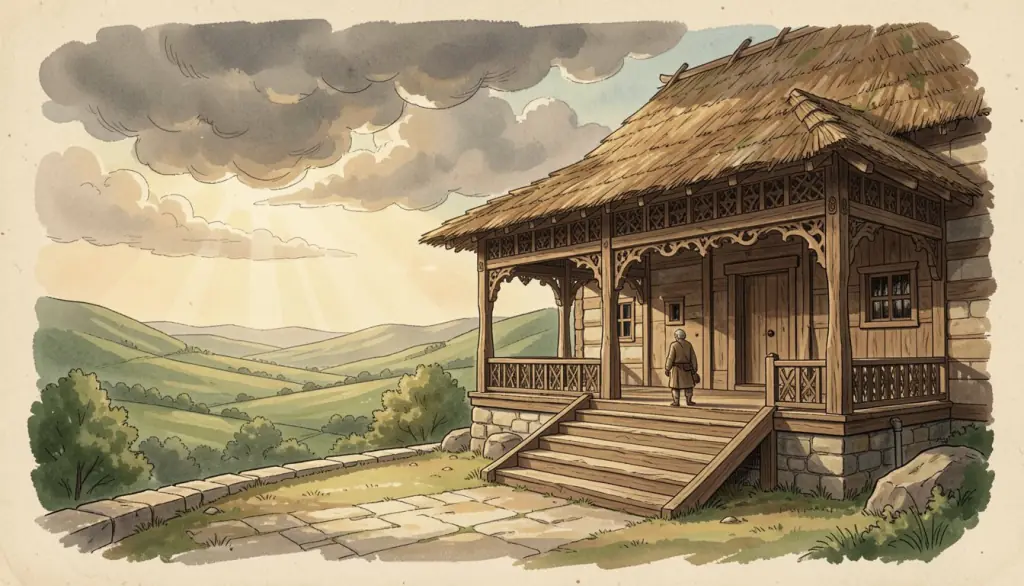
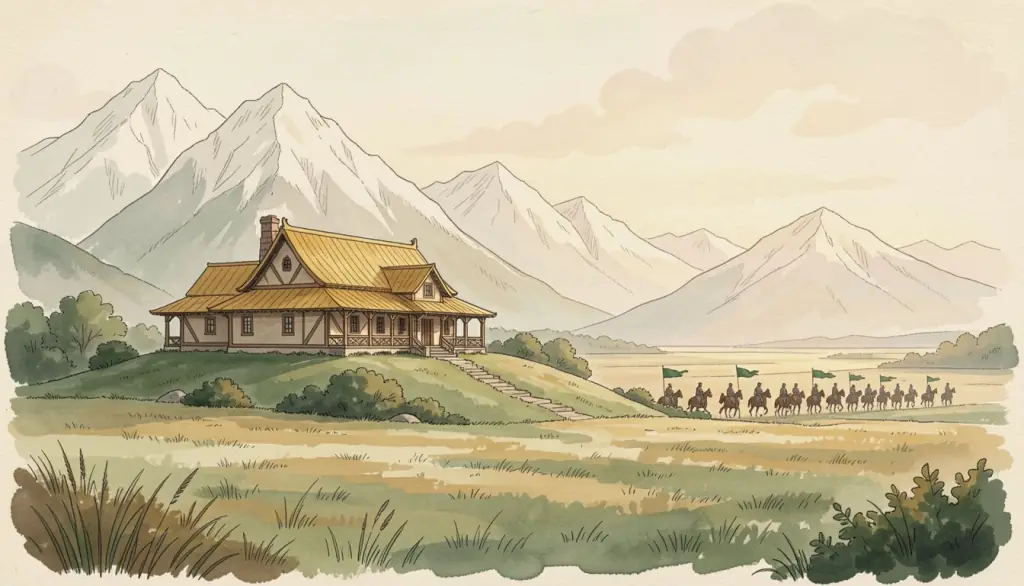
Gandalf, Aragorn, Legolas and Gimli ride to Edoras on 2 March. On the way Aragorn chants a lament for Eorl the Young, which begins "Where now the horse and the rider?" At the doors of Meduseld, Háma the doorward makes them give up their weapons. Gandalf keeps his staff, since Háma will not take an old man's walking-stick, and that turns out to matter.
Inside, the hall is dim. The king sits on his high seat, so bent with age that he seems almost a dwarf, with Éowyn standing behind his chair and Gríma crouched at his feet. Théoden greets Gandalf coldly, and Gríma names him Láthspell, "ill-news".
Then Gandalf acts. He raises his staff, thunder rolls, the hall goes dark, Gríma falls on his face, and Gandalf tells the king to come out of the shadows. Théoden rises and walks with Gandalf out onto the terrace before the doors, where the storm is clearing and the air is fresh. There Gandalf tells him to look out over his land, and Théoden straightens. He says that dark have been his dreams of late, and asks where Éomer is.
That question is the turning point. Éomer, the book tells us, is under arrest, held at Gríma's counsel for riding after Orcs against orders and threatening Gríma in the hall. Théoden orders him freed. His own sword, Herugrim, is brought to him from where it was found in Gríma's chest. Éowyn brings the cup, and the salute Westu Théoden hál, Old English for roughly "be thou well, Théoden", is spoken in the hall. Our guide to Rohirric explains that line and its partner Ferthu Théoden hál.
Gríma's choice. Théoden does not execute his counsellor. He offers him a choice: ride to war at the king's side and prove his loyalty, or leave. Gríma spits at the king's feet and flees toward Isengard.
Two more gifts come out of that morning. Théoden gives Gandalf Shadowfax, the great horse Gandalf had borrowed, as a free gift (The Two Towers, "The King of the Golden Hall"). And he decides to ride west to war himself, leaving Éowyn to lead the people who cannot fight. The old man who could not stand without help that morning rides out of Edoras that afternoon.
Helm's Deep
Théoden's plan is to strike at Saruman's army at the Fords of Isen, where the Second Battle has gone badly for Erkenbrand of Westfold. On the road he learns that the Riders at the Fords are scattered, and Gandalf advises him to make for Helm's Deep instead, the great refuge in the mountains named for Helm Hammerhand. Gandalf rides off alone on an errand of his own, promising to return (The Two Towers, "Helm's Deep").
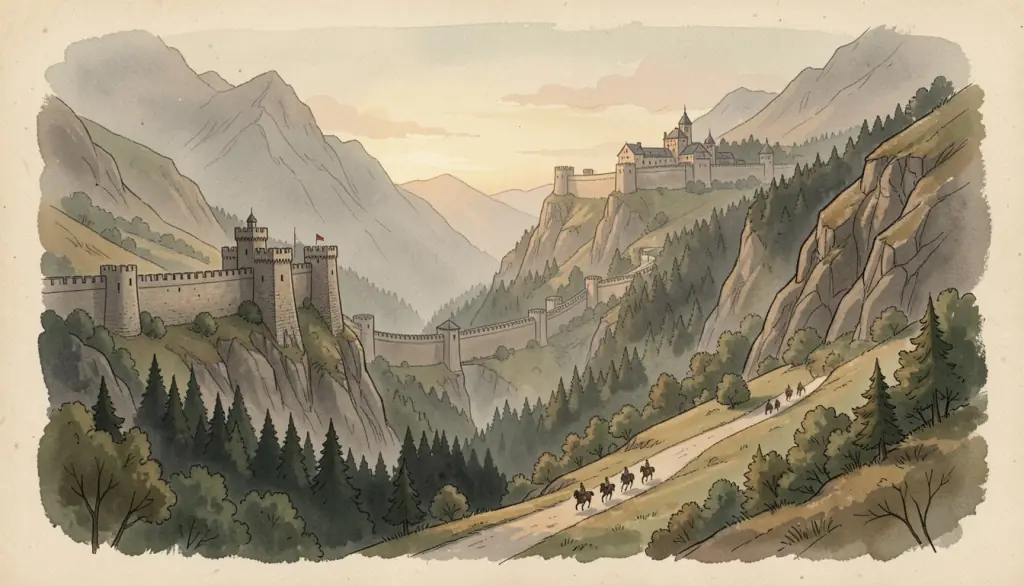
The Battle of the Hornburg is fought through the night of 3 to 4 March. The Hornburg is a fortress at the mouth of a deep gorge, with a long wall, the Deeping Wall, across the valley. Saruman's army of Orcs and Dunlendings attacks it in the dark and the rain. The wall is breached by a blasting fire from Isengard, and the defenders fall back into the Hornburg and the caves behind it. Háma is killed. By the last hours before dawn the position is hopeless.
Théoden does the one thing a king of the Mark is for: he rides out. As dawn comes he tells Aragorn he will not be taken like an old badger in a trap, the great horn of Helm is sounded, and the king and his household charge from the gate down the causeway and through the enemy. The Orcs break and flee toward the mouth of the valley, and find it full of trees that were not there the night before. These are the Huorns, the wild tree-shepherded forest of Fangorn, which have walked through the night; no Orc that enters them comes out. Gandalf and Erkenbrand arrive on the hills at the same moment. For the trees, see Ents and Huorns; for Saruman's army, Uruk-hai Explained.
Isengard and the Voice of Saruman
On 4 March Théoden rides with Gandalf to Isengard, and arrives on 5 March to find it ruined by the Ents. Merry and Pippin are sitting on the broken gate, smoking, and greet the king of Rohan with a mock-formal welcome. Théoden is delighted. He asks about the hobbits, recognises them from the old tales of Rohan as holbytlan, and he and Merry fall to talking about pipe-weed and herb-lore. He promises they will sit together in Meduseld one day and talk of it at leisure (The Two Towers, "Flotsam and Jetsam"). It is a small promise, and Tolkien makes sure it is not kept.
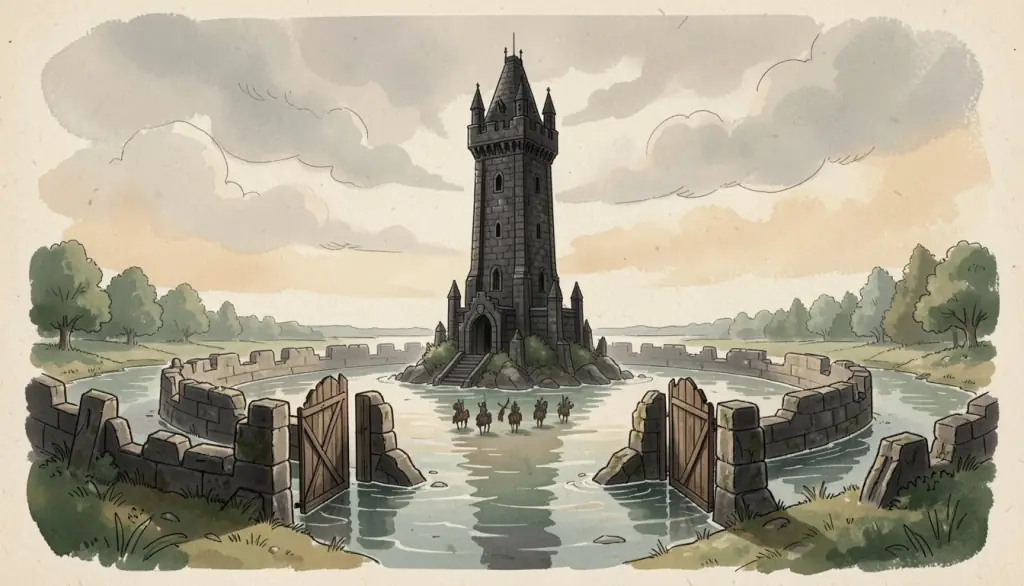
Then comes the parley at the foot of Orthanc (The Two Towers, "The Voice of Saruman"). Saruman's voice is his last real weapon: it makes anything he says sound wise. He speaks to Théoden as one old lord to another and offers peace. The Riders around the king, Tolkien says, fear that their lord will yield. Théoden does not. He answers with a speech that names the burned Westfold and the dead children, and ends: "We will have peace, when you and all your works have perished."
This is the clearest sign that Théoden's recovery is complete. For years one voice talked him into weakness. Now the master of that voice speaks to him directly, with all his skill, and the king turns him down in front of his men. For the rest of the scene and what happened to Saruman afterwards, see Saruman Explained and Gandalf Explained.
Merry, Esquire of Rohan
Théoden's friendship with Merry is one of the gentlest threads in the book, and it is built up deliberately.
At the Hornburg, before the Rohirrim set out, Merry kneels and offers his small sword to the king in service, and Théoden accepts, making him an esquire of Rohan (The Return of the King, "The Passing of the Grey Company").
At Dunharrow, when the summons from Gondor comes, Théoden releases Merry from going. The road will be fast and hard, Merry cannot ride a war-horse, and the king will not have him go (The Return of the King, "The Muster of Rohan"). Merry is crushed. A young Rider named Dernhelm quietly offers to take him up on his own horse, and the hobbit rides to war hidden under Dernhelm's cloak. The reader learns later who Dernhelm was; any reader of Old English would have guessed from the name, which means "secret helmet". That story belongs to Éowyn Explained.
The Muster and the Ride of the Rohirrim
On the Dawnless Day, 10 March, the darkness from Mordor covers the sky and the Muster of Rohan rides from Harrowdale (Appendix B). Gondor's summons has come with the Red Arrow, carried by the errand-rider Hirgon, and Théoden has promised to come with all the strength he can gather, though he warns that it will take time (The Return of the King, "The Muster of Rohan").
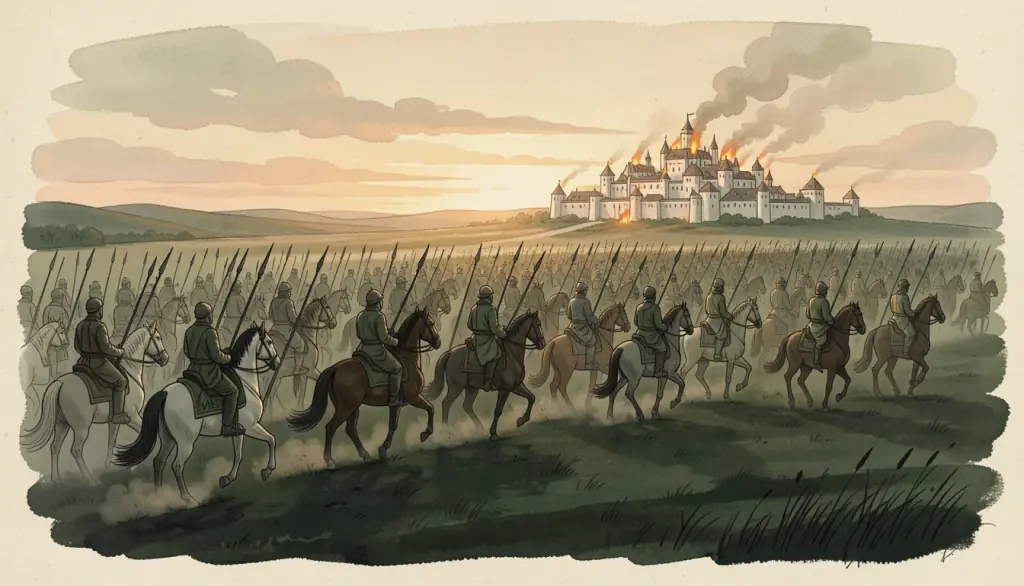
The ride itself is told in "The Ride of the Rohirrim" (The Return of the King, book V, ch. 5). The Rohirrim, around six thousand spears, find the road to Minas Tirith blocked. They are guided by the Woses, the Wild Men of the Drúadan Forest, and their headman Ghân-buri-Ghân, along a forgotten wain-road through the hills. Théoden treats the Wild Men with respect and promises them their forest in peace if the war is won, a promise King Elessar later keeps.
They come down onto the Pelennor before dawn on 15 March. Minas Tirith is on fire, its gate has just been broken, and the Witch-king is standing in the gateway. Then a cock crows in the city, and from the north the horns of Rohan answer.
Tolkien gives Théoden the most quoted moment of his life here. The king, who had paused on seeing the burning city, suddenly springs upright and calls his Riders with a verse beginning "Arise, arise, Riders of Théoden!" He seizes a great horn from his banner-bearer and blows it until it bursts, and the army charges. In the light of the coming dawn, Tolkien writes, the king looked like one of the gods of old, likening him to Oromë the Great in the battle of the Valar when the world was young.
Death on the Pelennor
The charge of the Rohirrim sweeps the besiegers off the northern half of the field. Théoden himself hews down the chieftain of the Haradrim, and the black serpent standard falls with him (The Return of the King, "The Battle of the Pelennor Fields"). For a moment the battle is won.
Then the Witch-king comes. He has left the gate and, mounted on a winged beast, falls on the king of Rohan. Snowmane, maddened with fear, is struck by a black dart, rears and falls, and the king is pinned beneath him. Théoden's household knights are scattered or slain. Only Dernhelm and Merry stand between the dying king and the Lord of the Nazgûl.
What follows is told in The Witch-king of Angmar and Éowyn Explained: Dernhelm is revealed as Éowyn, she beheads the beast, Merry stabs the Witch-king behind the knee with a blade from the Barrow-downs, and Éowyn's sword destroys him.
Théoden lives a little longer. He opens his eyes, sees Merry, and speaks to him. He says his body is broken and he goes to his fathers, but that even in their mighty company he will not now be ashamed. He tells Merry he will not be able to keep their talk of herb-lore. Then Éomer arrives, and Théoden, with his last strength, hails him as King of the Mark, bids him ride to victory and sends his farewell to Éowyn, not knowing that she lies wounded a few feet away. Then he dies.
Snowmane is buried where he fell, under a stone carved in the speech of Rohan with a short verse that calls him "faithful servant yet master's bane". Théoden's body is carried into Minas Tirith with honour, and the lament that the Rohirrim later sang for the fallen, The Mounds of Mundburg, remembers the Riders who fell on the field. Mundburg is the Rohirrim's name for Minas Tirith.
The Barrow at Edoras
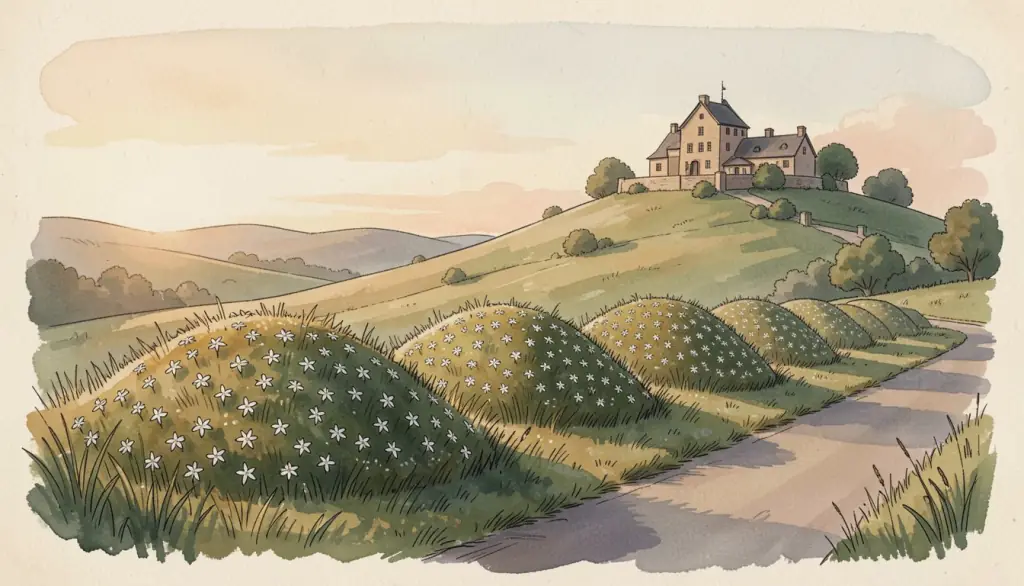
Théoden does not stay in Gondor. After the war, Éomer and a great company escort his body home to Rohan, and he is laid in a barrow outside Edoras among the mounds of the kings, where the white flowers called simbelmynë, "evermind", grow on the graves (The Return of the King, "Many Partings"). His minstrel Gléowine makes a last song about him, and the Riders ride around the mound singing of him. Then the feast is held in Meduseld, Éomer is acclaimed king, and Éowyn's betrothal to Faramir is announced; see Éomer Explained and Faramir Explained.
Théoden's Names and Language
Rohan's names are not Elvish. Tolkien presented the language of Rohan, Rohirric, through Old English, because Rohirric stood to the Common Speech as Old English stands to modern English. So the names of Rohan are real Old English words chosen to sound right to an English reader, the way the hobbits' names are chosen to sound English. Our full guide is Rohirric: The Language of Rohan; for the Common Speech itself, see Westron, the Common Speech.
Théoden. Old English þēoden, "lord, prince, king". In the poem Beowulf the word is used for kings, which is exactly why Tolkien chose it. The name is almost a title: Rohan's king is called, in effect, "Lord".
Ednew. Appendix A says the lore of Rohan remembered him as Théoden Ednew, because he fell into a decline under Saruman's spells and was cured by Gandalf, and in the last year of his life arose and led his men to victory. The epithet is Old English ed-, "again", plus nīwe, "new": "renewed".
Other names around him. Meduseld is "mead-hall", Edoras is "the courts", Gríma is "mask", Háma is "covering" and Dernhelm is "secret helmet", all standard Old English as set out in our Rohirric guide. His sword Herugrim is built from Old English heoru, "sword", and grim, "fierce", a standard etymology, though Tolkien does not gloss it in the text.
Rohan itself is Sindarin. The name Rohan is the Gondorian, Elvish name for the land. The Rohirrim themselves call it the Mark or the Riddermark. In our Elvish vocabulary, Rochir is "lord of horses", and Appendix F glosses Rohirrim as "horse-lords". So the king is called by an Old English title, but the country he rules is named in the Elvish speech of his southern allies.
Words from Théoden's world, with sources:
| Word or name | Meaning | Language | Source |
|---|---|---|---|
| Théoden | lord, prince, king | Old English for Rohirric | LotR; standard OE |
| Ednew | renewed | Old English for Rohirric | Appendix A |
| Westu Théoden hál | be thou well, Théoden | Old English for Rohirric | The Two Towers, III.6 |
| Ferthu Théoden hál | go forth in health, Théoden | Old English for Rohirric | The Return of the King |
| simbelmynë | evermind (a white flower on the barrows) | Old English for Rohirric | The Two Towers, III.6 |
| holbytla | hole-builder, the Rohirrim's word for a hobbit | Old English for Rohirric | Appendix F |
| Rohirrim | horse-lords | Sindarin | Appendix F |
| Rochir | lord of horses | Sindarin | LotR, Appendix F |
How to say it. The é in Théoden marks a long vowel, not stress. The name is stressed on the first syllable: THAY-o-den, with th as in "thin". The accent in Éowyn and Éomer works the same way.
Books vs Films vs The Rings of Power
Bernard Hill's Théoden in Peter Jackson's The Two Towers (2002) and The Return of the King (2003) is one of the trilogy's great performances, and its emotional shape follows the book. Many of its best-known scenes, however, are film inventions. These are film choices, not book lore:
- The possession. In the film, Saruman has possessed Théoden, who is shown aged and blank, and Gandalf drives Saruman out in what is effectively an exorcism, while Saruman is shown thrown back in Orthanc. None of this is in the book. Book Théoden is old and despairing from Gríma's counsel; Gandalf heals him by words, by exposing Gríma and by leading him outside.
- Théodred's funeral at Edoras. The film shows Théodred brought home to Edoras and buried there, with a grieving Théoden at the tomb. In the book Théodred dies at the Fords and is not brought to Edoras on screen; we hear only the news.
- Retreating to Helm's Deep from the start. In the film Théoden refuses to ride to war and evacuates his people straight to Helm's Deep. In the book he rides west to fight at the Fords of Isen and turns to Helm's Deep only when he learns the battle there is lost. Éowyn leads the people of Edoras to Dunharrow, not to Helm's Deep.
- "Where is the horse and the rider?" In the film Théoden recites lines adapted from the lament for Eorl as he arms before the battle. In the book that lament is chanted by Aragorn on the ride to Edoras.
- Refusing to aid Gondor and the lighting of the beacons. In the film Théoden hesitates to help Gondor until the beacons are lit by Pippin. In the book the Red Arrow comes with Gondor's formal summons and Théoden promises help at once; the beacons were lit by Gondor, not by Pippin.
- Gríma's end. In the extended edition of the third film, Gríma kills Saruman at Isengard and is shot by Legolas. In the book both survive Isengard, go to the Shire, and Gríma kills Saruman at Bag End and is shot by hobbit archers.
- The death scene. In the film Théoden dies speaking to Éowyn and recognises her face. In the book he speaks to Merry and then to Éomer, sends a farewell to Éowyn, and never knows she is beside him.
What the films get right, in our view: the arc from shadow to glory, the charge at the Pelennor and the sense of a king who finds himself again at the very end. What they change: the films make his fall supernatural and his recovery a duel between wizards. The book makes both of them human, and that is the more interesting version.
The War of the Rohirrim (2024). The animated film The Lord of the Rings: The War of the Rohirrim is set in the days of Helm Hammerhand, the ninth king, around 2758 to 2759 in Appendix A's dating. That is nearly two centuries before Théoden was born. He does not appear in it; the film's link to him is the house and the fortress his ancestor gave his name to.
The Rings of Power. The Rings of Power is set in the Second Age, more than three thousand years before Rohan existed. Théoden has not appeared in Seasons 1 to 3, and no casting has been announced. Season 3 premiered on 11 November 2026; see our Season 3 preview.
How Tolkien Built Théoden
Théoden is built around a few structural choices that are easy to miss because his story moves so fast.
1. He is introduced at the bottom. Every other great figure of the War of the Ring is introduced at or near full strength. Théoden is introduced as a ruin. Tolkien wants us to see the distance he will travel, and he puts the starting point as low as it can go without the king being dead.
2. His enemy is a voice. Gríma works with words, and Saruman's last weapon is his voice. Théoden is the one character who faces that kind of attack twice: once for years without knowing it, once at Orthanc with full awareness. The first time he loses, the second time he wins. The healing in Meduseld only matters because the refusal at Orthanc proves it held.
3. He is a mirror for Denethor. Théoden and Denethor are the two old lords of the free peoples of Men, both grieving a son, both pressed by the Enemy's power. Denethor looks into the palantír and despairs; Théoden looks out over his own land and rises. Tolkien places their deaths on the same day, 15 March, in the same battle. One dies in a charge; the other dies by his own hand on a pyre. For the Steward, see Denethor Explained.
Why Théoden Matters
Théoden matters because he is the clearest example in The Lord of the Rings of what it looks like to recover. Boromir falls and redeems himself in a single morning. Frodo is worn down and never fully heals. Théoden falls slowly, over years, and recovers in an afternoon, and then has to prove the recovery under the worst conditions imaginable.
Our Take
Our view, stated plainly: Théoden's healing is not the most important moment of his story. His refusal at Orthanc is. Readers and viewers remember the light coming back into his eyes at Edoras, and the film makes that scene a spectacle. But a healing done to you is a gift. What Théoden does at the foot of Orthanc three days later is a choice. He stands before the most persuasive voice in Middle-earth, the same power that emptied him for years, and he answers it in his own words. That is the moment Gandalf's work becomes Théoden's own.
We also think the book's version is braver than the film's. A possessed king is innocent; once the spirit is driven out, he owes nothing. Tolkien's Théoden knows that he listened to Gríma for years, that his son died while he sat in the dark, and that his nephew was in a cell on his orders. He does not dwell on it. He gets up and spends the rest of his life making it right. That is a harder, more adult kind of heroism, and the epithet Rohan gave him, "the Renewed", names it exactly.
Finally, Tolkien is unsentimental about the cost. The promise to Merry about herb-lore is never kept. Renewal, in Tolkien, does not mean a long reign afterwards; it means using the time left well, and Théoden used every hour of it.
People Also Ask
Who is Théoden in Lord of the Rings?
Théoden son of Thengel is the seventeenth King of the Mark, the realm of Rohan, ruling from Third Age 2980 to 3019. Weakened in old age by the counsel of Saruman's agent Gríma Wormtongue, he is roused by Gandalf, leads the Rohirrim at Helm's Deep, rides to the relief of Minas Tirith and dies on the Pelennor Fields on 15 March 3019.
How old was Théoden when he died?
Appendix A gives his dates as Third Age 2948 to 3019. Tolkien gives no birthday, so he was 70 or 71 when he fell on the Pelennor Fields on 15 March 3019, and he had been king for 39 years.
How does Théoden die in the book?
On the Pelennor Fields the Witch-king of Angmar swoops on him riding a winged beast. A black dart strikes Théoden's horse Snowmane, who falls and crushes the king beneath him. After Éowyn and Merry destroy the Witch-king, Théoden speaks his last words to Merry, names Éomer king and dies.
Was Théoden possessed by Saruman in the book?
No. The possession and the exorcism are inventions of the 2002 film. In the book Théoden is old, bent and despairing after years of Gríma Wormtongue's counsel, which served Saruman. Gandalf restores him with words, by exposing Gríma and leading the king out into the open air.
Who is Gríma Wormtongue to Théoden?
Gríma son of Gálmód was Théoden's chief counsellor at Edoras and secretly Saruman's agent. His advice kept the king weak and suspicious of his own captains. After Gandalf exposes him, Théoden offers him a choice to ride to war or leave, and Gríma flees to Isengard.
What does the name Théoden mean?
Théoden is Old English þēoden, "lord, prince, king". Tolkien rendered the language of Rohan as Old English, so the name is close to a title. Appendix A also calls him Théoden Ednew, "the Renewed", because he recovered from his decline.
What does Ednew mean?
Ednew is the epithet Appendix A says the lore of Rohan gave Théoden. It is built from Old English ed- "again" and nīwe "new", so it means "renewed", and it marks his recovery from Saruman's shadow and the victories of his last year.
How are Éomer and Éowyn related to Théoden?
They are the children of his youngest sister Théodwyn and of Éomund, a Marshal of the Mark. After Éomund was killed by Orcs and Théodwyn died, Théoden took them into his house and raised them as his own. Éomer succeeded him as king.
What was Théoden's horse called?
Snowmane. He fell on the Pelennor when a dart struck him and pinned Théoden beneath him. The Rohirrim buried him where he fell, under a stone carved with a short verse calling him faithful servant yet master's bane.
Is Théoden in The Rings of Power or The War of the Rohirrim?
No. The Rings of Power is set in the Second Age, before Rohan existed. The War of the Rohirrim (2024) is set about two centuries before his birth, in the reign of Helm Hammerhand. Théoden appears on screen only in Peter Jackson's trilogy, played by Bernard Hill, and in older animated adaptations.
Learn the Languages Around Rohan
Théoden's own names are Old English, but the world around him is named in Elvish: Rohan and Rohirrim are Sindarin, and so are Minas Tirith, Anduin and Isengard's tower of Orthanc. To learn the languages behind those names, start with our free Elvish course, which teaches Sindarin and Quenya using words Tolkien actually wrote.
Related Reading
People Also Ask
Who is Théoden in Lord of the Rings?
Théoden son of Thengel is the seventeenth King of the Mark, the realm of Rohan, ruling from Third Age 2980 to 3019. Weakened in old age by the counsel of Saruman's agent Gríma Wormtongue, he is roused by Gandalf, leads the Rohirrim at Helm's Deep, rides to the relief of Minas Tirith and dies on the Pelennor Fields on 15 March 3019.
How old was Théoden when he died?
Appendix A gives his dates as Third Age 2948 to 3019. Tolkien gives no birthday, so he was 70 or 71 when he fell on the Pelennor Fields on 15 March 3019, and he had been king for 39 years.
How does Théoden die in the book?
On the Pelennor Fields the Witch-king of Angmar swoops on him riding a winged beast. A black dart strikes Théoden's horse Snowmane, who falls and crushes the king beneath him. After Éowyn and Merry destroy the Witch-king, Théoden speaks his last words to Merry, names Éomer king and dies (The Return of the King, "The Battle of the Pelennor Fields").
Was Théoden possessed by Saruman in the book?
No. The possession and the exorcism are inventions of the 2002 film The Two Towers. In the book Théoden is old, bent and despairing after years of Gríma Wormtongue's counsel, which served Saruman. Gandalf restores him with words, by exposing Gríma and leading the king out into the open air (The Two Towers, "The King of the Golden Hall").
Who is Gríma Wormtongue to Théoden?
Gríma son of Gálmód was Théoden's chief counsellor at Edoras and secretly Saruman's agent. His advice kept the king weak and suspicious of his own captains. After Gandalf exposes him, Théoden offers him a choice to ride to war or leave, and Gríma flees to Isengard.
What does the name Théoden mean?
Théoden is Old English þēoden, "lord, prince, king". Tolkien rendered the language of Rohan as Old English, so the name is close to a title. Appendix A also calls him Théoden Ednew, "the Renewed", because he recovered from his decline.
What does Ednew mean?
Ednew is the epithet Appendix A says the lore of Rohan gave Théoden. It is built from Old English ed- "again" and nīwe "new", so it means "renewed", and it marks his recovery from Saruman's shadow and the victories of his last year.
How are Éomer and Éowyn related to Théoden?
They are the children of his youngest sister Théodwyn and of Éomund, a Marshal of the Mark. After Éomund was killed by Orcs and Théodwyn died, Théoden took them into his house and raised them as his own. Éomer succeeded him as king.
What was Théoden's horse called?
Snowmane. He fell on the Pelennor when a dart struck him and pinned Théoden beneath him. The Rohirrim buried him where he fell, under a stone carved with a short verse calling him faithful servant yet master's bane.
Is Théoden in The Rings of Power or The War of the Rohirrim?
No. The Rings of Power is set in the Second Age, before Rohan existed. The War of the Rohirrim (2024) is set about two centuries before his birth, in the reign of Helm Hammerhand. Théoden appears on screen only in Peter Jackson's trilogy, played by Bernard Hill, and in older animated adaptations.
Related Tags
Learn Elvish Free
39 free Elvish lessons, an AI tutor, and spaced repetition review — no credit card required.
Start Learning Free