Gollum Explained: Sméagol, the One Ring and the Road to Mount Doom
Try It Yourself — Free Elvish Tools
Quick Answer: Gollum is Sméagol, a hobbit of the Stoor kind from the banks of the Anduin. Around Third Age 2463 he strangled his friend Déagol for the One Ring, was driven out by his family, and hid with it under the Misty Mountains for nearly five hundred years. He lost it to Bilbo in 2941, spent the rest of his life hunting it, was captured in Mordor and by Aragorn, and finally guided Frodo and Sam to Mount Doom. There, on 25 March 3019, he bit the Ring from Frodo's hand and fell with it into the fire, destroying it.
Gollum is the only character in The Lord of the Rings who has already finished the journey the hero is beginning. He has carried the Ring, lived inside its hunger for centuries, and shows Frodo, every day they walk together, where that road ends. He is also the only reason the quest succeeds. Tolkien built the climax of his book so that the Ring is destroyed not by a hero's choice but by the creature everyone wanted to kill, kept alive by other people's pity.
That makes him hard to summarise. He is a murderer and a victim, a comic villain in The Hobbit and a tragic one in The Lord of the Rings, a creature with two voices and a single obsession. This guide takes him in order, from the Gladden Fields to the Sammath Naur, with dates from Appendix B, a section on his names and the language behind them, a separate look at what the films and series changed, and our own reading of why he matters, marked as interpretation.
For the forging of the thing he loved, see How Was the One Ring Made?. For the people he came from, start with the Hobbits of Middle-earth.
Gollum at a Glance
| Name | Sméagol; called Gollum by his relatives for the noise in his throat (The Fellowship of the Ring, book I, ch. 2, "The Shadow of the Past") |
| Original name | Trahald, "burrowing, worming in", rendered by Tolkien as Sméagol (LotR, Appendix F) |
| Other names | Slinker and Stinker (Sam's names, The Two Towers, book IV, ch. 2); "my precious" is what he calls the Ring and, often, himself |
| People | Hobbit, of a riverside folk Gandalf calls akin to the forefathers of the Stoors |
| Homeland | The banks of the Anduin near the Gladden Fields |
| Family | A clan ruled by a stern grandmother; no parents or siblings are named |
| Friend and victim | Déagol (original name Nahald, "secret") |
| Held the One Ring | About Third Age 2463 to 2941, close to five hundred years |
| Home after exile | An island in a cold underground lake beneath the goblin tunnels of the Misty Mountains (The Hobbit, ch. 5) |
| First appearance | The Hobbit, ch. 5, "Riddles in the Dark" (1937; revised 1951) |
| Main role in LotR | Pursuer of the Fellowship, then guide to Frodo and Sam from the Emyn Muil to Cirith Ungol |
| Death | Fell into the Crack of Doom with the Ring, 25 March 3019 (Appendix B; book VI, ch. 3) |
| Film actor | Andy Serkis, by performance capture (Jackson's Lord of the Rings, 2001 to 2003; An Unexpected Journey, 2012) |
| Rings of Power | Does not appear; his story belongs to a later Age |
Gollum Timeline
"Mae govannen" — want to actually speak Elvish?
Try It Free →Dates are Third Age (TA) and come from Appendix B of The Lord of the Rings unless stated. Several of Appendix B's Gollum entries begin "about this time", so treat those years as approximate.
| Year | Event |
|---|---|
| TA 2 | Isildur is killed at the Gladden Fields and the Ring is lost in the Anduin (Appendix B; Unfinished Tales, "The Disaster of the Gladden Fields") |
| TA 2460 | Sauron returns to Dol Guldur with increased strength |
| TA c. 2463 | The White Council is formed. Déagol the Stoor finds the One Ring and is murdered by Sméagol |
| TA c. 2470 | Sméagol-Gollum hides in the Misty Mountains |
| TA 2941 | Bilbo meets Gollum in the dark and finds the Ring; the riddle game (The Hobbit, ch. 5) |
| TA 2944 | Gollum leaves the mountains and begins his search for the "thief" of the Ring |
| TA c. 2980 | Gollum reaches the borders of Mordor and becomes acquainted with Shelob |
| TA 3009 to 3017 | Gandalf and Aragorn hunt for Gollum at intervals; in these years Gollum ventures into Mordor and is captured by Sauron |
| TA 3017 | Gollum is released from Mordor, taken by Aragorn in the Dead Marshes and brought to Thranduil in Mirkwood |
| TA 3018, about 20 June | Thranduil's realm is attacked and Gollum escapes |
| TA 3019, January and February | Gollum follows the Fellowship from Moria and down the Anduin |
| TA 3019, late February | Frodo and Sam capture him in the Emyn Muil and take him as guide (The Two Towers, book IV, ch. 1) |
| TA 3019, early March | Through the Dead Marshes to the Black Gate; taken by Faramir's men at the Forbidden Pool |
| TA 3019, 12 and 13 March | Gollum leads Frodo and Sam into Shelob's Lair |
| TA 3019, 25 March | Gollum takes the Ring at the Crack of Doom and falls with it into the fire |
Two figures are missing on purpose: Tolkien never gives Sméagol's birth year, and he never dates the moment Gollum entered Mordor more closely than "at some time" between 3009 and 3017.
Family and Relationships
Gollum's life is mostly a list of people who either wronged him, were wronged by him, or spared him when they could have killed him. The table separates the books from the films.
| Person | Relation | Read more |
|---|---|---|
| Sméagol's grandmother | Matriarch of his family, who drove him out after the murder | This post, "Sméagol of the Gladden Fields" |
| Déagol | Friend; finder of the Ring and Sméagol's first victim | This post |
| Isildur | Last owner of the Ring before Déagol, killed at the Gladden Fields in TA 2 | Isildur Explained |
| Sauron | Maker of the Ring; captures and tortures Gollum in Mordor | Sauron Explained |
| Bilbo Baggins | Finds the Ring in Gollum's tunnels and spares his life | Bilbo Baggins Explained |
| Gandalf | Pieces together his history and questions him in Mirkwood | Gandalf and Mithrandir |
| Aragorn | Catches him in the Dead Marshes in 3017 | Aragorn's Elvish Names |
| Thranduil | Keeps him prisoner, gently, until his escape in 3018 | Thranduil Explained |
| Frodo Baggins | His master and fellow Ring-bearer; spares him again and again | Frodo Baggins Explained |
| Samwise Gamgee | Distrusts him from first to last and names his two sides | Samwise Gamgee Explained |
| Faramir | Spares his life at the Forbidden Pool at Frodo's request | This post, "Slinker and Stinker" |
| Shelob | The great spider he serves in hope of loot | Giant Spiders of Middle-earth |
A note on Déagol: Gandalf calls him only Sméagol's friend. Tolkien does not say they were kin, so treat any family link you see online as unstated.
Who Gollum Is
Strip away the voice and the eyes, and Gollum comes down to three facts.
- He was a hobbit. Not a goblin or a thing of Sauron's making, but one of Bilbo's own small folk. When Frodo protests that this cannot be, Gandalf replies that it is true all the same, and the horror of the character depends on it.
- He is the Ring's longest-serving victim. Isildur carried it for two years and Bilbo for sixty. Gollum kept it for close to five hundred, and shows what a mortal becomes at the end of that road.
- He is never fully lost. Through The Two Towers Sméagol keeps surfacing, which is why Gandalf will not condemn him and why Tolkien's letters treat him as tragic rather than monstrous.
In The Hobbit he is a small, slimy creature with two big round pale eyes, paddling a boat with his flat feet. In The Lord of the Rings he is thin, starved and long-handed. He hates sun and moon and eats whatever he can catch, goblins included.
Sméagol of the Gladden Fields
Gandalf tells the origin story in "The Shadow of the Past" (The Fellowship of the Ring, book I, ch. 2), pieced together from his own guesses and from what he forced out of Gollum.
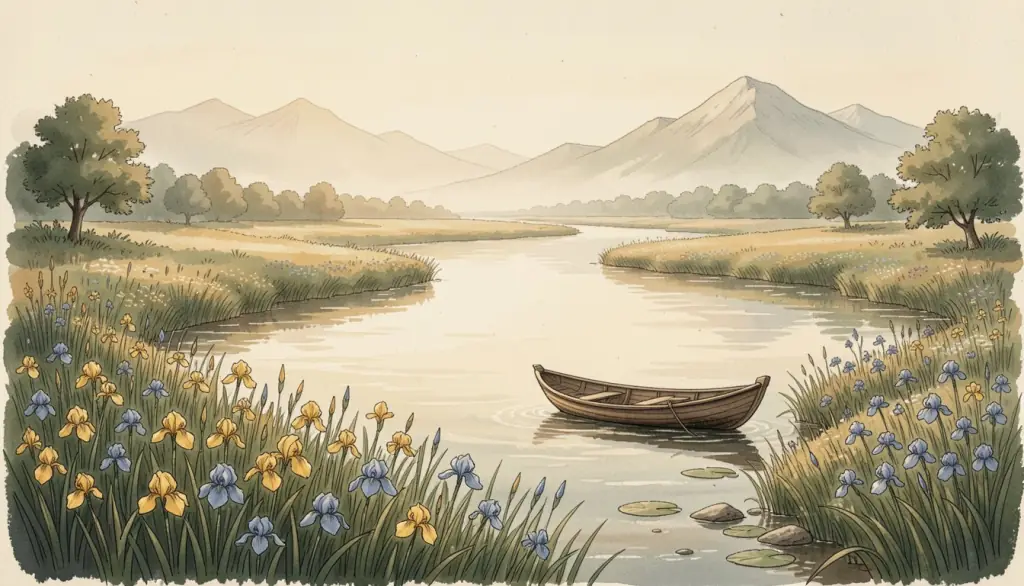
Sméagol's people were river-hobbits on the edge of Wilderland, at home in the water and in reed boats. His family was well-to-do and ruled by a stern grandmother learned in old lore. Sméagol was its most inquisitive member, and his curiosity pointed one way: down. He cared about roots and beginnings, dived into pools, burrowed under trees, and stopped looking up at hills or leaves.
One day he and his friend Déagol went fishing near the Gladden Fields, where the Gladden River meets the Anduin among beds of iris. A fish dragged Déagol into the water, and on the riverbed he saw something shining. He came up holding a golden ring. Sméagol, who had been watching, asked for it because, he said, it was his birthday. Déagol answered that he had already given him a present. Sméagol strangled him and put the ring on.
It is worth noticing what this scene lacks. Sméagol does not know what the ring is. He has no plan and no master. The Ring has lain in the mud since Isildur died in TA 2, and the first thing it does on being found is turn a friendship into a murder. Read against how the One Ring was made, that is the Ring working as designed.
Exile
Déagol's body was hidden and nobody learned what had happened. But Sméagol found that his family could not see him when he wore the ring, and he used it to pry into secrets and do small, spiteful harm. Gandalf's verdict is that the Ring gave him power according to his stature, which was little.
His relatives shunned him. Because of the gurgling in his throat they began to call him Gollum, and in the end his grandmother turned him out to keep the peace. He wandered upriver, came to hate the light of sun and moon, and went into the Misty Mountains in search of buried secrets. Appendix B dates this to about 2470.
Under the Misty Mountains
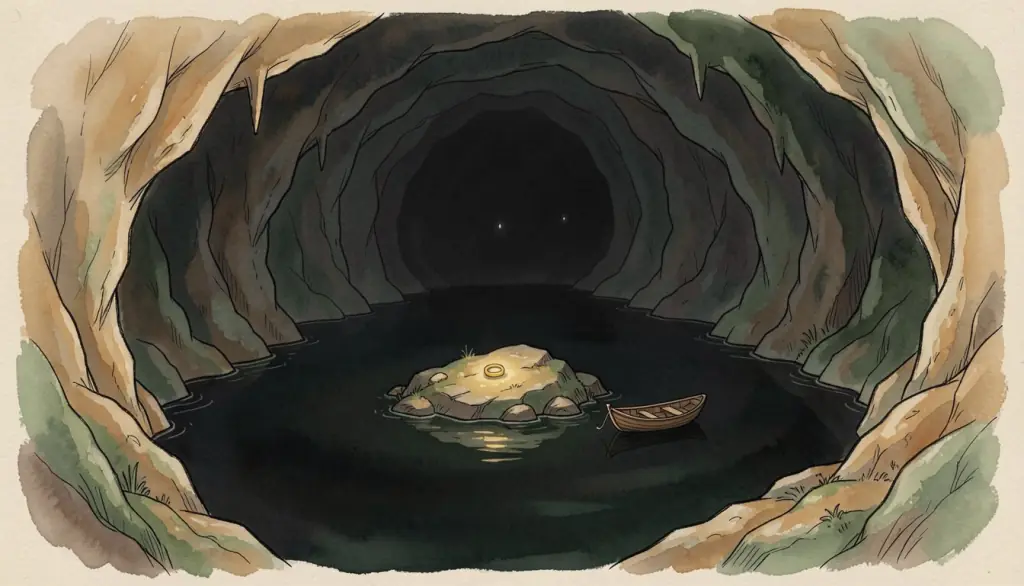
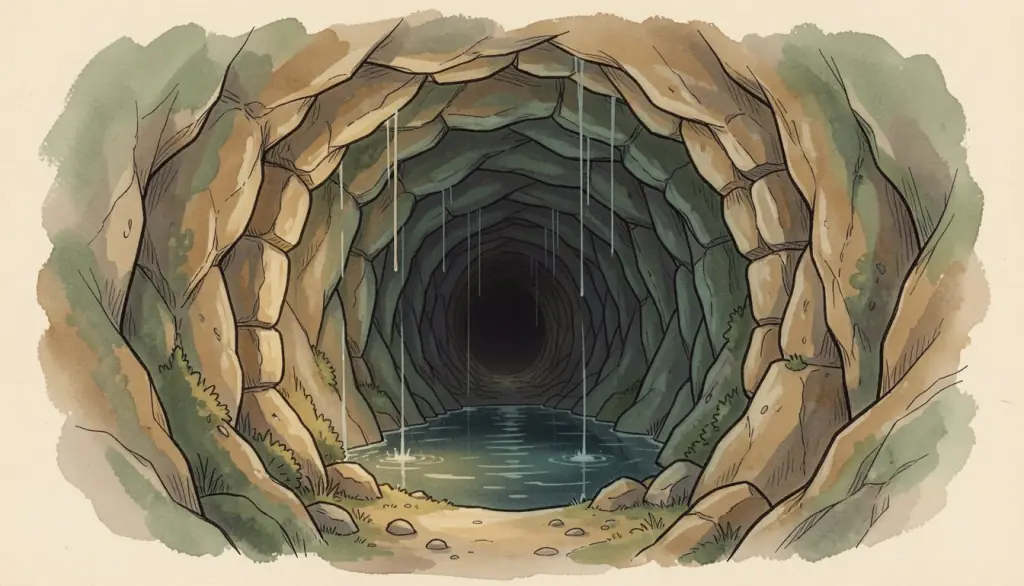
The Hobbit shows where those five centuries led: a cold lake far below the goblin tunnels, an island of slimy rock, and a creature who fished with his fingers, strangled stray goblins and talked to himself because there was no one else.
He called the Ring "my precious" and his "birthday present", a lie told so often he believed it. He kept it hidden on the island and wore it to hunt. Gandalf says he both loved and hated it, as he loved and hated himself, and had no will left to part with it. The secrets under the mountains turned out to be nothing. The Ring had not given him power, only length of days, and each day was smaller than the last.
Then it left him. Gandalf's reading is that Gollum did not lose the Ring; the Ring abandoned him, as it had abandoned Isildur, because its master had risen again and it was trying to get home. The first hand to pick it up was a Shire-hobbit's, and Gandalf adds that something beyond the Ring's maker was at work: Bilbo was meant to find it.
Riddles in the Dark: The 1937 and 1951 Versions
The meeting of Bilbo and Gollum in The Hobbit, chapter 5, is the most famous scene either of them is in, and it exists in two versions. We explain every riddle in The Hobbit's Riddle Game Explained; here the point is what each version does to Gollum.
The 1937 first edition. Gollum proposes the game, and the stakes are that if Bilbo loses, Gollum will eat him, and if Gollum loses he will give Bilbo a present, which he means to be his ring. Bilbo wins with the pocket question. Gollum goes to his island to fetch the ring, cannot find it, and comes back apologising, over and over. He shows Bilbo the way out instead. This Gollum is wicked but bound by the ancient rules of the game, and he keeps his word.
The 1951 second edition. Once Tolkien had decided, in writing The Lord of the Rings, that the ring was the One Ring, a Gollum who would cheerfully hand it over made no sense. He rewrote the chapter. Now the stake is only that Gollum must show Bilbo the way out. When he loses, he goes back to his island planning to put on the ring and kill Bilbo, finds it gone, guesses what was in Bilbo's pocket, and comes after him in a rage. Bilbo, invisible, escapes past him and spares his life at the last moment out of pity. The chapter ends with Gollum's cry that he hates the thief, Baggins, for ever.
The bridge between them. Tolkien did not pretend the first version had never existed. In the Prologue to The Lord of the Rings ("Of the Finding of the Ring") he explains that the earlier account was the one Bilbo first told the Dwarves and Gandalf, and that it was untrue: Bilbo invented the "present" story to strengthen his claim to the ring. Gandalf never believed it. The lie itself becomes evidence of the Ring's hold, because the honest Bilbo would not have needed it.
Our reading: this revision is the single most important edit Tolkien made to the character. The 1937 Gollum is a folk-tale monster who loses a contest. The 1951 Gollum is an addict who has just lost the thing he lives for. And the new scene adds the one detail the whole later book depends on, Bilbo's pity in the tunnel. Without it there is no Gollum on the slopes of Mount Doom.
The Hunt: Mordor, Aragorn and Thranduil's Halls
In 2944, Appendix B says, Gollum left the mountains to search for the "thief". By about 2980 he had reached the borders of Mordor and come to know Shelob. Some time between 3009 and 3017 he went into Mordor itself and was captured. Under torment he gave Sauron two words, Shire and Baggins, and Gollum's private grudge became the Enemy's first clue.
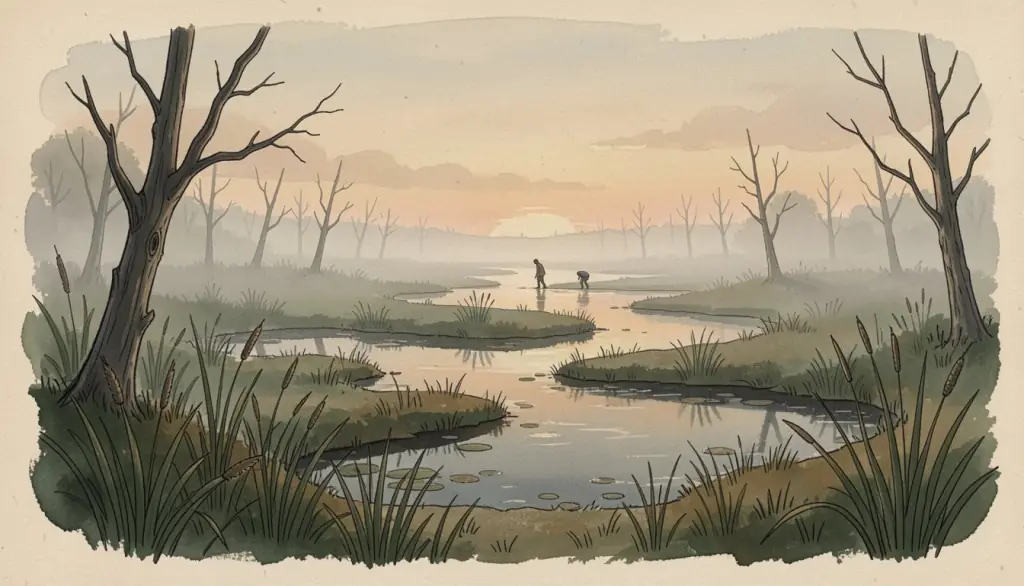
Released, then caught. In 3017 he was let go, and Gandalf suspects the release was a use, not a mercy: Gollum was sent out, knowingly or not, to find the Ring. That year Aragorn, who had hunted him at Gandalf's request for years, caught him by the Dead Marshes and drove him north, bound and gagged, to Mirkwood. The 2027 film The Hunt for Gollum is built on that pursuit; our Hunt for Gollum Elvish preview covers what is confirmed.
In the Elvenking's keeping. Gandalf questioned him in Thranduil's halls, admitting to Frodo that he had to be harsh, and that is how he knew the story he tells in Bag End. The Wood-elves treated their prisoner kindly; Legolas tells the Council of Elrond that they let him climb a great tree under guard. Orcs attacked the guard and Gollum escaped, around 20 June 3018 by Appendix B. For his jailer, see Thranduil Explained.
Gandalf's answer to the news is the hinge of the book. He is not angry. Gollum, he says, may yet have a part to play, for good or ill.
Following the Fellowship
From the summer of 3018 Gollum was hunting the Ring again, and he picked up its trail in Moria. Frodo hears soft padding feet behind the Company in the dark halls; in Lothlórien something climbs toward the hobbits' flet and escapes the Elves; on the Anduin a log drifts after the boats with eyes and paddling hands. Aragorn admits he had tried to catch the creature and failed. Again and again, a being this weak survives among warriors who could end him.
Slinker and Stinker: Guide to Mordor
After the Breaking of the Fellowship, Frodo and Sam go east alone into the Emyn Muil, the "drear hills" above the river. Gollum comes down a cliff after them in the night, and they catch him (The Two Towers, book IV, ch. 1, "The Taming of Sméagol").
The oath. Sam would have killed him. Frodo, remembering Gandalf's words about pity, will not. Gollum offers to swear by the Precious, and Frodo accepts, warning him that the Ring is treacherous and may hold him to his word in ways he does not expect. Gollum swears to serve the master of the Precious, calls Frodo "master" from then on, and leads the hobbits into the Dead Marshes.
The two voices. In "The Passage of the Marshes" (book IV, ch. 2) Sam, pretending to sleep, overhears Gollum arguing with himself. Sméagol wants to keep his promise; Gollum wants the Precious and starts wondering who else might take it from the hobbits for him. Sam privately names the two sides Slinker and Stinker, the cringing one and the scheming one, as good a summary of the split as any critic has offered.
The Black Gate. At the Morannon Gollum begs Frodo not to give the Ring back to Sauron by walking into Mordor through the front door (book IV, ch. 3). He offers another way, a secret path in the mountains to the south. He does not mention what guards it. Frodo, who has no better choice, agrees.
Ithilien and Faramir. In Ithilien Gollum catches rabbits for Sam to stew, though he scorns the cooked meat (book IV, ch. 4). Then Faramir's Rangers take the hobbits. Gollum turns up fishing in the Forbidden Pool below Henneth Annûn, where trespass means death (book IV, ch. 6). Frodo begs for his life and coaxes him out of the water into the hands of Faramir's men. He has saved Gollum, but to Gollum it is betrayal, and the trust Frodo had built never fully returns.
Our reading of these chapters: Frodo's taming of Gollum is real, and it is undone not by Gollum's malice alone but by a reasonable act of Frodo's in a dangerous place. Tolkien does not let his hero off. The road to Shelob's Lair is paved partly by Frodo's own good intentions.
The Stairs of Cirith Ungol
Gollum leads the hobbits up the endless stairs toward the pass of Cirith Ungol, "pass of the spider", and then slips away (book IV, ch. 8). He has gone to Shelob. His plan, as the earlier debate hinted, is that she will kill the hobbits and leave the Ring among the bones for him.
When he comes back, he finds Frodo and Sam asleep, Frodo's head in Sam's lap. Tolkien's description of the next moment is one of the gentlest passages in the book. Gollum looks at them, and for a moment he is no longer a scheming creature but an old, tired hobbit, shrunken by the years. He reaches out a trembling hand and touches Frodo's knee, almost a caress.
Then Sam wakes, sees him pawing at his master, and calls him an old villain and a sneak. The light in Gollum's eyes goes out. Within a page he is leading them into the tunnel. In Letter 246 Tolkien wrote that this is perhaps the most tragic moment in the tale, the point at which Gollum's repentance came closest and was lost, and he adds that Sam's failure to see the change was itself understandable.
Shelob stings Frodo; Sam drives her off; Frodo is carried away by orcs and Sam takes the Ring (book IV, ch. 9 and 10). Gollum disappears from the story until the last chapter of the quest. For Shelob herself and her kin, see Giant Spiders of Middle-earth.
Mount Doom
Gollum comes back on the slopes of Orodruin, the Mountain of Fire (The Return of the King, book VI, ch. 3, "Mount Doom"). He has followed the hobbits across Mordor. As Sam carries Frodo up the last path, Gollum attacks them and grapples for the Ring.
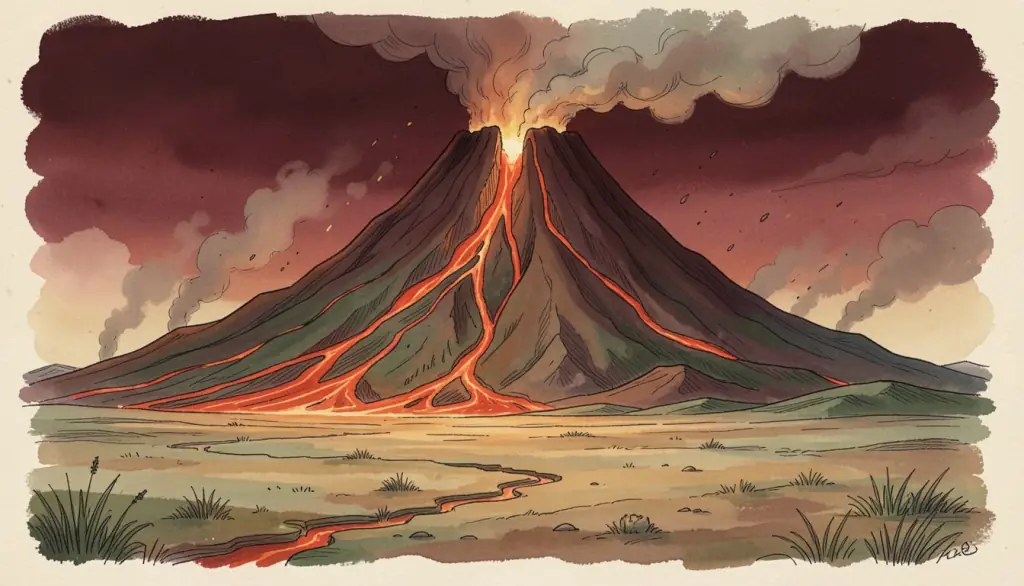
Frodo throws him off and stands over him, and for a moment Sam sees Frodo as a figure robed in white with a wheel of fire at its breast. Frodo commands him to begone, and warns that if he touches him again he will be cast himself into the Fire of Doom. Then Frodo goes on up to the Sammath Naur, the Chambers of Fire.
Sam stays to face Gollum with his sword. He could kill him now. But he has carried the Ring himself for a short while, and he sees in Gollum what it does to a bearer: a creature wretched, ruined, and wholly in its power. Sam cannot do it. He lets him go.
Inside the mountain Frodo stands at the edge of the Crack of Doom and claims the Ring. He puts it on and vanishes. Sam is struck down from behind as Gollum rushes past him, and in the red light Sam sees Gollum struggling with an invisible foe. Gollum bites off Frodo's finger, ring and all. He dances on the brink holding up his prize, crying out to his Precious, and then, with his eyes on the Ring, he steps too far, topples, and falls into the fire. His last cry is "Precious". The Ring is unmade, Barad-dûr falls, and the Nazgûl perish.
Frodo, maimed and himself again, says that without Gollum he could not have destroyed the Ring, and he forgives him. In Letter 181 Tolkien called this the "salvation" of the world, and of Frodo, achieved by Frodo's earlier pity and forgiveness of injury.
Our reading of the ending: Frodo's words on the slope were a curse, spoken by a Ring-bearer with the Ring's power behind him, and Gollum swore his oath in the Emyn Muil by the Precious itself. When he falls, both the oath and the warning come true at once. Tolkien never says this was magic; he leaves it as a pattern for the reader to notice. That is typical of the book: providence works through ordinary-looking accidents, and evil is undone by its own appetite.
Gollum's Names and Language
Each of Gollum's names comes from a different layer of Tolkien's fiction.
Gollum. His family's name for him, from the swallowing noise in his throat (The Fellowship of the Ring, book I, ch. 2; The Hobbit, ch. 5). It is a sound, not a word in any language of Middle-earth.
Sméagol and Déagol. Appendix F says these are not the original names. Tolkien presents himself as translator of the Red Book, and just as he represents the language of Rohan by Old English, he renders these river-hobbits' names in Old English style. The originals were Trahald, "burrowing, worming in", and Nahald, "secret". As a general note on Old English rather than on Tolkien's text, the substitutes match: dēagol means "secret, hidden", and smēagol sits beside the verb smēagan, "to examine, search into".
Slinker and Stinker. Sam's nicknames for Gollum's two halves, coined in the Dead Marshes (The Two Towers, book IV, ch. 2).
"My precious". His name for the Ring, and more and more for himself. When he says "we" and "us" he means himself and the Ring together, a grammar for a mind with no single centre left.
What he spoke
Gollum spoke Westron, the Common Speech, which the books render as English; Appendix F adds that the earliest Hobbits of the Anduin vales had used a Mannish tongue akin to that of the Rohirrim. His Westron is broken in recognisable ways: hissing plurals like "hobbitses" and "pocketses", and talk of himself in the third person. For the language itself see our guide to Westron, the Common Speech.
He has no Elvish name, which is telling in a book where Elves name almost everything. But the places of his story do carry Sindarin names, and they map his life precisely:
| Name | Meaning | Source |
|---|---|---|
| Loeg Ningloron | Gladden Fields, "pools of the golden water-flowers" | Unfinished Tales, "The Disaster of the Gladden Fields" |
| Emyn Muil | the Drear Hills (emyn "hills", muil "drear") | LotR; gloss from Tolkien's notes, cited in Hammond and Scull's Reader's Companion |
| Cirith Ungol | Pass of the Spider (cirith "pass", ungol "spider") | LotR |
| Orodruin | Mountain of Fire, literally "mountain of red flame" (orod + ruin) | LotR; The Silmarillion |
| Amon Amarth | Mount Doom (amon "hill", amarth "doom") | LotR; The Silmarillion, "Of the Rings of Power" |
| Sammath Naur | Chambers of Fire (naur "fire") | LotR, book VI, ch. 3 |
| Mordor | Black Land (morn "black") | LotR |
Read in order, the table is Gollum's life in one line: from the golden flower-pools where he killed, through the drear hills where he swore, past the spider's pass where he betrayed, to the doom-mountain where he died. If you want to see the mountain words in context, our post on the Elvish word for mountain explains orod and its plural ered. The Black Speech inscription on the Ring he loved is translated in The One Ring Inscription Explained.
Books vs Films vs The Rings of Power
Andy Serkis's performance-capture Gollum made the screen version as famous as the book. The films keep most of his story, but several of the best-known moments are inventions.
Peter Jackson's Lord of the Rings (2001 to 2003). Gollum is glimpsed in The Fellowship of the Ring and becomes a lead in The Two Towers and The Return of the King. What the films changed:
- The Déagol scene moves. In the book Gandalf tells the murder in Bag End. The films hold it back and open The Return of the King with it, showing Sméagol's slow change into Gollum on screen.
- The reflection scene. In the book Sam overhears the two voices argue in the Dead Marshes. The film stages it as Gollum talking to his reflection, with Sméagol briefly driving Gollum away. The split is Tolkien's; that victory is the film's.
- The lembas trick. On the stairs, the film's Gollum throws away the lembas, frames Sam, and Frodo sends Sam home. None of this happens in the book, where Sam never leaves Frodo and Gollum's near-repentance is the key moment instead.
- The fall. In the film Frodo and Gollum struggle at the edge and both go over; Frodo hangs on while Gollum falls with the Ring. In the book Frodo is already free of him, and Gollum falls alone while dancing with his prize.
The Hobbit: An Unexpected Journey (2012). The riddle scene follows the 1951 version, with Gollum's fury at the theft, and Serkis returns in the role.
Earlier adaptations. Gollum was voiced by Brother Theodore in the 1977 Rankin/Bass animated Hobbit and by Peter Woodthorpe in Ralph Bakshi's 1978 animated Lord of the Rings.
The Hunt for Gollum (2027). A new live-action film, directed by Andy Serkis and produced by Peter Jackson, is set for release in December 2027 and follows Aragorn's search for Gollum before the events of The Fellowship of the Ring. The books give that hunt only a few lines, so most of what the film shows will be new; our Hunt for Gollum preview covers it in detail.
The Rings of Power. The series is set in the Second Age, when the One Ring is forged; Gollum's story begins thousands of years later. He has not appeared, and by mid-November 2026, with Season 3 airing, no reliable report said he would.
What the films get right, in our view: the double voice, the physical misery, and above all the pity. Serkis plays Sméagol as someone worth saving, which is exactly what Tolkien asked the reader to feel. What they change: they give Sméagol a victory in the reflection scene and drop his real turning point on the stairs, so the film's Gollum relapses through cunning, where the book's relapses because Sam, understandably, did not see what was happening.
How Tolkien Built Gollum
Gollum, like the Ring, was not planned. He grew in three stages, and the stages explain his contradictions.
- 1930s, The Hobbit. A riddling monster in a cave, a fairy-tale ogre in miniature, with a ring of invisibility and nothing more. He loses the game and keeps his promise.
- Late 1930s and 1940s, The Lord of the Rings. Bilbo's ring becomes Sauron's Ring, so its old owner needs a past. Tolkien makes him a hobbit and gives him a murder, an exile and five centuries of decay, told through Gandalf.
- 1951, the revised Hobbit. "Riddles in the Dark" is rewritten to match, and the old version survives as Bilbo's lie.
Tolkien did not design a tragic figure and drop him into a children's book. He took a children's-book monster and asked what life could have made him. The answer, a hobbit ruined by one object, became the sequel's darkest warning, because the next Ring-bearer is a hobbit too.
His letters show how central Gollum became. In Letter 181 Tolkien says the quest was achieved through Frodo's earlier pity. In Letter 246 he imagines a repentant Gollum who might have taken the Ring and gone into the fire with it, saving everyone and himself, and treats the loss of that ending as the true tragedy.
Our Take
Our view, stated plainly: Gollum is the real Ring-bearer of The Lord of the Rings, and the book is designed so that you only realise it on the last page. Frodo carries the Ring to the fire, but cannot let it go. Gollum, who carried it longest and wanted it most, is the one who actually puts it into the Crack of Doom. The quest succeeds because the world's last real expert on the Ring is present at the end, and he is present only because six different people refused to kill him.
That is also why we think the films' reflection scene, good as it is, points in the wrong direction. It suggests Sméagol could win by arguing harder with Gollum. Tolkien's version is bleaker and more interesting. Sméagol nearly wins not by argument but by love, in a single unguarded gesture on the stairs, and loses it to a misunderstanding. Nobody is a villain in that moment. Gollum is ruined by the Ring, and what is left of the hobbit in him is ruined by being seen at the wrong moment.
If you want to understand Gollum, read three passages side by side: Gandalf's story of the Gladden Fields in "The Shadow of the Past", the stairs scene in book IV, chapter 8, and the last page of "Mount Doom". The first shows how he fell, the second how near he came to rising, and the third how his fall saved the world anyway.
People Also Ask
Who is Gollum in The Lord of the Rings?
Sméagol, a Stoor-kind hobbit who killed his friend Déagol for the One Ring around TA 2463, lost it to Bilbo in 2941, and fell with it into the fire of Mount Doom on 25 March 3019.
Was Gollum a hobbit?
Yes. Gandalf says Sméagol's people were of hobbit-kind, akin to the forefathers of the Stoors ("The Shadow of the Past").
What was Gollum's real name?
Sméagol. Appendix F adds that Sméagol and Déagol are Tolkien's Old English style renderings of the original names Trahald, "burrowing, worming in", and Nahald, "secret". Gollum was a nickname.
How did Gollum get the One Ring?
Déagol found it in the river near the Gladden Fields; Sméagol demanded it as a birthday present and strangled him for it, about TA 2463.
How old was Gollum when he died?
Tolkien gives no birth year, but he lived more than 550 years after the murder, which he committed as an adult.
Why is he called Gollum?
Because of the swallowing noise he made in his throat. His relatives began calling him Gollum after the Ring made him a thief and spy.
How did Gollum die?
He bit the Ring from the invisible Frodo's finger at the Crack of Doom, danced at the edge, and fell into the fire with it.
Is Gollum good or evil?
Neither simply. He is a murderer and in the end a traitor, but Sméagol survives in him. Tolkien called his near-repentance on the Stairs of Cirith Ungol perhaps the most tragic moment in the tale (Letter 246).
What does Slinker and Stinker mean?
They are Sam's names for Gollum's two sides, in "The Passage of the Marshes": Slinker is the cringing Sméagol who tries to keep his promise, Stinker the scheming Gollum who wants the Ring.
Is Gollum in The Rings of Power?
No. The series is set in the Second Age, long before his time, and he had not appeared by mid-November 2026.
Read the Names of Gollum's Road
Gollum never spoke Elvish, but the road he walked is named in it, from Emyn Muil to Orodruin. To read those names for yourself, start with our free Elvish course, which teaches Sindarin and Quenya using words Tolkien actually wrote, or write any name in Elvish letters with the Tengwar name tool.
Related Reading
- Characters of Middle-earth: Who's Who in Tolkien's World
- Gandalf Explained: Olórin, the Grey Pilgrim and the White Rider
- Aragorn Explained: Strider, Thorongil and King Elessar in the Books and Films
- Frodo Baggins Explained
- Samwise Gamgee Explained
- Bilbo Baggins Explained
- The Hobbit's Riddle Game Explained
- How Was the One Ring Made?
- The Hunt for Gollum: Elvish Language Preview
- Hobbits of Middle-earth
- Giant Spiders of Middle-earth
- Isildur Explained
- Westron: The Common Speech of Middle-earth
People Also Ask
Who is Gollum in The Lord of the Rings?
Gollum is Sméagol, a hobbit of the Stoor kind who murdered his friend Déagol for the One Ring around Third Age 2463 and kept it in a cave under the Misty Mountains for nearly five centuries. Bilbo found the Ring in 2941. Gollum then hunted it for the rest of his life, guided Frodo and Sam into Mordor, and fell into the fire of Mount Doom with the Ring on 25 March 3019.
Was Gollum a hobbit?
Yes. In "The Shadow of the Past" Gandalf says Sméagol's people were of hobbit-kind, akin to the forefathers of the Stoors, and lived by the Great River near the Gladden Fields. Centuries of the Ring and of life in the dark changed his body and mind, but he began as a hobbit.
What was Gollum's real name?
His name was Sméagol. Appendix F of The Lord of the Rings adds a further layer: Sméagol and Déagol are Tolkien's Old English style renderings of the original names Trahald, glossed "burrowing, worming in", and Nahald, "secret". Gollum was a nickname his relatives gave him.
How did Gollum get the One Ring?
His friend Déagol found it in the river near the Gladden Fields while they were fishing. Sméagol demanded it as a birthday present, and when Déagol refused he strangled him and took it. Gandalf tells the story in "The Shadow of the Past", and Appendix B dates it to about Third Age 2463.
How old was Gollum when he died?
Tolkien gives no birth year. The Ring was found about Third Age 2463 and Gollum died in 3019, so he lived more than 550 years after the murder, and he was already grown when he committed it. The Ring stretched his life far past any natural hobbit span.
Why is he called Gollum?
Because of the horrible swallowing noise he made in his throat. His own family began calling him Gollum after the Ring turned him into a thief and a spy, and the name stuck. He often still calls himself Sméagol and speaks to the Ring as "my precious".
How did Gollum die?
At the Crack of Doom Frodo claimed the Ring and put it on. Gollum attacked the invisible hobbit, bit off the finger that wore it, and, dancing at the edge with his prize, stepped too far and fell into the fire. The Ring was destroyed with him (The Return of the King, book VI, ch. 3, "Mount Doom").
Is Gollum good or evil?
Neither simply. He is a murderer, a liar and in the end a traitor who leads Frodo to Shelob, but the book also shows Sméagol, the part of him that remembers kindness. In Letter 246 Tolkien called the moment on the Stairs of Cirith Ungol, when Gollum nearly repents, perhaps the most tragic moment in the tale.
What does Slinker and Stinker mean?
They are Sam's private names for the two sides of Gollum, in The Two Towers, book IV, ch. 2, "The Passage of the Marshes". Slinker is the cringing, half-tamed Sméagol who tries to keep his promise to Frodo; Stinker is the scheming Gollum who wants the Precious back.
Is Gollum in The Rings of Power?
No. The Rings of Power is set in the Second Age, and Gollum's story belongs to the late Third Age; the Ring was lost in the Anduin until Déagol found it in about 2463. He had not appeared in the series by mid-November 2026, while Season 3 was airing.